

Healthcare EDI Monitoring: The Complete Guide for Payer Operations

.png)

Healthcare EDI monitoring is the continuous, automated tracking of every electronic data interchange transaction — enrollment files, claims, eligibility checks, and remittance — flowing through a payer's systems. It gives operations teams real-time visibility into file completion, transaction errors, SLA adherence, and audit readiness, replacing spreadsheet-based manual checks with dashboards, alerts, and audit trails that run around the clock.
- Healthcare EDI monitoring tracks every inbound and outbound transaction across enrollment, claims, eligibility, and payment workflows in real time
- Manual monitoring — spreadsheets, scheduled reports, reactive ticket-based escalations — leaves payers exposed to SLA breaches, compliance gaps, and avoidable revenue leakage
- Automated monitoring enables same-day error detection, closed-loop alerting, and continuous audit evidence collection
- Operations leaders and compliance officers increasingly require monitoring platforms that serve both technical EDI teams and non-technical business users
- The shift from batch-era oversight to real-time command-center visibility is now a competitive differentiator in payer RFP evaluations
Healthcare EDI monitoring is the practice of systematically observing, validating, and reporting on every electronic transaction a health insurance payer sends or receives. That includes:
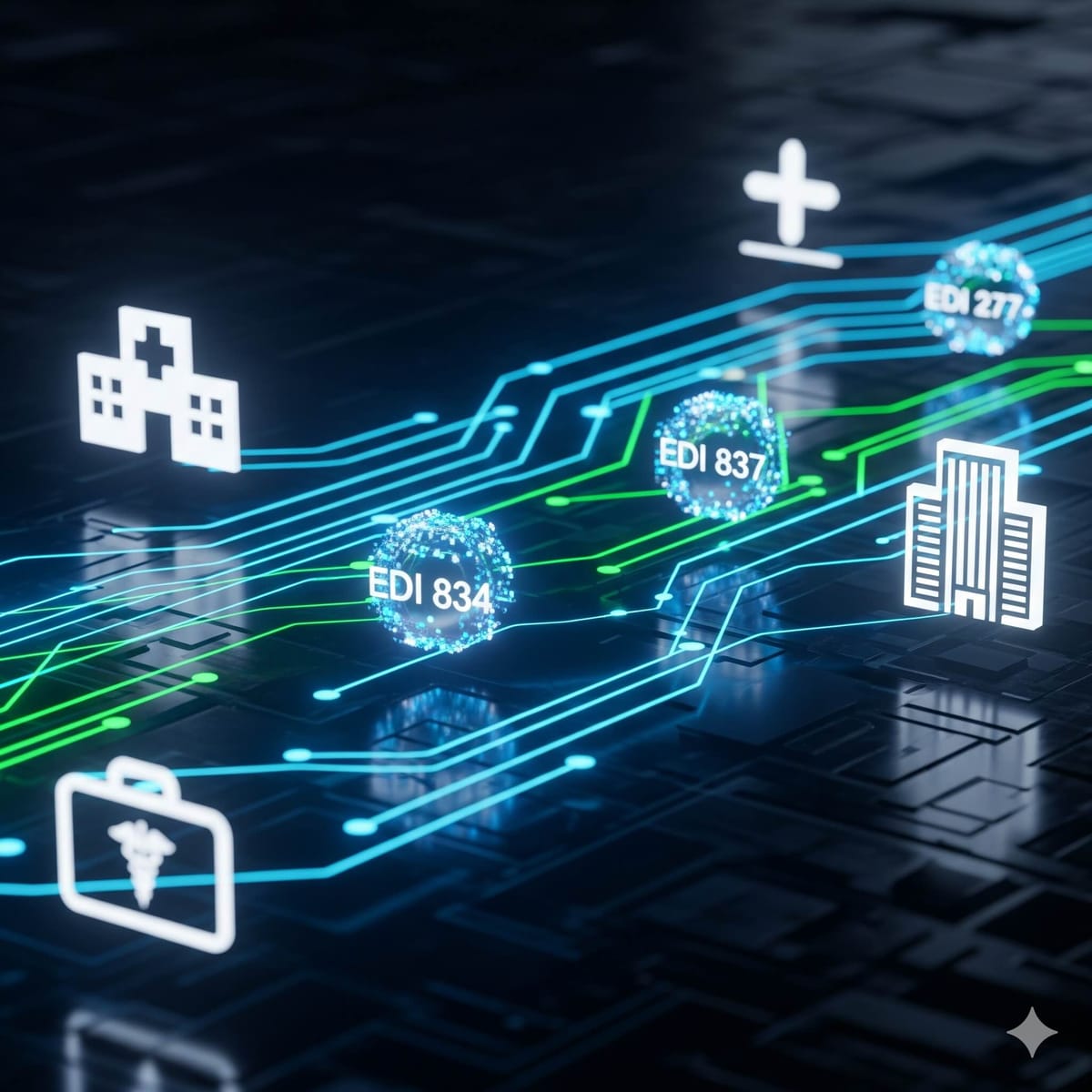
- EDI 834 benefit enrollment and maintenance files from employer groups and benefits administrators
- EDI 837 professional, institutional, and dental claim submissions from providers and clearinghouses
- EDI 270/271 eligibility inquiry and response transactions
- EDI 277CA claim acknowledgments and status updates
- EDI 835 electronic remittance advice files
- EDI 999 and TA1 interchange acknowledgments
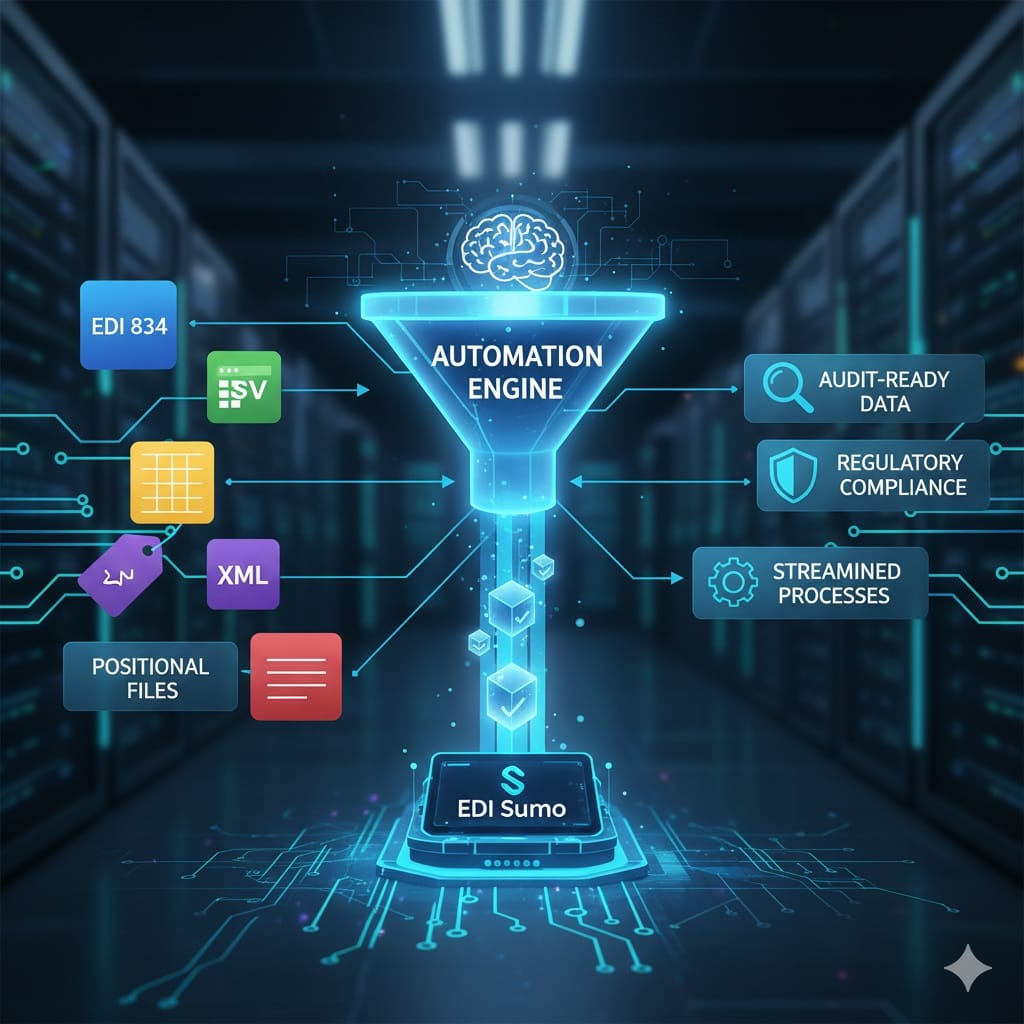
- Non-standard inbound formats — CSV, XML, positional flat files — that must be normalized before processing
At its core, monitoring answers three questions payer operations teams ask every day: Did every expected file arrive? Did every transaction process correctly? Can we prove it to an auditor?
Early EDI monitoring was largely reactive — teams discovered a problem when a provider called about a missing remittance or when a 999 rejection surfaced in a morning report. Modern monitoring is proactive: automated thresholds trigger alerts before SLAs are missed, dashboards surface anomalies the moment they appear, and audit trails build themselves continuously in the background.
Effective healthcare EDI monitoring operates across four distinct layers, each catching a different class of problem.
Did the file arrive from the trading partner? On time? With the expected record count? Connectivity monitoring catches missing files before downstream teams know to look for them.
Does the file conform to X12 standards? Are envelope segments (ISA, GS, ST) correctly formed? SNIP Level 1 and 2 validations happen here.
Are NPI numbers valid? Do subscriber IDs match enrolled members? Are diagnosis codes present and correctly formatted? SNIP Levels 3 through 7 operate here.
Did the 837 claim produce a 277CA acknowledgment? Did the accepted claim produce an 835 remittance? Closed-loop monitoring ties the full transaction lifecycle together.
The Volume and Velocity Problem
A mid-sized regional health plan may process hundreds of thousands of EDI transactions every day across dozens of trading partners. Open enrollment compresses that volume into weeks — transaction counts can spike three to five times above baseline. Manual review processes that function adequately off-peak collapse under that load. Monitoring systems that cannot scale to peak volume are, effectively, not monitoring at all when it matters most.
File Completion Gaps
One of the most common — and most damaging — failures in healthcare EDI operations is an incomplete file that goes undetected. An 834 that arrives with 4,800 records when 5,200 were expected represents members whose coverage may not be activated on time. Without automated record-count reconciliation and threshold alerting, that gap may not surface until affected members call customer service or appear at a point of service without active coverage.
The Spreadsheet Trap
Many payer EDI operations teams still rely on manually maintained spreadsheets to track daily file receipt and processing status. The limitations are well understood: spreadsheets are updated reactively, depend on individuals who may be unavailable, cannot trigger real-time alerts, and provide no audit-grade evidence trail. Despite these known shortcomings, the switch to automated monitoring is often delayed by competing IT priorities or uncertainty about integration complexity.
Alert Fatigue vs. Alert Gaps
Poorly configured monitoring creates one of two failure modes. Too many low-signal alerts train operations staff to ignore notifications — the alert that matters gets buried in noise. Too few alerts, or thresholds set too loosely, mean real problems go undetected. Calibrating alert logic to the actual risk profile of each transaction type and trading partner is an ongoing operational discipline, not a one-time setup task.
SLA Exposure and Performance Guarantee Risk
Payer contracts with employer groups, brokers, and providers increasingly include explicit SLA commitments around enrollment processing timelines, claims acknowledgment windows, and eligibility response times. Missing these commitments carries financial penalties and reputational consequences. Real-time monitoring is the only reliable mechanism for detecting SLA-threatening conditions early enough to intervene before a breach occurs.
Audit and Compliance Evidence
SOC-1, SOC-2, and HIPAA audits require payers to demonstrate that controls over transaction processing, data completeness, and access management are operating effectively. Producing that evidence from fragmented system logs and manually maintained records is labor-intensive and introduces risk of gaps. Automated monitoring platforms that build continuous, tamper-evident audit trails dramatically reduce the preparation burden and improve audit outcomes.
The Customer Service Feedback Loop
When EDI monitoring fails, the first indication often arrives through the contact center. A member calls because their new coverage isn't showing active. A provider calls because a claim submitted three weeks ago has no acknowledgment. These calls are expensive to handle and represent preventable service failures. Real-time EDI visibility — including access for non-technical customer service staff — closes the feedback loop, allowing agents to see transaction status without escalating to IT.
Batch monitoring reviews transaction logs periodically — often nightly. Real-time monitoring processes events as they occur and triggers alerts immediately when thresholds are breached. For high-volume, SLA-sensitive environments, real-time monitoring is the appropriate standard. Batch monitoring is acceptable only for low-volume, low-criticality transaction types where same-day detection is sufficient.
Leading payer operations teams maintain a daily file completion standard — every expected inbound file accounted for, every expected outbound acknowledgment confirmed, every record count reconciled. Proving 100% file completion daily is both an operational discipline and an audit control. Automated monitoring platforms make this achievable without manual effort.
Closed-loop monitoring ties together the full lifecycle of a transaction. An 837 claim that arrives but never produces a 277CA response signals that something has broken in the downstream processing chain. Monitoring for the expected response — not just the inbound file — is what separates reactive oversight from genuinely proactive operations management.
Not all transaction quality problems originate inside the payer. Employer groups and providers submit files with varying levels of accuracy. Trading partner scorecards — which track rejection rates, format compliance, and retransmission frequency by partner — give payer teams objective data to drive remediation conversations and, over time, measurably improve the quality of inbound data.
One of the most significant operational improvements available to payers is extending EDI visibility beyond the EDI team. When customer service agents, enrollment coordinators, and compliance staff can directly look up transaction status without a support ticket, resolution times drop and IT teams can focus on higher-value work.
What is the difference between EDI monitoring and EDI translation?
EDI translation converts files between formats — for example, transforming an inbound 834 into a format your enrollment system can consume. EDI monitoring observes whether those translations and subsequent processing steps are completing correctly, on time, and with the expected data. The two functions are complementary; translation without monitoring leaves you flying blind, and monitoring without robust translation creates a bottleneck before the data even reaches your systems.
How does EDI monitoring support SOC-2 compliance?
SOC-2 audits evaluate controls across the Trust Services Criteria, including availability, processing integrity, and confidentiality. EDI monitoring contributes evidence that transactions are processed completely and accurately (processing integrity), that systems maintain uptime and responsiveness (availability), and that access to transaction data is controlled and logged (confidentiality and security). Automated monitoring platforms that maintain tamper-evident logs, generate exception reports, and support role-based access align directly to the evidence auditors look for.
What should trigger an EDI monitoring alert?
Alert thresholds should be calibrated to the risk profile of each transaction type and trading partner. Common alert triggers include: an expected file that has not arrived within a defined window after its scheduled receipt time; a file that arrives with a record count more than a defined percentage below or above expectation; a 999 or TA1 rejection; a 277CA acknowledgment indicating rejected claims above a defined rate; and any transaction pending longer than the SLA window for that transaction type. The goal is to surface meaningful signals, not generate noise.
Can non-technical staff use EDI monitoring tools?
Yes, and they should. The most effective payer operations environments give customer service agents, enrollment coordinators, and compliance staff access to a simplified view of transaction status — without requiring them to interpret raw EDI files or navigate technical dashboards designed for EDI analysts. Role-based interfaces that surface member-level and claim-level status in plain language are the standard that leading payer platforms now provide.
How does real-time monitoring reduce SLA risk?
SLA breaches typically result from problems that were detectable — but undetected — for hours or days before they crossed the threshold of a contractual commitment. Real-time monitoring compresses the detection-to-resolution window by alerting operations teams the moment a transaction enters a risk condition. That early warning is what makes intervention possible before a breach occurs rather than after.
What is an EDI command center?
An EDI command center is a centralized monitoring environment — typically a dashboard-based platform — that gives payer operations leadership a consolidated real-time view of all transaction flows, system health, alert status, and SLA performance across trading partners and transaction types. It replaces the fragmented, multi-screen, multi-system oversight approach that many payer EDI teams currently rely on.




.png)

.png)


.png)

