

From IT Backlog to Business Self-Service: The EDI Access Model Healthcare CIOs Prefer

.png)

Health insurance CIOs today are contending with an unprecedented IT burden. The growing complexity of EDI file formats, ever-shifting compliance standards, and surging demand for real-time data from business teams have created new friction points. As a company that works closely with payer IT leaders, we see these trade-offs every day.
Why Spreadsheet-Based EDI Monitoring Costs Health Plans More Than They Realize
Many health plans rely on spreadsheets to track EDI transactions, monitor exceptions, and research claims or enrollment discrepancies. At first glance, this approach seems flexible, allowing anyone with Excel skills to log data and share updates. However, spreadsheets introduce hidden costs and risks that accumulate over time:
- Error-prone manual entry: Each row of copied or pasted data multiplies the risk of misreporting, missed exceptions, or overlooked files. These errors may lead to misrouted claims or eligibility mismatches, which often get traced back to IT for troubleshooting.
- Lack of real-time insights: Spreadsheets are rarely current and often lag behind by hours, if not days. By the time an exception is spotted, the resolution window has likely closed—impacting customer service and SLA guarantees.
- Scalability issues: As the transaction volume grows, tracking claims, enrollments, or acknowledgments (like 990 and 277 files) across multiple business lines quickly exceeds what manual logs can sustain.
- Audit and compliance risk: Auditors require transparent, immutable history of EDI activities. Spreadsheets offer weak audit trails and make HIPAA and SOC-2 preparedness stressful and time-consuming.
The reality is that what seems inexpensive on the surface actually incurs higher operational and compliance costs down the line, especially when files go undetected, leading to downstream revenue leakage or regulatory penalties.
The Hidden Cost of SLA Penalties in Health Insurance EDI
Service-level agreements (SLAs) in healthcare are no longer an afterthought. They’re the bedrock on which payers build trust with providers, trading partners, and regulators. Yet, monitoring compliance with SLAs—especially when you’re juggling multiple EDI file types and trading partners—can expose health plans to serious financial penalties. This problem only becomes more acute when:
- Files aren’t transmitted or received within the agreed time frame.
- Exceptions go unnoticed until a provider flags missing payments or denied claims days later.
- The absence of automated alerts and monitoring means business users, not just IT, remain in the dark about time-critical failures.
Undetected SLA breaches often trigger contractual penalties or even attrition of key employer groups. Worse, they can erode your organization's reputation, leading to lost RFPs and contract renewals. For CIOs and IT Directors, the headache isn’t just the cost—it’s the recurring distraction away from strategic modernization projects, as teams scramble to triage breakdowns that could have been flagged and acted on sooner.
Manual EDI Exception Handling: The #1 Resource Drain on IT Teams
It’s common for busy payer IT groups to spend far too much time on exception management involving enrollment and claims EDI. Here's why this matters:
- High ticket volume: Each problematic file, eligibility discrepancy, or missing acknowledgment typically generates multiple support tickets—requiring manual investigation, reprocessing, communication, and documentation.
- Specialized expertise bottleneck: Only a handful of staff know how to troubleshoot complex EDI formats, validate 834, 837, or proprietary CSV/XML files, or correct technical errors. This creates dependency and makes succession planning difficult.
- Slow business resolution: Customer service and enrollment teams who depend on IT for every record lookup or problem resolution wait in queue, slowing down member onboarding and claim payouts.
Every hour spent resolving preventable EDI exceptions is an hour not being invested in automation, analytics, or preparing for future healthcare data standards. Manual exception handling is now widely agreed to be the single biggest resource drain that holds IT departments back from true digital transformation.
Missed Files, Missed Revenue: How Outdated Alerting Systems Allow Hidden EDI Failures
While the IT backlog is a visible issue, many organizations underestimate the silent threat caused by outdated processes and systems (sometimes literally, aging “pagers” or manual notification processes). Missing an inbound or outbound EDI file isn’t just an administrative error—it’s a revenue-impacting event. Consider these scenarios:
- Missed enrollment files lead to ineligible members, lost premium payments, or delayed coverage initiations.
- Uncaught claims file failures mean lost reimbursement days or months later, and often, unbilled services that cannot be retroactively recovered.
- Lack of timely alerts or self-service dashboards means no one notices the outage until reconciliation uncovers discrepancies long after the fact.
This is why CIOs and EDI Directors are prioritizing universal, real-time access to EDI tracking for all business departments—not only for efficiency, but to proactively plug revenue leaks and preserve relationships with providers and members.
The Case for Business Self-Service: The EDI Access Model CIOs Prefer
What if business users—enrollments, claims, and customer service teams—could track, research, and resolve EDI questions without involving IT every step of the way? Our experience at EDI Sumo has proven that a self-service EDI access model transforms IT operations by:
- Freeing IT from routine tickets so they can focus on strategic priorities.
- Enabling instant file searches, audit trails, and error alerts for business users, all through user-friendly dashboards instead of spreadsheets.
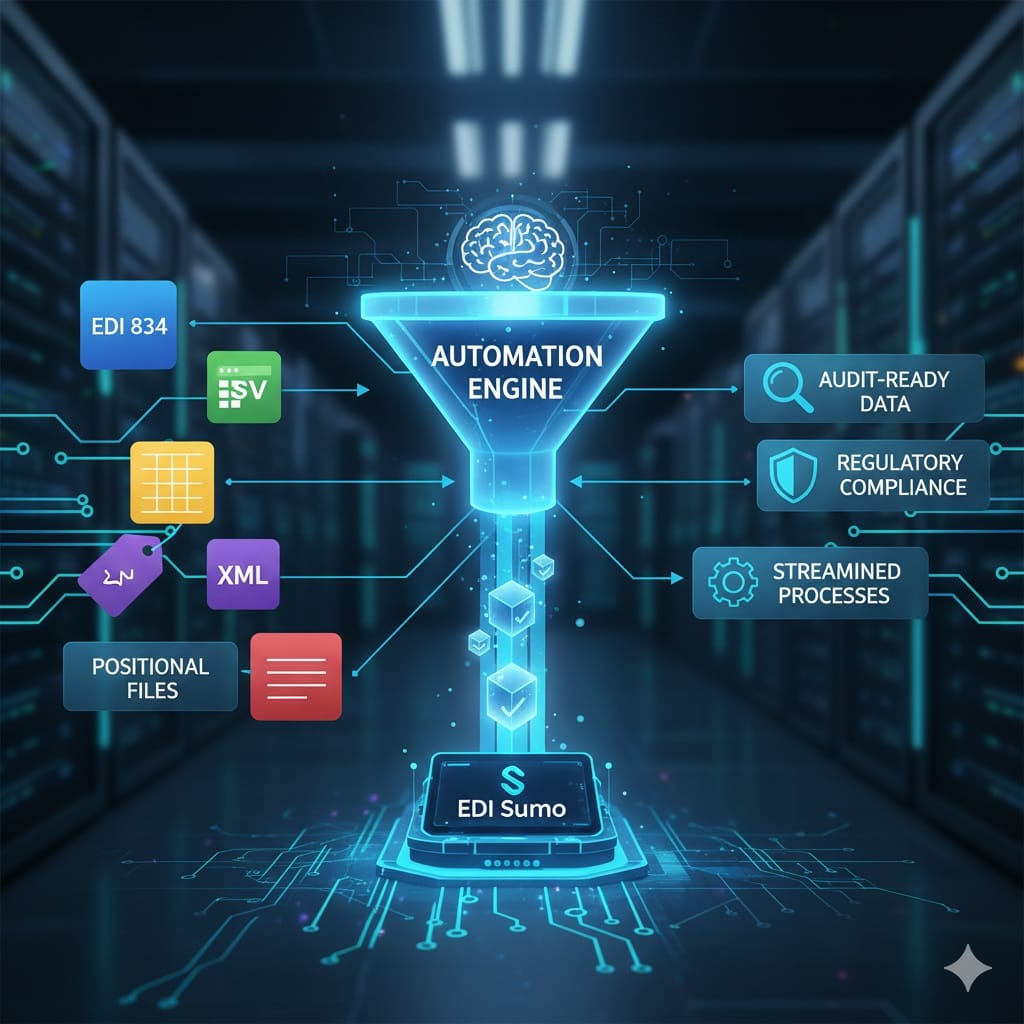
- Standardizing data from any source (EDI 834, 837, XML, proprietary CSV, positional formats) so everyone sees the same clear view—eliminating confusion from format proliferation.
- Empowering customer-facing teams to address member issues on the first call, with access to detailed record histories and discrepancy insights.
- Ensuring true compliance with HIPAA and internal controls via audited access, real-time alerting, and secure, role-based permissions.
Most importantly, this model turns “firefighting” into proactive exception prevention. With real-time monitoring and automated notifications, missed files are flagged in minutes, not days, enabling teams to resolve issues before they become customer complaints or unrecoverable revenue lapses.
Implementing Self-Service EDI in Your Organization: Practical Steps
Moving from IT-heavy, manual EDI handling to a business-empowered, self-service model is a journey. Here’s how leading payers have approached this transformation with us:
- Audit and Quantify Backlog: Review all IT support tickets or emails connected to EDI file monitoring, claims exception management, and eligibility record lookups. Calculate the average resolution time and business impact from delays.
- Engage Business Stakeholders: Partner with key business users—enrollment managers, claims directors, and customer service leads—to prioritize the most common EDI challenges and define success criteria.
- Deploy a Unified Dashboard: Standardize EDI visibility by consolidating all formats and trading partners into a single, intuitive dashboard. This enables both technical and non-technical users to see file status, exceptions, and key performance indicators instantly. Our approach at EDI Sumo ensures that all file formats (like EDI 834, Excel/CSV, XML) are supported, and integration with claims management platforms is seamless.
- Automate Exception Management: Configure automated monitoring for file arrivals, exceptions, format errors, and SLA breaches. Role-based alerts notify the right team in real time, allowing for prompt resolution before a support ticket is even needed.
- Enable Enterprise-Wide Access and Training: Grant dashboard access to business users with role-based permissions and provide concise training. Empowering your teams to self-serve drives adoption and accelerates business outcomes from day one.
Key Benefits Realized in Business Self-Service EDI
Transitioning to self-service EDI unlocks both operational and financial gains. Based on our work with payer organizations:
- IT ticket volume drops dramatically: Over 70% of support requests related to file tracing and record lookups are eliminated.
- SLA compliance soars: Timely alerts and shared dashboards help teams resolve exceptions ahead of deadlines, reducing penalty exposure.
- Revenue recovery improves: Missed files and claims get flagged for correction in real time, plugging leaks that traditionally go unnoticed until reconciliation.
- End-user satisfaction increases: Business users can finally answer member or provider questions immediately, without escalation delays.
- Compliance is strengthened: Full audit trails and real-time access simplify HIPAA and audit reporting.
Overall, IT leaders regain the bandwidth to innovate, and business units become self-sufficient in managing enrollment and claims exceptions.
Conclusion: The Future of EDI is Business-Led, IT-Empowered
The Medicare, vision, and dental payer environment isn’t slowing down. As formats proliferate, compliance expectations rise, and consumer experience moves to the forefront, the need for true business self-service EDI access is clear.
If you’re ready to eliminate spreadsheet-based monitoring, escape the IT backlog trap, and shift to a scalable self-service EDI model, we’d love to show you how EDI Sumo can help you get there. Contact us for a personalized demonstration or learn more on our website. We’re here to help CIOs bring EDI data access and control back into the hands of the business—where it drives the most value.





.png)

.png)


.png)

