

How to Ensure Real-Time Data Visibility Across Enrollment, Claims, and Customer Service in Healthcare Insurance

.png)

Real-time data visibility across enrollment, claims, and customer service starts with data standardization — making sure that every data source, regardless of format or origin, is transformed into a single, unified record that can be securely tracked and processed. When these processes operate in sync and data flows seamlessly between them, the result is fewer headaches, improved regulatory compliance, and better service for members. The key enablers are multi-format integration, a unified data model, role-based dashboards, automated error alerting, comprehensive audit trails, and flexible integration with existing systems.
- Healthcare insurance data is more fragmented, complex, and mission-critical than ever before — for payers, real-time data visibility across enrollment, claims, and customer service isn't just a technical wish list item; it's an operational necessity.
- Visibility isn't just about making data available somewhere — it's about delivering clean, trusted information instantly to the people that need it, when they need it, and in a form they can use.
- Most healthcare payers still battle multiple data formats (EDI 834, 837, XML, CSV, Excel, and custom positional formats), legacy systems that don't communicate natively, manual processes that create bottlenecks, and fragmented visibility buried in EDI black boxes.
- Automated error detection using WEDI/SNIP Levels 1–7 validation means the majority of pends and denials never even make it to the operations team — they are resolved on intake, before they impact member eligibility or downstream systems.
- When visibility is integrated into daily workflows — not just bolted on — payers see reduced SLA penalties, improved cash flow from faster claims cycles, audit preparedness, higher support staff productivity, and improved member satisfaction.
Healthcare insurance data is more fragmented, complex, and mission-critical than ever before. For payers, real-time data visibility across enrollment, claims, and customer service processes isn't just a technical wish list item — it's an operational necessity. When information lags or data is siloed, patient experiences suffer, compliance risks mount, and internal teams are left chasing their tails. At EDI Sumo, we know these pain points intimately, and we're passionate about untangling them with proven, practical strategies.
Why Is Real-Time Data Visibility Essential in Healthcare Insurance?
Visibility isn't just about making data available somewhere — it's about delivering clean, trusted information instantly to the people that need it, when they need it, and in a form they can use. For payers, that means:
- Enrollment: Onboarding members quickly, accurately, and handling updates without manual firefighting.
- Claims: Processing high volumes efficiently, reducing turnaround, and avoiding costly errors or SLA penalties.
- Customer Service: Empowering support teams with instant answers to member and provider questions, while tracking all activity for compliance.
When these processes operate in sync and data flows seamlessly between them, the result is fewer headaches, improved regulatory compliance, and — most importantly — better service for members.
What Are the Critical Challenges to Real-Time Data Visibility for Payers?
Despite advances in technology, most healthcare payers still battle hurdles that limit data transparency and speed:
- Multiple Data Formats: Data comes in as EDI 834, 837, 990s, 277s, XML, CSV, Excel, and even custom positional formats — making standardization daunting.
- Legacy Systems: Outdated enrollment, claims, or CRM platforms rarely speak to each other natively.
- Manual Processes: Human intervention is required for mapping, error resolution, or audit compliance, creating bottlenecks and opportunities for mistakes.
- Fragmented Visibility: Even if data is technically available, it's often divided across departments or buried in cryptic file formats and "EDI black boxes."
- Compliance and Security: HIPAA and state regulations require not just data privacy, but a clear, auditable chain-of-custody.
Fragmented Visibility vs. Real-Time Integration: How Do the Approaches Compare?
| Capability | Fragmented / Siloed Approach | Real-Time Integrated Platform |
|---|---|---|
| Data availability | Delayed; buried in batch files or cryptic EDI black boxes | Accessible to all authorized stakeholders within minutes of ingestion |
| Format handling | EDI only, or one format at a time with custom scripts | EDI 834, 837, XML, CSV, Excel, and custom positional — all in one workflow |
| Error detection | Reactive; found after loading into core systems | WEDI/SNIP Levels 1–7 + custom rules at ingestion; resolved before downstream impact |
| Audit trail | Manual logs; incomplete; requires scrambling at audit time | One-click; every interaction logged automatically and retrievable on demand |
| Customer service access | Patching together status from multiple disconnected sources | Unified member view with full history in one place; issues resolved in seconds |
| SLA compliance | Penalties discovered after the fact | Proactive alerts and real-time tracking help meet and exceed SLAs |
| Security posture | Inconsistent controls; data moved via email or spreadsheets | Encryption in transit and at rest; OAuth2/MFA; granular role-based access |
What Is the EDI Sumo Approach to Breaking Down Data Silos?
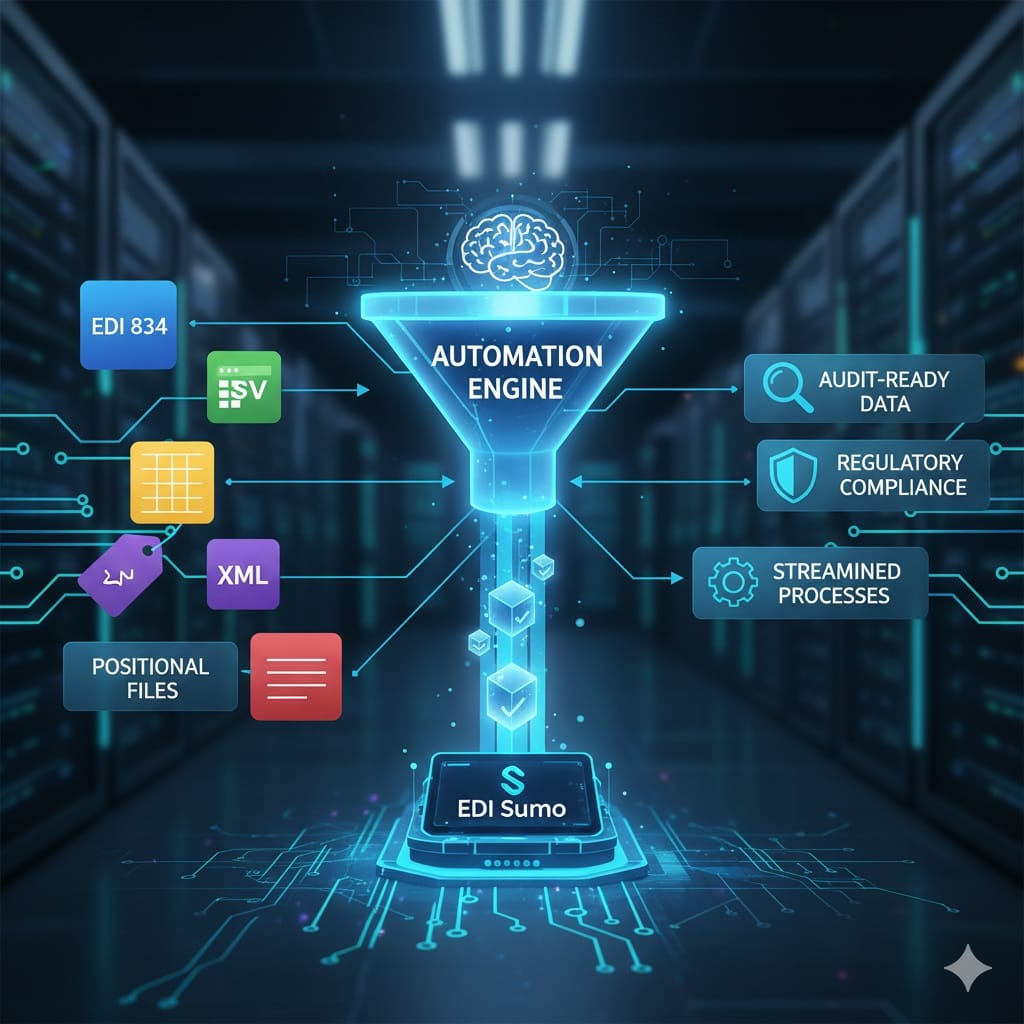
At EDI Sumo, we believe true real-time visibility starts with data standardization — making sure that every data source, regardless of format or origin, is transformed into a single, unified record that can be securely tracked and processed.
- Universal Data Ingestion: We handle EDI files (like 834 for enrollments, 837 for claims, 277/999 for acknowledgments) as well as Excel, CSV, XML, and custom positional files, automating the transformation into a consistent structure.
- Real-Time Monitoring: As data flows in, every file is instantly tracked and time-stamped — so you always know where data is in the process and can address issues before they snowball.
- Validation & Error Handling: Advanced rules (even for WEDI/SNIP Levels 1–7) identify data discrepancies early, sending automated alerts so exceptions are managed proactively, not reactively.
- One-Click Audit Trails: Every interaction with member or claim data is logged. You're always ready for internal reviews or regulatory audits — without scrambling to generate reports or recreating the past.
How Does Real-Time Visibility Work in Practice Across the Insurance Lifecycle?
Enrollment Data: Eliminate the Waiting Game
Enrollment files are notorious for causing delays — especially when they arrive in different formats. With automated data intake and normalization, there's no need for your staff to "clean up" files for hours or days. Instead:
- Instant Data Availability: Enrollment data is accessible to all authorized stakeholders within minutes.
- Automated Exception Alerts: Built-in logic notifies you of missing or invalid data before it ever impacts member eligibility or downstream systems.
- Integrated Updates: Structure changes, additions, or terminations are reflected system-wide, so everyone is working with the latest truth.
Claims Processing: Accuracy and Speed, Not Sacrifice
Claims are the beating heart of payer operations. Real-time monitoring means:
- Continuous Tracking: Every claims file is tracked from intake through adjudication, with real-time status visible on a unified dashboard.
- Error Prevention: Automated error detection (WEDI/SNIP 1–7 validation, and custom rules) means the majority of pends and denials never even make it to your ops team — they're resolved on intake.
- Role-Based Access: Stakeholders only see the data they need, protecting PHI while minimizing bottlenecks.
- Full Auditability: Every action is logged, simplifying compliance and internal reporting.
Customer Service: Empower Support Teams With Data, Not Guesswork
Customer support too often plays "information detective," patching together eligibility or claims status from multiple sources. With real-time data access:
- Unified Member View: Customer service reps have instant, role-based access to a full history of member, dependent, and claim information in one place.
- Faster Issue Resolution: Error tracking and audit trails mean that mismatches or disputes can be researched in seconds, not hours.
- Compliance Confidence: Every lookup and action is tracked, so support can focus on outcomes, not defensive documentation.
What Are the Must-Have Capabilities for Real-Time Data Visibility?
Ready to make this a reality? Here's what we recommend as absolute must-haves:
- Multi-Format Integration: Your platform must accept and process EDI, Excel/CSV, XML, and custom files out-of-the-box.
- Unified Data Model: All incoming data is normalized into a consistent, queryable format — removing silos and duplication.
- Role-Based Dashboards: Visualize file flows, error rates, and real-time statuses from a central console, customized to user roles.
- Automated Error Detection/Alerting: Never wait for a scheduled report to find out there's a problem. Automated alerts allow for immediate triage.
- Comprehensive Audit Trail: Every change and access is logged, providing a defensible compliance story.
- Flexible Integration Points: Easily connect with claims management, eligibility processing, or CRM systems without weeks of custom coding.
How Does EDI Sumo Ensure Security and Compliance With Real-Time Data Access?
Real-time visibility means nothing if your data isn't safe. At EDI Sumo, security is built into everything we do:
- Encryption: All sensitive data is encrypted in transit and at rest using asymmetric encryption.
- HIPAA and GDPR Compliance: Processes are designed to meet — and exceed — industry regulatory standards.
- Deployed on Your Terms: Our solutions can run on your own servers, ensuring you retain full control over your information.
- Granular Security Policies: With support for OAuth2 and MFA, administrative access is tightly controlled and monitored.
How Does EDI Sumo Integrate With the Systems You Already Use?
Nothing wreaks havoc like a new tool that won't play nice with your stack. EDI Sumo's modular architecture and out-of-the-box integrations enable connectivity with:
- Claims management platforms (including Guidewire and IBM Sterling B2Bi)
- Major payers and intermediaries (Aetna, Cigna, United, and more)
- Eligibility engines, EDI translators, and SFTP workflows
This ensures your data can flow where it's needed, without manual re-entry or duplicated effort. Learn more about our seamless integrations →
What Outcomes Can Payers Expect From Real-Time Data Visibility?
When visibility is integrated into your daily workflows — not just bolted-on — you get:
- Reduced SLA penalties: Proactive alerts and real-time tracking help you meet and exceed service level agreements, boosting partner and member trust.
- Improved cash flow: Faster claims cycles mean revenue is realized sooner, with fewer denials.
- Audit preparedness: Every transaction, correction, and inquiry is tracked from start to finish, reducing the stress and cost of compliance checks.
- Support staff productivity: With fast, accurate answers, your teams resolve more inquiries per hour and shrink backlog queues.
- Member satisfaction: Up-to-date information translates to fewer coverage issues, claim denials, and frustrated calls.
How Do You Make the First Move Toward Real-Time Visibility?
Change doesn't have to involve ripping and replacing your whole tech stack. We recommend starting by:
- Mapping your existing data flows — and identifying the choke points for visibility or delays.
- Piloting real-time monitoring for your highest-volume enrollment or claims processes.
- Bringing stakeholders from IT, operations, and customer service together to set shared data access standards.
- Evaluating modular solutions that support your formats, scale, and security needs — without long implementations or surprises.
Frequently Asked Questions About Real-Time Data Visibility in Healthcare Insurance
Ready to See Real-Time Data Visibility in Action?
Real-time data visibility doesn't have to be a distant goal — it can be your competitive edge. If you're ready to simplify your enrollment, claims, and customer service processes, let's put actionable, accurate data where it belongs: in the hands of those who make healthcare better every single day.
Schedule a Demo →




.png)

.png)


.png)

