

How Better EDI Visibility Can Improve Your Health Insurance RFP Win Rates

.png)

Health insurance RFPs increasingly require detailed, credible answers about real-time EDI monitoring, audit trails, compliance automation, and SLA performance — and payers who can answer these questions with live data rather than anecdotes win more business. EDI visibility is not just an IT capability; it is a sales asset that directly impacts RFP win rates by demonstrating operational agility, compliance readiness, and data transparency to procurement teams and employer group consultants.
- Modern health insurance RFPs require granular detail on real-time EDI monitoring, error detection, SLA performance, HIPAA/GDPR compliance workflows, and data standardization across file types.
- Payers who can back their RFP responses with live dashboards, automated audit trail exports, and past SLA performance data present as low-risk, high-performance partners to employer groups and consultants.
- True EDI visibility means all internal stakeholders — IT, claims, enrollment, compliance, customer service — see what they need from a single source of truth, not fragmented IT-managed reports.
- EDI Sumo layers onto existing claims and enrollment infrastructure without rip-and-replace, delivering real-time access and audit-ready reporting without disrupting current workflows.
- Payers who reference standardized integrations (Guidewire, Cigna, Aetna), role-based portals, and automated compliance enforcement in RFPs differentiate on operational depth — not just price.
Winning new group business or retaining strategic accounts in health insurance often comes down to operational credibility — and nowhere is that credibility tested more rigorously than in the RFP process. Procurement teams and employee benefits consultants increasingly ask detailed, technical questions about EDI operations that expose the gap between payers who have real visibility into their data flows and those who are guessing. The payers who win are the ones who can answer those questions with data, not just promises.
What EDI Questions Do Health Insurance RFPs Actually Ask?
Anyone who has responded to a group health insurance RFP knows how granular the data handling questions have become. These are no longer general capability questions — they are operational audits conducted before a contract is signed.
What Is EDI Visibility and Why Does It Affect Sales Outcomes?
EDI visibility is the ability to monitor, track, and act on all data exchanged with clients, providers, TPAs, and regulators — in real time and across all formats. It makes EDI data accessible and actionable for both internal stakeholders and external trading partners.
| Capability | Without EDI Visibility | With EDI Visibility (EDI Sumo) |
|---|---|---|
| RFP technical questions | Answered from memory or IT-compiled reports | Answered with live dashboard exports and past performance data |
| SLA performance evidence | Reconstructed manually — incomplete | Automated SLA reports available on demand |
| HIPAA/GDPR compliance proof | Assembled pre-audit — not continuous | Real-time audit trails generated automatically |
| Error detection timeline | Reactive — discovered after complaints | Proactive — alerts at moment of exception |
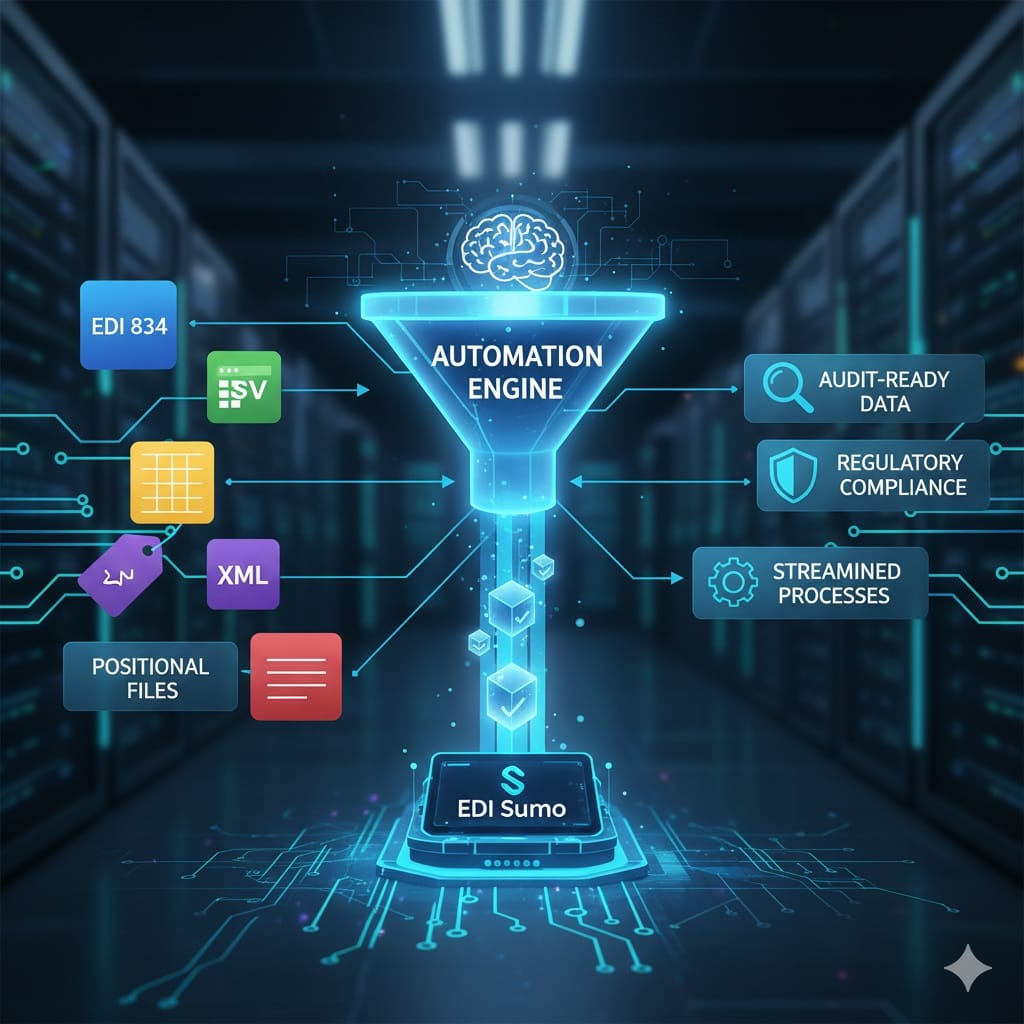
| Multi-format data handling | Custom script per format — slow onboarding | Unified ingestion — EDI, CSV, XML, positional |
| Business user access | IT-gated — slow response to inquiries | Role-based self-service for all departments |
How Does EDI Visibility Directly Improve RFP Win Rates?
-
1Faster, more accurate RFP responses.
When your technology provides unified, real-time access to all inbound and outbound EDI activity, you answer technical RFP questions without the painful email chains or last-minute IT scrambles. You can provide proof of HIPAA and GDPR compliance through automated reports, confident SLA discussions backed by past performance data, and specific details on file tracking, error handling, and data correction timelines.
This agility signals to employer groups and consultants that your organization is a low-risk, high-performance partner — which is precisely what group business procurement teams are evaluating.
-
2Demonstrating real-time monitoring as a differentiator.
Modern RFPs require granular detail on how you manage eligibility and claims files in-flight. Real-time dashboards and automated error alerts let you promise proactive issue detection rather than reactive support — showing how you avoid delays, data bottlenecks, and missed enrollments. A transparent workflow builds buyer trust in finalist meetings and demos in ways that narrative claims cannot.
-
3Proving claims and enrollment precision with verifiable data.
RFP evaluators care about your ability to automate eligibility precision and streamline claims processing. Deep EDI visibility lets you demonstrate that enrollment files are standardized and validated before integration, that claims are monitored in real time for discrepancies, and that error alerts are handled immediately — not days later. These specific capabilities can be cited directly in proposals and backed up with live system evidence if invited to finalist presentations.
-
4Addressing compliance and security concerns head-on.
Procurement teams need confidence that member and claims data will be secure and systems will be audit-ready at any moment. Real-time audit trails for all EDI activity, documented HIPAA and GDPR enforcement, and robust encryption and access controls provide that confidence in writing — and compliance modules that enable instant reporting during audits resonate strongly in both written proposals and finalist Q&A sessions.
-
5Showcasing operational efficiency and cost control.
Every RFP asks about speed, cost control, and staffing impact. With strong EDI visibility, teams spend less time troubleshooting or mapping new file formats, support teams access enrollment and claims data without IT intervention, and manual work is reduced to the point where you can highlight automation-driven savings as a concrete operational differentiator — not a vague efficiency claim.
Which Internal Stakeholders Benefit Most From Enhanced EDI Visibility?
EDI visibility is not just an IT or compliance tool — it changes the day-to-day experience of every team that touches health plan operations.
Fewer data integration headaches and exception escalations — IT capacity shifts from firefighting to strategic work.
Fewer exceptions, lower operational cost, and real-time visibility into claims status without manual log review.
Automated regulatory reporting and instant audit trail generation replace pre-audit evidence scrambles.
Role-based portals give support teams direct access to enrollment and claims data without waiting for IT.
No manual file chasing — standardized multi-format ingestion and real-time validation keep enrollment current and accurate.
Live dashboard exports and automated performance reports replace narrative claims with verifiable operational evidence.
What Are the Five Steps to Increase Your RFP Win Rate With EDI Visibility?
-
1Conduct a visibility audit.
Evaluate where gaps exist in your current EDI monitoring and reporting — identify which RFP question categories you currently cannot answer with live system data versus narrative descriptions.
-
2Empower business users.
Shift EDI data access out of IT queues and into the hands of the people who answer RFPs, support customers, and manage SLAs. Role-based dashboards make this possible without compromising data security.
-
3Integrate real-time alerting and dashboards.
Ensure issues are found and fixed before clients or employer groups ever notice. Real-time SLA risk alerts and exception dashboards move your posture from reactive to proactive.
-
4Automate compliance and reporting.
Make it possible to pull audit trail data, compliance records, and SLA performance reports instantly — for any RFP question, regulatory request, or finalist demo.
-
5Reference your capabilities specifically in every RFP.
Use detailed, data-driven examples from your unified EDI dashboards — not generic capability descriptions or IT-managed reports that cannot be verified. Reference standardized integrations with Guidewire, Cigna, Aetna, and others to demonstrate plug-and-play onboarding for new employer clients.
Frequently Asked Questions: EDI Visibility and Health Insurance RFPs
What specific EDI capabilities do health insurance RFPs most commonly require?
How does EDI visibility help answer SLA performance questions in RFPs?
Can enhanced EDI visibility be achieved without replacing existing claims and enrollment systems?
How do role-based dashboards strengthen RFP responses for customer service capabilities?
Which integrations should health plans highlight in RFP responses related to EDI capabilities?
Make EDI Visibility Your RFP Differentiator
EDI Sumo gives health plans the real-time dashboards, automated audit trails, multi-format support, and role-based access that turn technical RFP questions from liabilities into competitive advantages — without replacing your existing claims and enrollment infrastructure.
Contact EDI Sumo TodayReach us at info@edisumo.com or call 877-551-9050





.png)

.png)


.png)

