

What 277 Claim Status Files Reveal Before Provider Disputes Start

.png)

For payers and claims leaders, 277 claim status files act as an early warning system to prevent provider disputes before they surface. These files do not just track where claims are in the workflow—they reveal the precise edits and decisions affecting claims, giving you the ability to proactively explain, correct, and communicate before issues become calls or appeals. By leveraging the detail in 277s, you can reduce friction, improve provider trust, and save your claims and support teams from unnecessary manual work.
277 claim status files show, in near real time, where a claim stands, which edits or rules triggered, and where provider questions or disputes are most likely to originate. When used properly, this insight helps health plans fix claim issues, clarify outcomes for providers, and prevent a significant share of provider disputes before they reach your support teams. Solutions like EDI Sumo make it easy to standardize, analyze, and act on these signals across your enterprise.
In this guide
- Core insights hidden in 277 responses that signal upcoming denials and disputes
- How to connect 277 status codes to pre-dispute actions
- Actionable workflows for reducing call volume using claim status files
- Proof-points for claims, provider relations, and IT leadership
- The way EDI Sumo enables organization-wide 277 visibility
With every provider inquiry—whether direct, via 276/277 electronic transactions, or through portal/call center—you return a 277 claim status file. These files report not only if the claim was accepted, pending, paid, or denied, but also which business rules or data issues impacted it. As a result, 277s form the structured foundation for transparent claim communication, enabling you to spot patterns and intervene before frustration leads to disputes.
When organizations begin analyzing 277s at scale, common root causes emerge: delays in editing, ambiguous status messages, and the same code repeated for groups of providers. By shifting your approach from reactive dispute handling to proactive 277-driven monitoring, your teams gain insight into the precise points of friction—and can engage providers before issues escalate.
What 277 claim status files reveal before disputes happenA 277 status response acts as a snapshot of a claim’s journey. Each file answers several core questions relevant to provider relations, claims operations, and IT teams. Here are the main insights you gain before provider frustration turns into a formal dispute:
1. Claim status and progression points- Received or pending: 277s confirm claims are ingested and moving through adjudication. Extended time in “pending” triggers provider concern—if a group’s claims get stuck, calls follow.
- Final outcome: Claims finalized as denied or rejected, especially where denial codes are unclear or inconsistent, routinely drive provider questions and eventually appeals.
- Delay risks: Repeated or prolonged statuses highlight operational delays. Gaps here signal upstream process or EDI performance challenges.
- Front-end errors: Codes for invalid member IDs, provider IDs, or data format errors forecast incoming disputes as providers challenge your edits.
- Policy-driven denials: Medical necessity, authorization, or coverage denials appear in 277 responses—typically well before remittance. Pattern spikes after policy changes become particularly visible here.
- Coordination of benefits: Status codes that point to secondary coverage alert you to claims at high risk for COB-based disputes.
- Inconsistent codes: If a 277 denial or reason code does not match the 835 remittance, providers often call to reconcile the discrepancy.
- Level of detail: Claim-level versus line-level status can raise questions. Aggregating too broadly leaves providers chasing answers about individual service lines.
- Batch delays: Outdated or slow batch processes (versus near-real-time 277 responses) create information gaps and higher call volumes.
- High rejection rates at specific integration points: Spikes in rejection-related codes, traced to a particular gateway or trading partner, highlight where technical fixes are needed.
- Implementation drift: When your own 277 content diverges from published companion guides, unnecessary confusion is introduced for providers.
Seeing alert patterns in 277s is powerful, but impact comes from how you operationalize this insight. Here is a framework many payers adopt, built to scale from a small pilot to a comprehensive program.
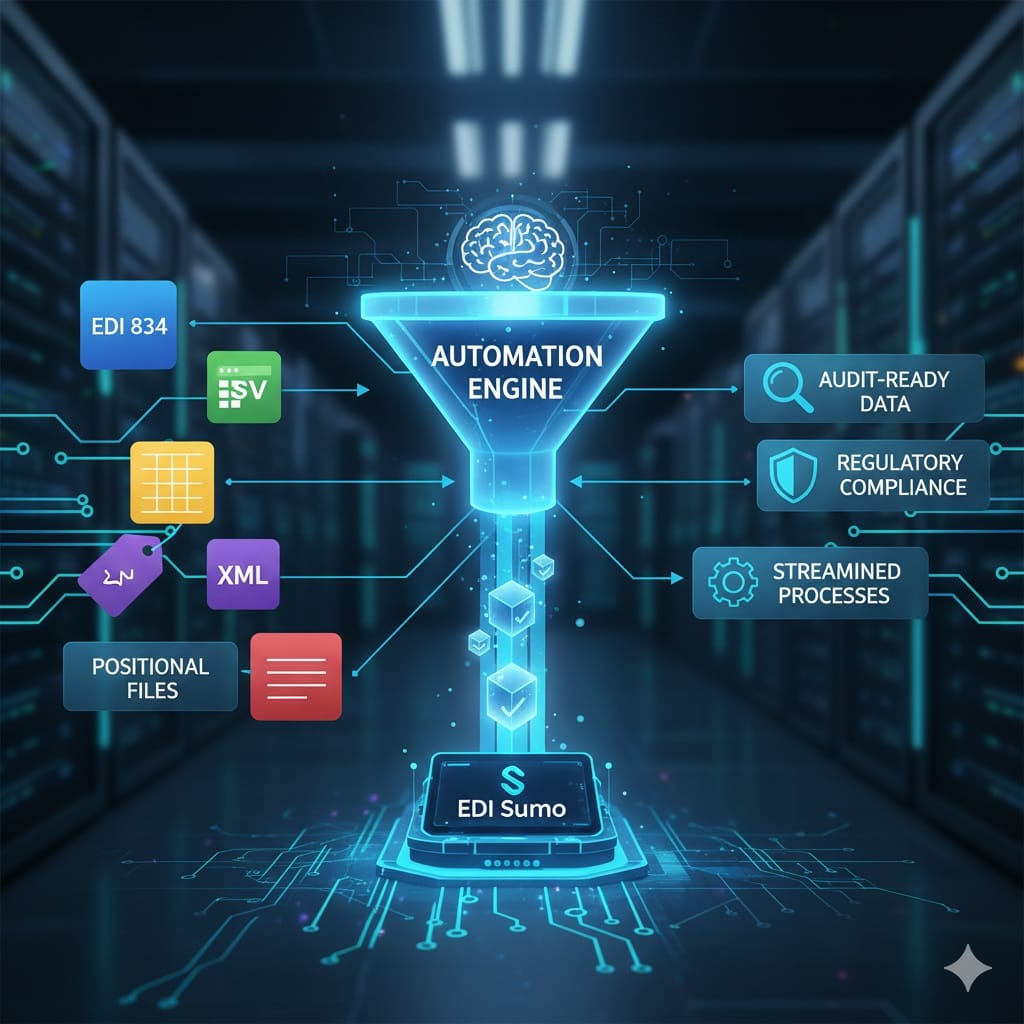
Step 1: Centralize all relevant EDI transactionsStart by creating a single source of truth for claims data: aggregate 837 claim files, incoming 276 status requests, all 277 responses, 999 and 277CA acknowledgments, and the 835 remittance outcomes. EDI Sumo is uniquely designed for this, supporting multiple formats—X12 EDI, CSV, XML, positional—and providing a unified, business-user-friendly dashboard to monitor all transactions in one place.
Step 2: Map status codes to provider frictionGroup 277 status codes into risk categories. Typical groupings include:
- High dispute risk: Documentation, medical necessity, or benefit denials—the top drivers of appeals.
- Moderate risk: Non-covered service codes, COB issues, or timely filing denials—often challenged by providers.
- Low risk: Clean, correctable errors such as duplicates or invalid identifiers, where providers tend to self-correct.
- Operational risk: Persistent pending statuses or batch slippage—key drivers of call volume, rather than formal disputes.
Combine code patterns by provider, group, or trading partner. This enables you to spot:
- Providers with unusually high rejection rates on a product line
- Groups experiencing unique denial patterns after policy changes
- Clearinghouses or submitters generating recurring format errors
Turn 277 data into operational playbooks. For instance:
- Trigger outreach when a provider exceeds a threshold for high-risk codes within a set period
- Update portal content and standard FAQ responses for top recurring status questions
- Route spikes in new denial patterns to claims rule owners for rapid investigation
- Adjust customer service scripts so representatives can clearly explain status outcomes
EDI Sumo simplifies these workflows by offering alerting, reporting, and real-time dashboards that do not require technical EDI expertise to use.
Step 5: Close the loop with payment and remittanceTo fully understand and explain disputes, link your 277 history to final 835 remittance details. This traceability makes it possible to show the whole journey—from claim submission to denial and payment—supporting both compliance and faster provider communication. EDI Sumo gives business and support teams this integrated view, streamlining response time for difficult questions.
Practical use cases for 277-driven dispute prevention 1. Reducing status calls- Ensure rapid movement from claim receipt to 277 “received” or “in process” codes
- Set up EDI Sumo to alert you to claims missing timely 277 responses
- Feed clear claim status directly to portals for provider self-service
- Monitor for spikes in denial codes after new policies are implemented
- Coordinate between configuration, medical policy, and provider relations to debug before large volumes accumulate
- Proactively educate providers on new requirements
- Identify providers contributing the most high-risk code volume
- Break down their rejection/denial reasons and share targeted training or tips
- Follow up with relationship managers to prevent repeats
- Provide complete, accurate 277 status and explanations in online provider tools
- Power portals with real-time eligibility and claims repository data (see how in our eligibility and 271 monitoring overview)
- Track reduction in manual calls as self-service grows
- Leverage 277 timestamps and status codes to demonstrate compliance with adjudication SLAs
- Map the claim journey for auditors, showing when status was communicated
Here are essential metrics you can track when implementing a more proactive 277 monitoring strategy:
Call center performance- Volume of status-related calls per 1,000 claims
- Average speed to answer and resolution rates using unified EDI claim history
- Rate of first-contact resolution for status disputes
- Percentage of claims hitting top high-risk status codes
- Average days from claim receipt to final 277 status/outcome
- On-time SLA performance, backed by 277 timestamps
- Ratio of disputes or appeals per denied claim
- Portal and API transaction adoption over manual call reliance
- Complaint categories mapped back to root 277 code causes
Unlike legacy EDI tools, EDI Sumo was developed for claims leaders, IT teams, and end users who need actionable insight without waiting for technical support. We provide:
- Multi-format data intake, normalizing EDI, CSV, XML, and APIs into usable datasets
- Real-time and batch claims monitoring, with configurable alerts
- Unified dashboards for eligibility, claims, and customer service
- Role-based access so every user sees the right data
- Audit trails and HIPAA-compliant tracking, simplifying compliance reporting
- Compatibility with leading payer, claims core, and B2B integration platforms
- Advanced encryption and data security controls aligned with HIPAA and GDPR
This approach lets business teams act on the signals in 277 files quickly, preventing downstream issues and empowering operational and customer service improvements that show up directly in your call, dispute, and compliance metrics.
Accelerating provider dispute prevention: a 90-day roadmapHere is a pragmatic, stepwise approach to implement better 277 monitoring and proactively prevent disputes:
Days 1–30: Foundation- Inventory all existing EDI sources: claims, status inquiries, acknowledgments
- Ingest recent history (60–90 days) into EDI Sumo for normalization
- Create baseline 277 status code distribution and identify current status-call volume
- Define the 277 codes that signal high provider friction
- Configure dashboards and alerts for these high-risk scenarios
- Pilot proactive workflows with selected provider groups
- Expand dashboards and automated actions to more business lines
- Measure results on call reduction, improved response metrics, and provider satisfaction
- Use the data to plan next-phase improvements
If you are managing claims, EDI, or provider relations for a payer—whether vision, dental, or medical—your 277 claim status files are already showing you tomorrow’s dispute risks. The question is whether you can act on them in time. EDI Sumo gives you the foundation to do exactly that, uniting all formats, automating analysis, and empowering your business users with clean, actionable claims insight.
To see your own 277 data in one place and start building modern, preventative workflows, reach out for a demo or conversation. The EDI Sumo team will show you how to turn what’s hidden in your claim status files into results you can measure.
What is an EDI 277 claim status response?
An EDI 277 is an electronic transaction used by payers to respond to a provider’s 276 claim status request. It confirms the current status of a claim and uses standardized codes to communicate if a claim has been accepted, is in process, or has been paid, denied, or rejected—and why.
Does a 277 contain payment amounts?
No, the 277 provides status updates (such as pending, paid, or denied) but not payment detail. The EDI 835 remittance provides payment information and adjustment reasons.
How are 276 and 277 files connected?
Providers send a 276 to ask for a claim’s status. The payer replies with a 277; together, these transactions are part of the HIPAA standard for promoting transparency and reducing manual status calls.
Can 277 files really help prevent provider disputes?
Yes—by aggregating and analyzing 277 data, payers can identify claims and providers most at risk for disputes, proactively communicate status and root causes, and significantly cut call volumes. Tools like EDI Sumo make those workflows accessible for claims, provider relations, and support teams.





.png)

.png)


.png)

