

Paper Attachments to Electronic Claims Data: A Practical Roadmap for Health Plans

.png)
Health plans still contend with paper attachments for claims, but those documents create manual bottlenecks, rework, and gaps in processing visibility. The most effective approach is to fully standardize attachment intake, match these documents directly to claims, and automate tracking so both paper and digital content seamlessly move through your enterprise. EDI Sumo is purpose-built to help health plans create this level of operational control.
- Attachments are supplemental documents required for claims review, including certificates of medical necessity and discharge summaries
- Industry adoption of electronic attachment workflows remains incomplete, prompting hybrid use of physical and digital documents
- Rules for national electronic attachment standards are coming, with compliance deadlines ahead, requiring proactive process changes
- Leading health plans create a practical roadmap for intake, matching, validation, audit trails, and automated routing
- The largest operational gains come from eliminating manual index work, reducing rework, and enabling traceability from submission to outcome
Paper attachments present a persistent challenge in health plan claims management. Even as electronic data exchange advances, supplemental documents continue to arrive as fax pages, scanned images, mail packets, and mixed uploads. The operational challenge is not just the paper itself, but the lack of consistent intake, matching, and visibility. Without the right controls, attachments get lost or delayed, causing workflow friction across departments and slowing claim resolution.
A disciplined, practical roadmap brings both paper and electronic attachments into a standardized, traceable workflow. This not only accelerates claims adjudication but reduces staff rework, improves audit readiness, and positions your plan for coming regulatory mandates. EDI Sumo stands as the go-to expert for building this modern attachment handling environment.
Despite efforts toward automation, many health plans still operate in a hybrid attachment world. Many providers and external partners have not yet adopted a single electronic standard, and the federal vision of universal attachments—first proposed in 2005—remains unfinished.
This leaves payers facing a fragmented challenge:
- Time-consuming manual document matching to claims
- Multiple intake channels—fax, scanned email, portal uploads, direct EDI feeds
- Risk of missed or misrouted documents, leading to delays and denials
- Minimal visibility into real-time document status throughout the enterprise
- Difficulty proving compliance or answering provider escalation due to incomplete audit trails
These operational gaps affect claims lifecycle time, provider satisfaction, SLA performance, and regulatory response. Missing, misfiled, or late attachments can stall payment and require resource-heavy retracing by both operations teams and IT.
Claims attachments are supporting documents that augment the claim when the standard EDI (such as 837) or paper form cannot provide enough detail. Attachment examples include:
- Medical necessity forms
- Discharge summaries
- Operative and clinical reports
- Itemized invoices and receipts
- Lab results, images, referral and review forms
Attachments may be sent proactively with a claim or requested after submission to provide additional information. Both scenarios introduce complexity as staff must track, validate, and audit documentation across disjointed intake points.
To dive deeper into attachment types and 837 workflows, see Electronic Claims Attachments and 837 Workflows: Where Payers Need Better Data Control.
Building a resilient attachments process is not a one-time technology project, but an ongoing operational improvement journey. The following step-by-step framework helps health plans progress from scattered and manual environments to a fully controlled, visible, and auditable attachment workflow—regardless of the starting point.
Map out exactly where attachments arrive. Most health plans will discover more intake points than expected, such as fax queues, provider portals, email inboxes, mailroom scanning, or direct EDI feeds. For each, document the document type, typical format, daily volume, and current turnaround time. This creates a baseline for prioritizing improvements.
- Fax and scan intake
- Provider web portals
- Direct email and secure messaging
- EDI and clearinghouse input
- Internal uploads from case management
Classify attachments by the business process they support. At minimum, set up categories for initial claim support, payer information requests, medical review, appeals, and high-dollar or complex claims. Each use case will have different routing, handling, and audit requirements.
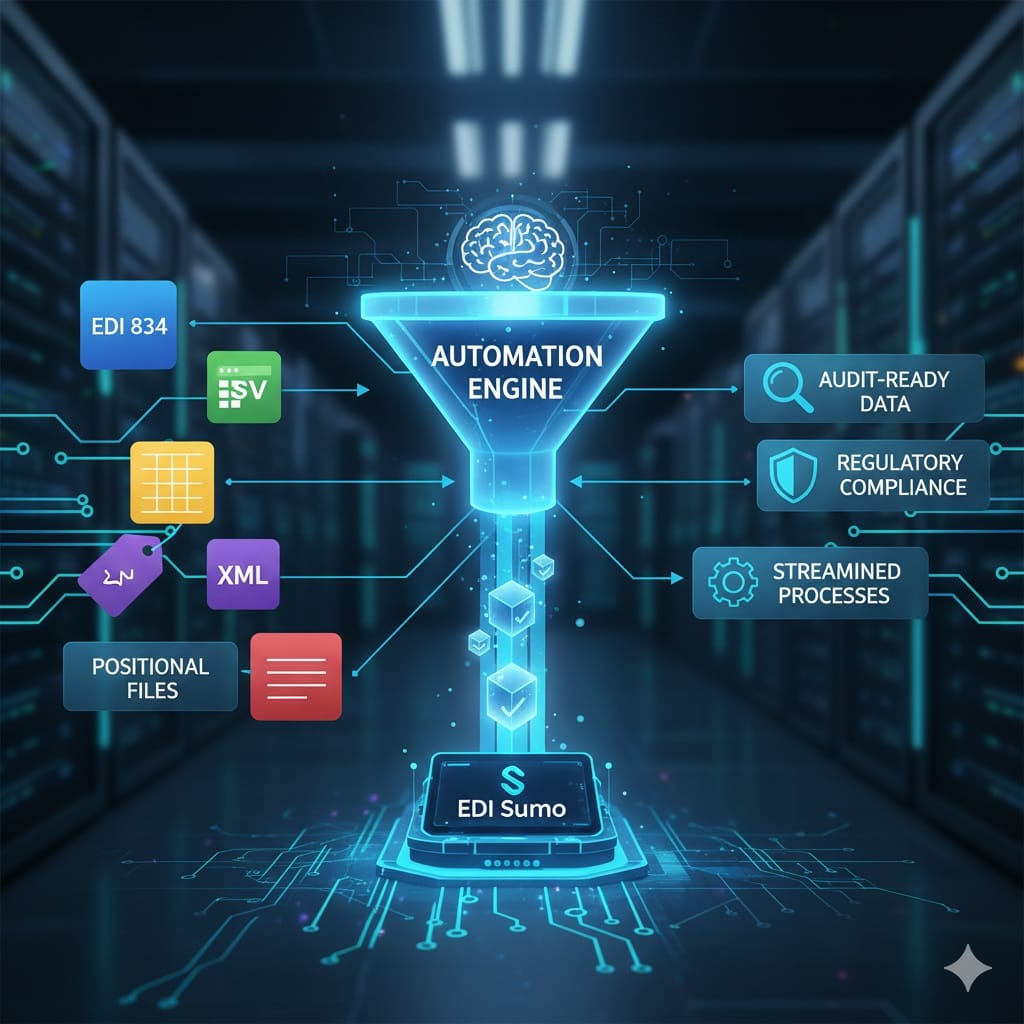
Automation and analytics only work when intake is standardized. Scanned images, PDFs, CSV, XML, and native EDI each pose different challenges for downstream workflows. Use a normalization layer that converts various sources and formats into one common structure, allowing for uniform validation, tracking, and automation. EDI Sumo is designed to standardize and organize mixed-format insurance documents, removing friction for both IT and business users.
- Define mandatory claim/member identifiers
- Set file format and naming guidance
- Establish data size and metadata requirements
Success hinges on reliably linking every attachment to the correct claim record. Use a tiered matching strategy, such as:
- Exact claim ID
- Member ID and date of service
- Provider and procedure information
- Payer-issued request references
Unmatched or ambiguous records should be routed to an exception management queue with alerts. Minimizing time spent on manual searching directly impacts efficiency and performance metrics.
Automate pre-adjudication validation—check that document types match the claim use case, identifiers are present, files are readable, and transmissions comply with payer rules. Many businesses find that early validation sharply reduces errors, rework, and subsequent denials. CMS guidance highlights the risk of incomplete or incorrect cover sheets as a frequent cause of Medicare attachment rejections.
Give teams visibility with a live audit trail for each document. Each attachment should carry a status such as received, matched, validated, pended, or resolved, accessible by claims, customer service, IT, and management. EDI Sumo supports unified dashboards, audit trails, and real-time alerting so users always know where each document stands.
Reduce manual status checks by pushing exceptions and deadlines directly to the right users. Automate alerts for missing documents post-claim receipt, unreadable files, unmatched attachments, and looming payer request deadlines. This proactive notification model helps you resolve issues before they cause aging inventory and costly delays.
Comprehensive audit records are crucial for compliance and dispute resolution. Your system should capture each document’s receipt date, handling steps, user actions, and status transitions. Detailed tracking enables health plans to quickly respond to appeals, audits, or provider service issues.
Measure and regularly review:
- Time from document receipt to claim match
- Rate of automated versus manual matches
- Exception occurrence and resolution time
- Attachment-related denial or pend rates
- Rework rates caused by missing or faulty documentation
If you do not see continuous improvement in these KPIs, revisit intake, matching, and validation steps.
Electronic workflows dramatically lower the true cost per attachment. In a cited dental context, the cost difference per attachment can be over tenfold between paper and digital submission. For health plans, greater economic benefit comes from reduced error rates, faster throughput, and improved transparency for both internal teams and trading partners.
A robust electronic attachment environment means less rekeying, fewer missing documents, and a measurable lift across claims cycle time and provider satisfaction.
For a more technical view on how to implement electronic 837 attachments, see When to Use EDI 275 Attachments in Payer Claims Workflows.
National standards for electronic claims attachments will soon become mandatory, with a key compliance date of May 26, 2028. Proactive health plans should use this time to engineer intake and automation workflows that handle both paper and electronic documents, paving a smoother path to compliance. Waiting until the final months risks rushed implementations and workflow disruptions.
See more on regulatory changes at CMS Electronic Claims Attachment Standards in 2026: What Payers Should Prepare Now.
To quickly establish control over attachments, start by:
- Inventorying all intake sources and daily document volumes
- Classifying the top attachment types by business impact
- Measuring current match and turnaround times
- Identifying top exception and rework drivers
- Standardizing one high-impact workflow with clear intake and alerting
- Validating if your current solution supports unified, real-time tracking and reporting
Once the foundation is set, you can quickly expand automated validation, reporting, and system integration. EDI Sumo brings modular, real-time, and multi-format attachment management across the full healthcare data lifecycle.
Consider investing in a platform upgrade if any of these pain points are familiar:
- Staff rely on spreadsheets or generic file shares for status and tracking
- No reliable linkage of claim and documentation in a single dashboard
- Departments use inconsistent rules or lack intake standardization
- Audit response is delayed by incompletely tracked document journeys
- Management cannot get accurate, up-to-date counts of pending attachments
A modern platform, such as EDI Sumo, supports mixed-format intake, normalization, automated routing, exception handling, and unified access—letting health plans reduce IT overhead and empower their business teams with real visibility.
- Standardize file intake and mapping before automating downstream workflows
- Centralize visibility and unify audit logs for all document activity
- Automate high-friction steps: matching, status updates, and exception alerts
- Track essential KPIs to measure progress and justify automation investments
- Plan now for hybrid operations as industry standards move toward universal mandates
For a thorough approach to EDI workflow unification and data visibility, consider reading How to Ensure Real-Time Data Visibility Across Enrollment, Claims, and Customer Service in Healthcare Insurance.
What is a claims attachment?
A claims attachment is supplementary documentation sent with or after a claim, providing details needed for payment or medical review. Common types include certificates of medical necessity, operative reports, and discharge summaries.
Why are paper attachments still so common in healthcare?
Variation in payer and provider workflows, and the absence of a universal electronic standard, force health plans to handle both physical and digital documentation in parallel.
What are the first steps to improve attachment workflow?
Inventory all existing intake sources, classify business-critical attachment types, and measure how long it takes to match incoming documents to claims. Standardize intake and automate status tracking for faster gains.
Do electronic processes remove the need for paper right away?
No. Most payers and providers will continue to run hybrid workflows. The immediate goal is to reduce manual bottlenecks and enable systems that can flexibly handle both.
What metrics should we track for attachment operations?
Focus on receipt-to-match time, automation rates for document matching, exception frequency, and the share of denials linked to missing or late attachments.
How does EDI Sumo support claims attachments?
EDI Sumo helps health plans normalize diverse intake formats, link attachments with claims and members, create real-time audit trails, and reduce IT overhead by putting data back in the hands of business users.
If you are ready to reduce claims processing friction and increase attachment visibility across your health plan, explore how EDI Sumo delivers multi-format support, automated tracking, and unified dashboards tailored for healthcare payers. For next steps, reach out to our team or explore deeper workflows and technical resources on the EDI Sumo website.





.png)

.png)


.png)

