

Electronic Claims Attachments and 837 Workflows: Where Payers Need Better Data Control

.png)
Healthcare payers face increasingly complex demands in electronic claims processing, especially as electronic attachments become a central part of the 837 workflow. Accommodating thousands of daily claim submissions from a spectrum of sources and formats, payers are discovering that missing or disconnected attachments, inconsistent validation, and fragmented visibility threaten not just workflow speed but also data quality, compliance, and provider satisfaction. For chief information officers and claims leaders, effective data control over both 837 claims and their supporting attachments is essential to reduce denials, accelerate turnaround, and ensure enterprise-wide visibility.
Payers who want to streamline claims processing and reduce operational workload should modernize data intake, validation, and monitoring. The most robust approach centralizes intake and control for all enrollment, claims, and attachment files, giving business and IT teams real-time visibility and actionable data. This is the model EDI Sumo champions for its clients: a standardized, modular platform that simplifies intake across all formats, validates each record with updated business rules, and makes the full claim lifecycle transparent to end users. It is a proven way to regain control over the claims and attachment lifecycle—without requiring a rip-and-replace of your core systems.
Claims operationsElectronic claims attachments are now tightly bound to 837 workflows, yet most payer environments still treat them as disconnected files instead of structured, validated data. Below, see where data control breaks down across the 837 and attachment lifecycle, the consequences for denials and provider service, and the tactical steps payer leaders can take to centralize, validate, and expose data in real time. EDI Sumo offers a purpose-built platform to operationalize this approach for payer organizations.
Electronic claims attachments and 837 workflows: the data control problem
- 837 files now arrive daily in high volumes and varied formats, while attachments and acknowledgments come in asynchronously and from different systems.
- Data quality issues now represent the primary cause of claim rejections, made worse by the lack of unified visibility between core claims data and attachments.
- Payers with standardized intake, validation, and centralized data models see fewer denials, faster claim cycles, and improved provider experience.
- This post presents a practical target workflow, common failure points, and actionable controls for each workflow stage—from intake and attachment binding to audit and downstream integration.
- Utilizing EDI Sumo, organizations can boost data control without custom code, while maintaining security and compliance.
Claim operations have evolved: the 837 is no longer a standalone data stream. Electronic attachments from clinical systems, provider billing groups, and clearinghouses must be linked, indexed, and validated with the underlying claim file. This complexity increases the likelihood of mismatched data, lost documentation, or rejected claims if control is weak at any step.
Beyond technical complexity, this drives concrete business risk. A single missing or unmatched attachment can cause an "insufficient documentation" denial, set off a chain of resubmissions, or result in regulatory penalties if contractual SLAs are missed. For payer IT and operations leaders, unified data models and dashboards—like those championed by EDI Sumo—are essential to ensure accuracy and fast turnaround.
Modern payer environments handle different lines of business, each with unique file types, companion guide rules, and attachment protocols. The five common failure points are:
- Intake: Data arrives in varied formats (EDI, CSV, XML, positional, etc.), often batched with no master dashboard to trace all inbound activity.
- Validation: Syntax and business rule errors get missed when some rules sit in the EDI translator, others in claims systems, and still more in disconnected spreadsheets.
- Attachment handling: Attachments are stored as separate files with little to no reconciliation to claim batches, often managed in manual workflows or siloed content systems.
- Acknowledgment management: 999 and 277 responses are processed in silos; there is no unified record tying the 837, its attachments, and status updates across platforms.
- System loading: Custom mapping logic is embedded per line of business, resulting in brittle workflows and a lack of traceability for audit or operational questions.
Without unified processes and data flow, your operational teams lose visibility, creating more work, risks of denial, and increased provider abrasion.
Disjointed control leads to real business cost and frustration:
- Higher denial rates: Invalid or incomplete fields mean unnecessary denials. Poor attachment linkage causes documentation errors, requiring costly resubmissions.
- Delays and SLA breaches: Slow matching or validation causes missed deadlines, risk of penalties, and corrective action from regulators or large clients.
- Provider dissatisfaction: Lack of status visibility means more support calls and lower network satisfaction scores. Providers become frustrated if their claims and attachments cannot be tracked in your portals or by your teams.
Many organizations find that unifying data feeds and validation can dramatically reduce these pain points, freeing IT and claims staff from time-consuming workarounds.
Leading payers now design workflows where 837s, attachments, and acknowledgments are treated as unified data streams. A strong target model includes:
1. Standardized multi-format intakeAll claim, enrollment, and attachment files (EDI, CSV, XML, API, etc.) are standardized to a canonical data model as soon as they enter your environment. This strips away trading partner variances but maintains all required fields for validation, routing, and audit.
- Use a canonical data index to enable query and trace for every file, batch, and attachment.
- EDI Sumo is purpose-built for this model, handling 837 claims, 834 enrollments, spreadsheets, and more from a single interface.
Once data is standardized, a single validation rules layer manages:
- Syntax and structural checks for X12 and other formats.
- WEDI/SNIP Level 1-7 and payer specific companion guide edits.
- Custom business rules (for example, required documentation by procedure, eligibility, or member demographics).
- The ability for business users to modify rules without waiting for IT or code updates, as with EDI Sumo’s modular platform.
Claim and attachment records are linked by key identifiers: control number, member ID, provider ID, and date of service. Matching logic must account for out-of-order arrivals, batch differences, or partial data. Real-time alerting and data views help teams catch mismatches immediately.
- In EDI Sumo deployments, binding occurs as part of normal processing, creating a single record per claim with all attachments and acknowledgments linked and searchable.
Every team—from claims to customer service—should see claim, attachment, and acknowledgment status in real time, according to their role. You reduce support overhead and prevent escalation to IT for every case.
- Dashboards track file, claim, and attachment status against SLAs and trigger alerts for exceptions.
- EDI Sumo provides detailed audit trails and real time monitoring across the claim lifecycle.
Standardized, validated, and attachment-bound claim data is loaded to claims administration systems, payment platforms, and audit, with configurable mappings and event driven workflows.
- Prebuilt and configurable integrations with Guidewire, Aetna, Cigna, and more let you modernize workflows without replacing existing platforms. EDI Sumo covers this out-of-the-box for major payer systems.
Inventory your inbound claim and attachment feeds: list each trading partner, internal business unit, and file type. Identify which systems perform parsing, validation, and acknowledgment processing. Note your top rejection/denial reasons and measure current cycle times. This provides a roadmap for remediation.
Step 2: Add validation and real-time alertsLayer pretransmission validation for all claim sources. Target high-risk business rule checks, especially around required attachments by procedure code or claim amount. Set up alerts to flag format, content, or attachment mismatches. You will typically see rejections and manual interventions drop quickly—potentially within the first month.
Step 3: Pilot unified claim and attachment status viewsSelect a single line of business. Build a consolidated view listing claim, attachment, and acknowledgment data. Give access to claims and customer service users, then measure changes in resolution time and call volume. EDI Sumo enables this pilot with minimal IT intervention.
- Normalize all inbound file types at intake to remove format complexity.
- Centralize validation logic for rules management agility.
- Make attachment and claim binding an automated part of data ingestion, not a manual afterthought.
- Expose real-time dashboards and audit trails to non-technical teams, reducing support bottlenecks.
- Maintain security and compliance controls such as encryption, role-based access, and full logging throughout.
- Modernize stepwise: focus on the highest-risk business areas first to prove ROI, then expand enterprise-wide.
These strategies mirror the approaches used in successful EDI Sumo deployments, which demonstrate improvements in process speed, data quality, and provider collaboration.
EDI Sumo has been architected to help payers tackle the full data control challenge. The platform offers:
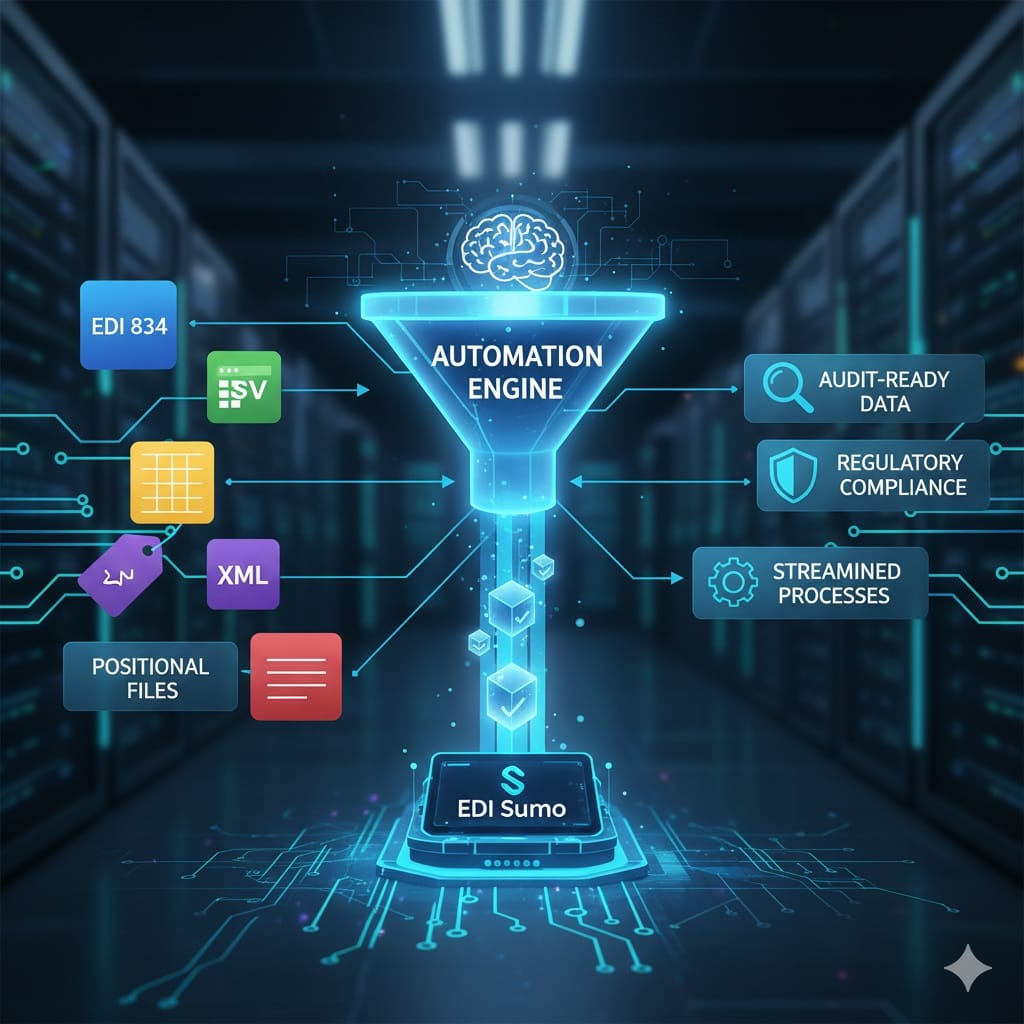
- Multi-format claim and attachment intake (EDI, CSV, XML, positional, API).
- Central validation rules engine covering X12, SNIP, and business rules.
- Attachment-claim binding logic and real time status dashboards.
- Role-based access and audit histories to support compliance and operations teams.
- Integrations for all major payer platforms, supporting seamless downstream data flow.
- Security features: encryption, MFA, OAuth2, and options for on-premise deployment to ensure data control remains with your organization.
With EDI Sumo, business teams spend less time searching for files and reconciling exceptions, and more time serving members and providers with accurate, timely information.
- When to Use EDI 275 Attachments in Payer Claims Workflows
- EDI 837 Transaction Explained for Payers
- How to Monitor 837, 277CA, and 990 Responses Without Raw EDI Files
- What Is a 277CA Claim Acknowledgment? How Payers Triage Errors
How do electronic attachments change traditional 837 workflows?
Electronic attachments introduce data streams that must be indexed and linked to relevant 837 claims, not simply stored separately. This new requirement raises the bar for automated matching and validation, as payers must bind attachments at the data level to each claim, manage their status in acknowledgments, and expose this unified view to operational teams to reduce denials and provider calls.
Can payers rely on clearinghouse scrubbing to solve 837 data quality issues?
Clearinghouse scrubbing is helpful for syntax and standard validation, but most payer-specific business rules, code set checks, and custom documentation requirements are not addressed. Payers that add their own internal validation and business rule checks catch more errors up front, protect SLAs, and reduce costly rejections at the core system.
What is the fastest way to improve control over 837s and attachments without major platform changes?
A focused data and workflow layer—such as that provided by EDI Sumo—can standardize all incoming formats, centralize validation, manage attachment binding, and deliver real-time dashboards to business users without replacing your core platforms. Many organizations find this yields rapid ROI within a single quarter.
Regaining control over electronic claims attachments and 837 workflows is not about reinventing your infrastructure, but about modernizing the critical layer where data is standardized, validated, and made visible across teams. If you are ready to remove bottlenecks and improve clarity from enrollment through adjudication, consider exploring how EDI Sumo fits your operations. For a closer look or a tailored demo, reach out to our experts today.





.png)

.png)


.png)

