

When to Use EDI 275 Attachments in Payer Claims Workflows

.png)

EDI 275 attachments should be used by payers whenever claim, encounter, or prior authorization workflows require supporting documentation that cannot reside in the core 837 or 278 files. Examples include medical records, progress notes, and certificates that provide essential clinical or administrative information for adjudication. Moving attachment workflows to 275 streamlines intake, enhances record keeping, and replaces manual fax or portal uploads with automated, secure electronic transmission. Solutions like EDI Sumo help payers standardize and automate these processes, bringing improved visibility, compliance, and operational efficiency.
Executive summary for payer and EDI operations leaders
- EDI 275 is the HIPAA standard for securely transmitting clinical and administrative attachments—such as PDFs, images, and reports—linked to claims (837) or authorizations (278).
- Payers incorporate attachments in two primary ways: unsolicited (sent proactively by provider) and solicited (sent in response to a payer’s request for additional information).
- Operational rules often require attachments within a set timeframe (commonly 5 days of the claim), cap number and size of attachments, and define accepted file types.
- Automating attachment intake with EDI 275 reduces manual efforts, lost documentation, and delays in reimbursement. Platforms like EDI Sumo offer validation, reconciliation, and end-to-end monitoring.
Health plans and payer teams working in claims, enrollment, or EDI operations know that supplemental documentation is often the biggest bottleneck for getting claims paid accurately and on time. Fax, email, and portal uploads create delays, missed SLAs, and frequent provider support calls. The EDI 275 standard is designed to resolve these hurdles by electronically connecting attachments to claims and authorizations.
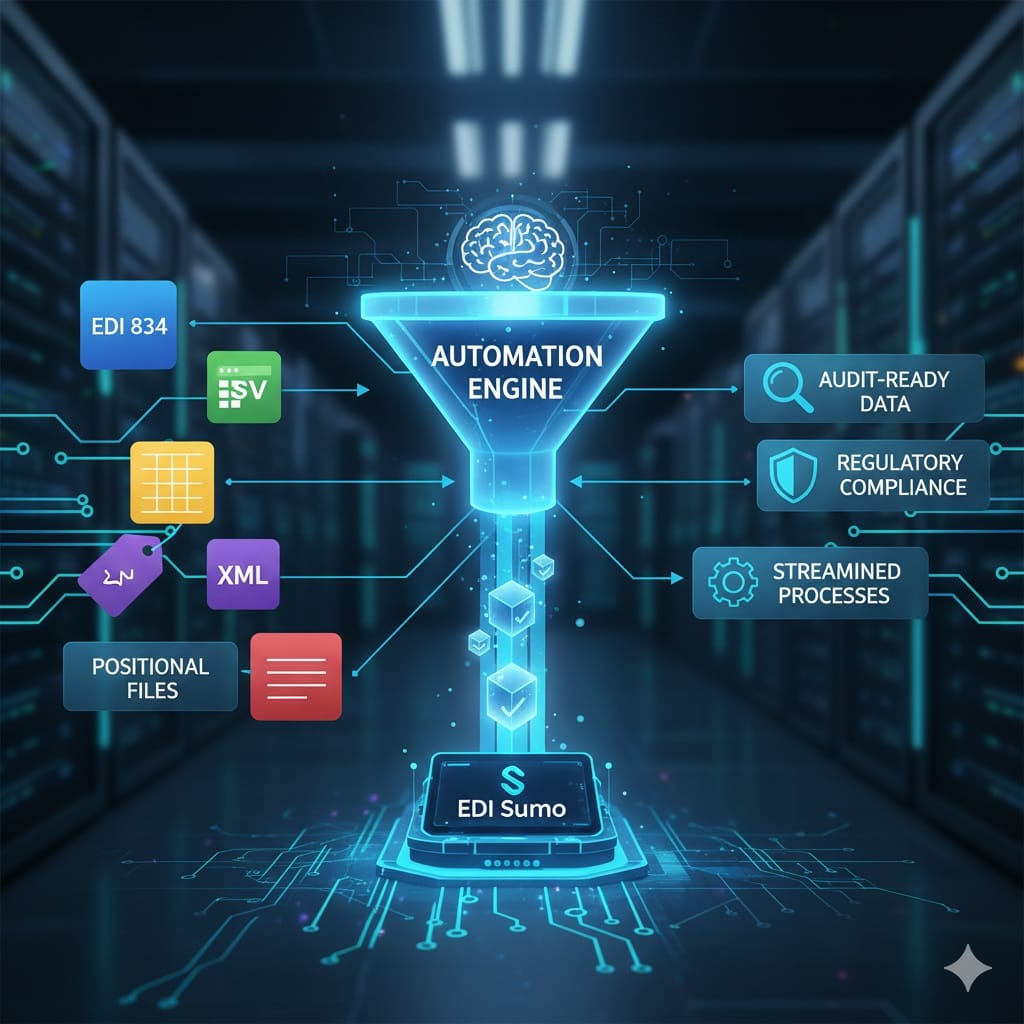
This comprehensive guide explains when and how to use EDI 275 attachments in payer workflows, breaks down practical scenarios, and shares technical rules and operational best practices. You'll see how EDI Sumo supports payers by centralizing data across EDI, CSV, XML, and API formats, while enforcing business rules, tracking compliance, and providing real-time dashboard visibility to front-line teams.
Understanding EDI 275 Attachments in Claims WorkflowsEDI 275 is the industry-standard X12 transaction for transmitting healthcare attachments—most often clinical or administrative documents that support adjudication but cannot fit within the 837 or 278 file specifications. Typical examples are certificates of medical necessity, discharge summaries, operative notes, imaging reports, or invoices. These are uploaded in electronic form instead of paper or manual uploads.
Attachments are delivered via EDI 275 and explicitly matched to their corresponding claim (837) or authorization (278) using uniquely shared control numbers, ensuring a secure, automated link in the recordkeeping.
Common File Types and Limits in EDI 275 Workflows- Accepted document types often include: PDF, JPG, PNG, TIFF, DOC, XLS, and similar standard formats.
- Industry companion guides frequently require all attachments for a given claim to total less than 100 MB and cap per-file size at several gigabytes (e.g., 4 GB per file).
- It's common to permit up to 10 attachments per EDI 275, with additional transactions needed for larger document sets.
These requirements help ensure compatibility across clearinghouses and claims systems. EDI Sumo enforces these limits through automated validations so files are never rejected for compliance reasons.
Solicited vs Unsolicited EDI 275 Attachments: How They WorkEDI 275 attachments come into payer organizations through two central patterns, each with specific triggers and operational flows.
Unsolicited Attachments- The provider includes documentation (such as medical records or certificates) along with—or immediately after—an 837 or 278 submission based on pre-existing requirements.
- The EDI 275 includes a reference control number that allows your system to instantly match it to the right claim or authorization.
- Common for services or equipment that always require clinical support, such as DME claims, complex imaging, or high-dollar surgeries.
Many plans enable unsolicited attachments for scenarios where documentation is always necessary for adjudication, reducing avoidable back-and-forth with providers.
Solicited Attachments- Your claims team receives an 837 or 278 and determines more documentation is needed.
- A request is made to the provider (often via 277 Request for Additional Information or equivalent notification) asking for the required documents.
- The provider replies by sending the EDI 275 attachment, again referencing key identifiers for reassociation in your claims system.
Solicited flows are essential for cases that only occasionally require extra documentation (such as rare authorization scenarios or unanticipated coding issues).
When to Use EDI 275 Attachments: Practical Scenarios Use 275 Attachments When:- Claims or authorizations require supporting documentation that cannot be accommodated in standard EDI 837 or 278 notes.
- The attachment is necessary for initial adjudication—not after-the-fact disputes, appeals, or grievances.
- Both provider and payer support technical standards for matching control numbers and meet companion guide content/timing rules.
- Imaging claims (MRI, CT) where radiology reports, images, or specialist notes are required.
- Surgical claims needing operative notes or pathology results as proof of medical necessity.
- DME claims with certificates of medical necessity or vendor invoices.
- Complex inpatient cases requiring extensive medical record review.
- Out-of-network or special coverage scenarios where granular clinical detail is needed for policy review.
Many businesses find that automating these scenarios with solutions like EDI Sumo greatly reduces administrative cycles and likelihood of missing documentation.
275 Should Not Be Used For:- Appeals or formal grievances after claim denials.
- Disputes over pricing, contracts, or non-clinical payment issues.
- Member complaints or regulatory filings outside of standard claims processing.
These scenarios require distinct workflows, as outlined in many payer bulletins and industry guides. For more on identifying and triaging claim status concerns, see this related blog on 277 claim status files.
Key Technical and Operational Rules for Payer 275 Workflows Timing Requirements- Attachments are typically required to be received within a set window (often 5 calendar days) from when the claim/authorization arrives.
- Claims and attachments must align by control number (TRN/PWK) as called for in your companion guides.
- Entries should use correct metadata to ensure robust matching and minimize rejections.
Automating these processes is critical for scale. EDI Sumo lets you codify rules centrally and adjust them as payer policies or trading partner contracts evolve.
Control Numbers and Reassociation- Use unique Attachment Control Numbers and ensure consistency across all transaction sets.
- Document properly in the PWK segment of 837 to indicate presence and type of additional information (typically EL for electronic attachment).
- Align control numbers (TRN02/PWK06) to tie attachments with the originating claim or authorization.
Many plans leverage real-time dashboards and search tools for this purpose. You can learn more about EDI visibility and workflow optimization in our guide on EDI history and data access.
Benefits of Moving Attachments to EDI 275- Faster claim turnaround: Automated matching and intake accelerates adjudication.
- Reduced manual tasks: Eliminates legacy print, fax, and portal upload steps.
- Fewer lost records: Digital transactions minimize separation of documentation and claims.
- Better audit support: Centralized, timestamped digital trails improve compliance.
- Enhanced visibility for operations teams: Real-time dashboards cut down on provider support calls and internal IT tickets.
These gains are amplified for high-volume or high-complexity lines of business, as seen in many payers' progress toward automated claims management.
How EDI Sumo Supports EDI 275 AttachmentsEDI Sumo helps health insurance payers standardize and streamline claims and enrollment data (across EDI, CSV, XML, API, and other formats). Our platform automates validation, manages attachment-claim reassociation, enforces timing and file-format rules, and provides a unified dashboard for real-time monitoring. These tools reduce the burden on IT and empower your operational and customer service teams with instant access and audit trails.
- Supports a wide range of X12 components (837, 275, 277, 278, 834, 999) as well as CSV, XML, and API feeds.
- Centralizes companion guide rules for timing, matching, and file type—allowing you to update logic as standards or requirements evolve.
- Integrates with leading claims platforms for seamless workflow and exception reporting.
- Offers detailed search and real-time visibility so every team (from customer service to executive) knows status instantly.
Operations and payer IT teams can stop building and maintaining custom scripts or one-off solutions, freeing resources and reducing errors.
Step-by-Step: Implementing or Expanding EDI 275 Attachments at Your Organization 1. Map Your Existing Attachment Flows- Document all current channels used for receiving attachments (fax, mail, portal, existing EDI 275).
- Track volume and turnaround time for attachments by claim type and provider group.
- Identify rates of missing or mismatched documentation and reasons for rework.
- Align your operational guidelines with X12 and CAQH CORE recommendations.
- Codify timing, content, and reassociation requirements centrally in your EDI platform.
- Test integration with trading partners for compliance with real-world data.
- Choose a high-impact scenario (e.g., inpatient stays or DME claims) to validate new workflows.
- Monitor clean claim rates, time to adjudication, and support call volume during the pilot period.
- Iterate rules and exception handling based on pilot outcomes.
- Include more provider groups and additional claim types as readiness increases.
- Automate alerting, analytics, and exception reporting for operational leaders.
- Continue team and provider education about attachment and matching standards.
- Maintain a centralized catalogue of all timing and matching rules for each line of business.
- Proactively communicate acceptable file types and size limits to providers.
- Use real-time dashboards and search tools to increase transparency between operational and customer-facing teams.
- Audit intake and matching regularly to spot and correct gaps in attachment flows.
- Update rules as standards or trading partner requirements evolve.
- Leverage platforms like EDI Sumo to avoid custom development and reliance on overburdened IT teams.
What is EDI 275 used for in healthcare claims?
EDI 275 is specifically designed to electronically transmit supporting documents—such as medical records, images, or administrative certificates—that do not fit within the primary 837 or 278 claim files.
How is an EDI 275 attachment matched to its claim?
Each attachment is assigned a unique control number, documented in both the 837/278 and the 275, allowing automated and auditable matching across your claims systems.
Can attachments be sent before they are requested?
Yes. Unsolicited workflows are common when certain claim types always require attachments. Solicited attachments, by contrast, are sent after a payer issues a request due to a specific adjudication need.
What are best practices for file size and format?
Follow companion guide limits (e.g., total file bundle below 100 MB; individual files may be up to several GBs; up to 10 attachments per transaction). Accept only whitelisted document types such as PDF, DOCX, and JPEG.
What operational improvements can be expected?
Automating via 275 cuts down on manual sorting, reduces documentation loss, improves compliance, and enhances responsiveness for providers and customer service staff.
For payer organizations evaluating or expanding EDI 275 attachment workflows, investing in a robust, enterprise-ready platform like EDI Sumo can dramatically improve claims accuracy, reduce cycle times, and give your teams the real-time visibility needed to support operations and compliance. To see how this can work with your data or to learn more, you can reach out to the EDI Sumo team directly.





.png)

.png)


.png)

