

How to Choose the Right Healthcare EDI Platform: A CTO’s Decision Checklist

.png)

Healthcare payers and insurance companies today face an overwhelming landscape of data, regulations, and integration needs. For CTOs tasked with selecting the right healthcare EDI (Electronic Data Interchange) platform, this decision is about more than ticking feature boxes—it's about enabling operational efficiency, ensuring compliance, and empowering your business users without constantly overburdening IT teams. Drawing on our daily work with some of the most forward-thinking payers, we're breaking down a practical CTO’s decision checklist.
Understanding Your Real Challenges: More Than Just Compliance
Let’s be honest: The healthcare EDI market is awash with vendors touting fancy dashboards and technical jargon. But real pain lies in data fragmentation, endless formats, slow processing, SLA breaches, and relentless compliance pressure (HIPAA, audit requests, and more). And IT departments often bear the brunt, firefighting one integration or data issue after another.
That’s why an effective EDI platform must solve these—not just exist as another system for your team to manage.
Decision Checklist: The Modern CTO’s Guide
Here’s the checklist we wish every CTO would use, sharpened by working with enterprise payers and distilled through real deployment war stories.
1. Flexibility in Data Format Support
- Multi-format compatibility: Can the EDI platform natively process EDI 834, EDI 837, Excel, CSV, positional files, XML, APIs, and whatever new formats your trading partners might use?
- Format normalization: Are incoming files automatically standardized, so downstream systems (and users) see one clean format?
- Manual mapping reduction: Does the system dramatically cut or fully automate file mapping, so business changes won’t require weeks of developer time?
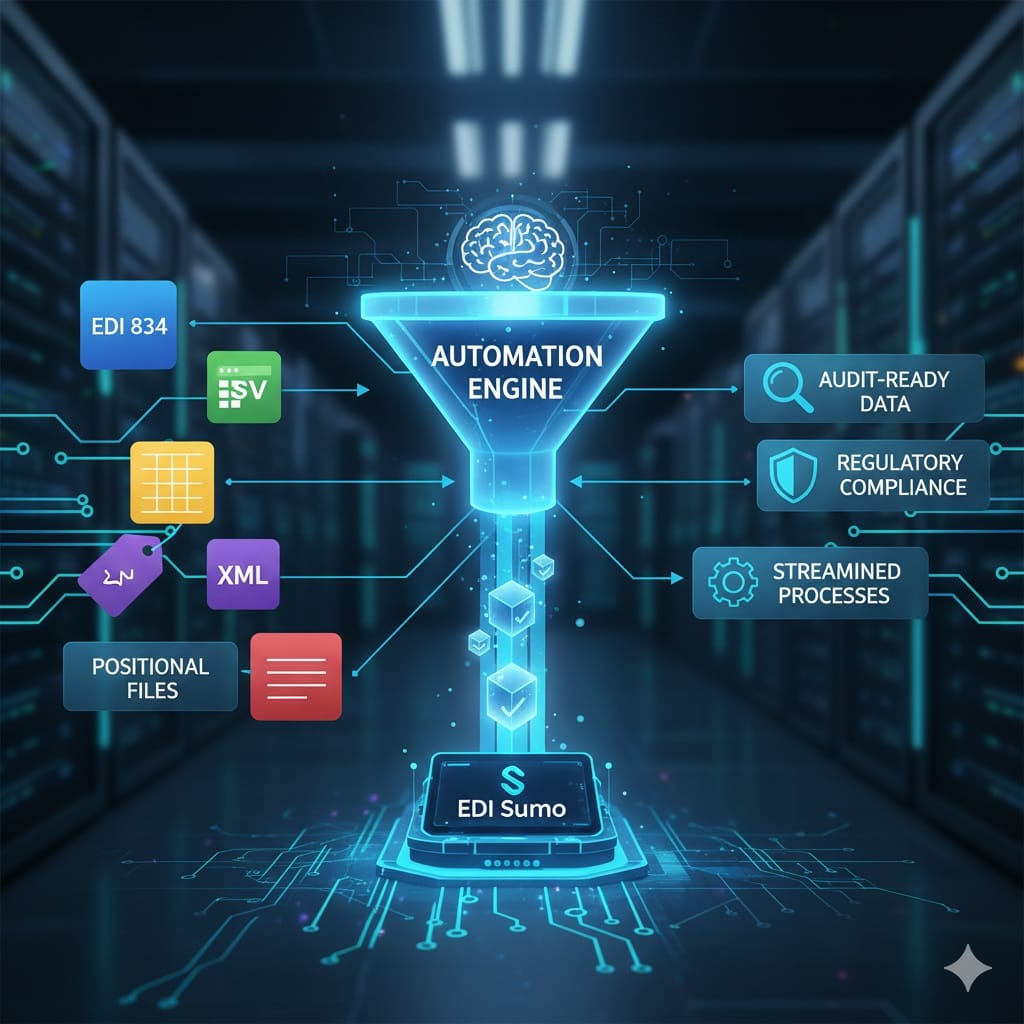
We built EDI Sumo specifically to tackle this headache. Our platform seamlessly processes multiple formats—including corner-case EDI flavors—without you needing to build a mountain of custom scripts.
2. Business User Empowerment, Not IT Overload
- Self-serve for business teams: Can claims and enrollment teams resolve issues, lookup records, or audit files in real time without involving IT?
- Unified dashboard: Is all your EDI and related eligibility data in one place, rather than scattered across silos?
- Role-based access: Does the solution enforce permissions, so sensitive data is exposed only to the right people?
The best EDI solutions are built with the end user in mind. EDI Sumo provides comprehensive dashboards so your support and operations teams can work with data directly, speeding resolution and freeing up your IT team for truly strategic work.
3. Audit & Compliance Automation
- HIPAA compliance as table stakes: Does the platform help you maintain constant compliance, not just at audit time, but every day?
- Automated audit trails: Are all data touches logged, and can you generate compliance-ready reports instantly?
- Validation engines: Can the solution perform advanced custom validations—WEDI/SNIP Levels 1-7, custom payer rules, etc.?
Instead of scrambling at audit time, choose a platform that bakes compliance into every workflow. With EDI Sumo, all user interactions and data flows are automatically tracked—so you’re always audit-ready.

4. Real-Time Monitoring, Alerts & SLAs
- Real-time visibility: Can you instantly detect slowdowns or missing files before partners call you?
- Custom SLAs/alerts: Does the platform send proactive alerts for high-value events—missing submissions, error spikes, or partner-specific deadline misses?
- Performance dashboards: Are your SLA metrics visible at a glance?
When you’re managing hundreds of trading partners and millions of records, real-time transparency isn’t a nice-to-have—it’s survival for your business and reputation. Our clients have used EDI Sumo’s dashboards to avoid costly SLA penalties and improve partner trust.
5. Scalability & Modular Architecture
- Can you grow without re-architecting? Will the platform handle tens of millions of records as smoothly as your current volumes?
- Modular expansion: Can you add new payers, file types, or connections with minimal effort?
Payers don’t have the luxury of hitting the pause button for a major IT overhaul.
6. Integration Harmony
Integration can make or break EDI deployments. Questions to ask include:
- Simple system integration: Does the EDI solution connect cleanly with your claims adjudication, CRM, ERP, and legacy platforms?
- Modern connectors: Is support for SFTP, EDI translators, and APIs built-in?
- Pre-built payer integrations: Are standard connectors for major payers (e.g., Aetna, Cigna, United, Guidewire, etc.) included?
7. Security, Privacy, and Data Control
- End-to-end encryption: Are all sensitive eligibility and claims files encrypted at rest and in transit using best-practice methods?
- On-premise or managed? Can the platform be deployed under your full control, meeting your IT security requirements?
- OAuth2/MFA support: Does the system provide modern access management and multifactor authentication for maximum account protection?
Security is not just a concern for compliance teams—it’s a board-level risk.
Questions to Challenge Potential EDI Vendors
- How long does it take to onboard a new partner and file type?
- What does the process for custom validation or business rule creation look like?
- How do business users access file-level data and reporting?
- Can you provide real-life examples of SLA improvement or audit automation?
- What level of integration support is available for our existing systems (claims, enrollment, legacy)?
If you’re not hearing crystal-clear, client-tested answers, consider it a red flag. In our experience, EDI projects fail not because of a lack of base features but because of poor user empowerment, integration friction, or compliance blind spots.
Bonus: What to Watch Out For
- Vendor lock-in: Proprietary mapping or workflow logic that prevents easy migration later
- Overly rigid workflows: Platforms that force you into their way of working, not yours
- Generic UI with little business context: Dashboards should speak your language—eligibility, claims, SLA, not just technical error codes
Putting It All Together: CTO’s Quick Reference Table
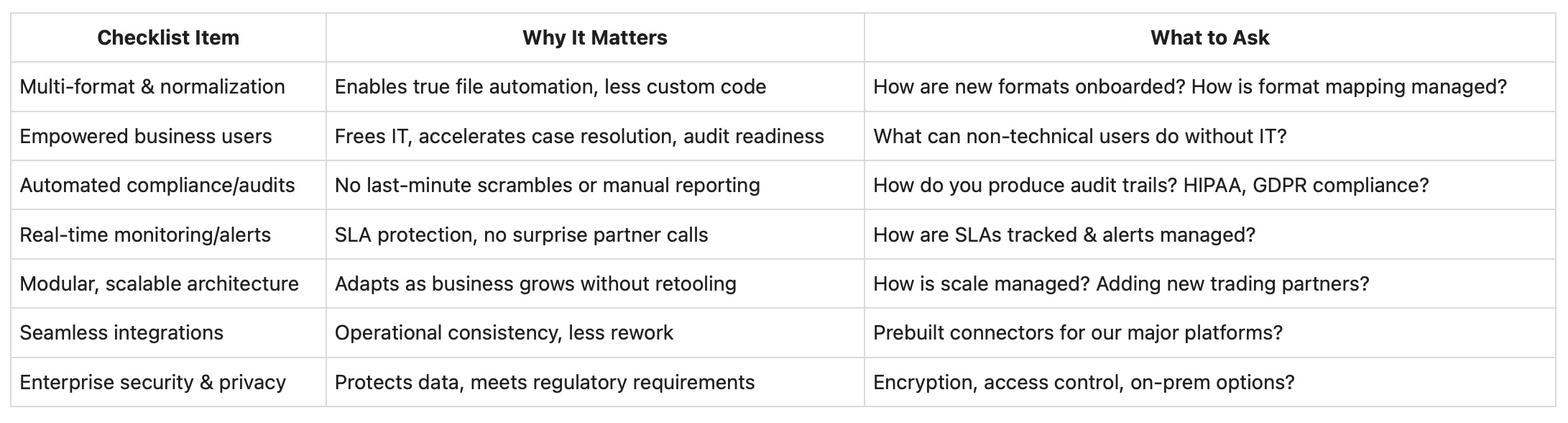
Conclusion: The CTO’s Role as Enabler, Not Gatekeeper
Choosing the right healthcare EDI platform puts you in the driver’s seat—not just to meet technical specs but to enable faster, safer, and more business-centric operations.
If you’re ready to see how a unified, next-generation EDI solution can help you streamline eligibility, claims, and customer support processes without a rip-and-replace project, you can learn more or schedule a demo with EDI Sumo. We’d love to support your decision journey—on your terms, with your architecture, and with your teams in mind.
Further Reading
- Learn more about EDI Sumo security & trust to understand why many payers choose us for seamless, in-house deployments with advanced privacy features.
- EDI Sumo’s integration suite offers proven connectors for industry-leading payers and systems—from Guidewire to Blue Cross to IBM Sterling—eliminating months of custom work.
- Claims Payment Automation in 2026





.png)

.png)


.png)

