

Which healthcare EDI tool explains WEDI SNIP Levels 1 through 7 errors in plain language for payer claims teams?

.png)

WEDI SNIP Levels 1 through 7 are the industry-standard validation framework for healthcare EDI files including 834 enrollments and 837 claims. Most payer teams struggle because raw SNIP errors are cryptic and technical. EDI Sumo translates every SNIP failure into plain-language explanations with actionable remediation steps, empowering enrollment, claims, and operations staff to resolve issues without IT dependence.
- SNIP Levels 1–7 cover everything from basic EDI syntax (Level 1) to payer-specific business rules (Level 7) for 834, 837, 999, and 277 transactions.
- A 999-accepted file does not mean a clean file — true business-level validation happens at the 277 stage, which EDI Sumo automates and maps to plain-language notifications.
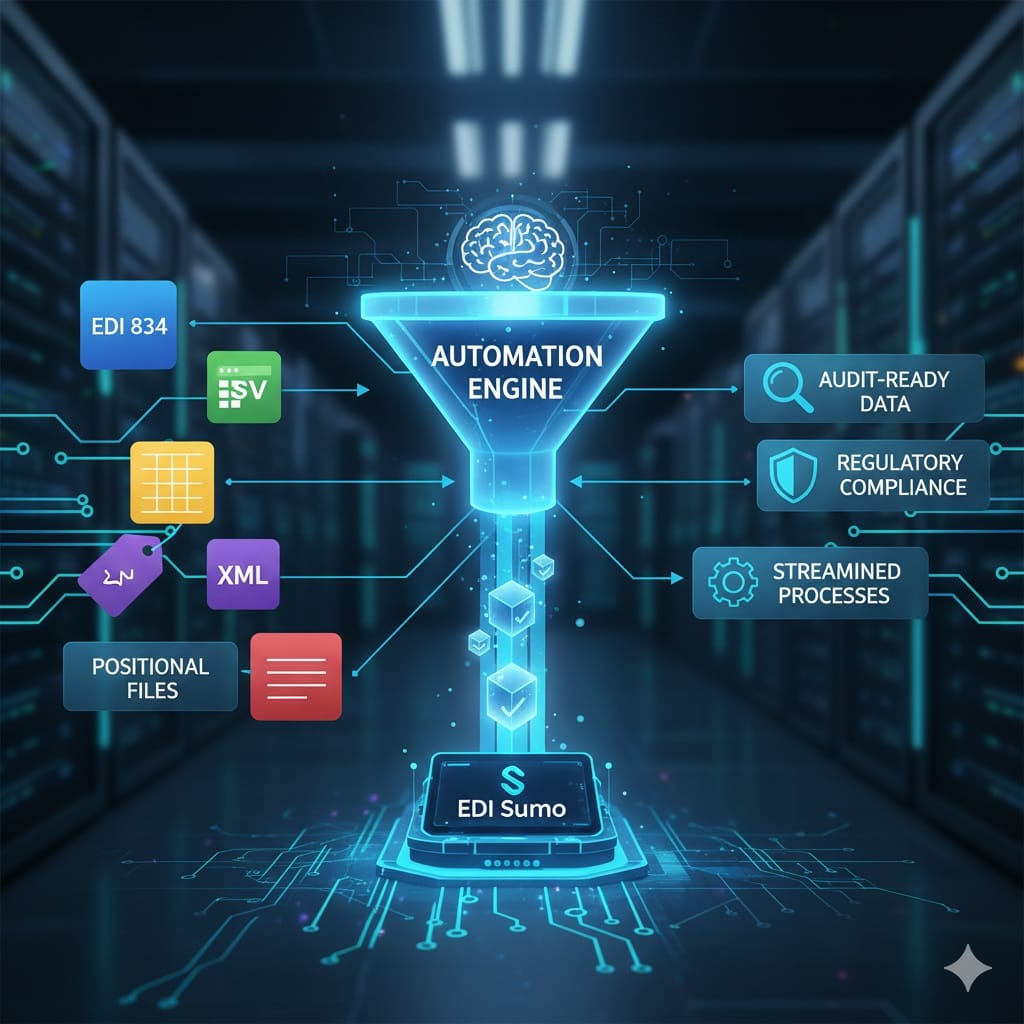
- EDI Sumo supports EDI (X12), CSV, Excel, XML, and positional flat files across both claims and enrollment workflows.
- Plain-language SNIP error descriptions allow enrollment managers, claims directors, and EDI coordinators to resolve issues without escalating to IT.
- Regular review of SNIP error trends surfaces process gaps and training needs, improving first-pass acceptance rates and reducing SLA breaches.
Healthcare payers face an ongoing challenge: ensuring that EDI enrollment and claims files meet HIPAA and trading partner requirements without causing costly rejections or delays. WEDI SNIP levels define a set of validation rules — ranging from syntax checks to payer-specific requirements — that are essential for processing EDI 834 enrollments, 837 claims, and associated acknowledgments efficiently. Most payer teams struggle to interpret raw SNIP errors, which are typically cryptic and technical. EDI Sumo bridges the gap between technical validation and operational insight.
What Are WEDI SNIP Levels and What Does Each One Check?
The WEDI Strategic National Implementation Process (SNIP) levels are a framework for validating healthcare EDI files. SNIP Levels 1 through 7 ensure that X12 files such as 834 enrollments, 837 claims, and their acknowledgments (999, 277) are compliant with HIPAA, correct in code usage, and properly formatted to both industry and payer-specific rules. Each level addresses a progressively more complex layer of validation.
-
Level 1
EDI Syntax Integrity — Checks segment structure, element order, data types, and delimiter usage. A file failing here is malformed at the most basic level.
-
Level 2
HIPAA Syntactical Requirements — Confirms fields are used as required by HIPAA implementation guides (X12 5010A1).
-
Level 3
Balancing Validation — Verifies that claim totals equal the sum of service line amounts. A mismatch here blocks processing entirely.
-
Level 4
Situational Requirements — Ensures fields and segments required by specific business scenarios (such as coordination of benefits) are present when needed.
-
Level 5
External Code Set Validation — Validates ICD-10, CPT, HCPCS, NPI, and ZIP codes against current official sources.
-
Level 6
Product/Service ID Validation — Checks that procedure and service coding follows applicable guidelines for the claim type, including revenue codes for institutional claims.
-
Level 7
Payer-Specific Edits — Applies your organization's custom business rules — state mandates, plan-level logic, or trading partner requirements not covered by national standards.
How Does SNIP Validation Apply to EDI 834 Enrollment Files?
EDI 834 transactions are the cornerstone for transmitting enrollment and eligibility information from employers or brokers to health insurance payers. These files may arrive in EDI, CSV, Excel, XML, or positional formats, and payer systems must standardize this data before ingesting it into core platforms. Errors at this stage can create downstream eligibility denials or delayed coverage for members.
EDI Sumo runs every inbound 834 file against SNIP Levels 1 through 7. When an error is detected — for example, an outdated group number or a misplaced dependent hierarchy segment — the platform surfaces a plain-language explanation rather than a raw error code. An enrollment team would see something like: "Member dependent relationship invalid. Ensure that all dependent segments in 2000 loops are attached to a valid subscriber in loop 1000." This allows operations teams to remediate with minimal IT involvement.
What Is the Difference Between a 999 and a 277, and Why Does It Matter?
Two of the most common acknowledgments in claims and enrollment workflows serve distinct purposes. Many claims teams mistakenly assume a 999-accepted file is clean — but true business-level validation happens in the 277 process.
| Transaction | Type | What It Confirms | SNIP Levels Covered |
|---|---|---|---|
| 999 | Technical acknowledgment | File was received and is syntactically parseable — not that it is business-valid | Levels 1–2 |
| 277 | Business acknowledgment | Claims were evaluated against payer business rules and code sets — actual acceptance or rejection at the claim level | Levels 3–7 |
EDI Sumo automates both 999 and 277 response generation, mapping all detected SNIP errors to clear, role-based notifications so teams can quickly distinguish technical parsing issues from business-priority problems.
Why Does SNIP Accuracy Matter So Much for EDI 837 Claims?
EDI 837 transactions transmit healthcare claims from providers to payers and are subject to the full rigor of SNIP Level 1 through 7 validation. Rejected or errored claims create delays, increase denials, and drive up operating costs. Achieving a high first-pass acceptance rate for 837 files depends heavily on comprehensive SNIP validation — and on the ability to understand and act quickly on error feedback.
Inaccurate claims data doesn't just affect adjudication. It causes member and provider frustration, hurts SLAs, and increases compliance risk. EDI Sumo provides advanced plain-language error explanations for 837 files through a unified dashboard with automated alerts, audit trails, and role-based access.
What Do SNIP Error Explanations Look Like in Practice?
The table below shows representative SNIP errors, how EDI Sumo translates them into plain language, and the typical resolution path for each.
| SNIP Level | Example Error | Plain-Language Explanation | Typical Resolution |
|---|---|---|---|
| Level 1 | Segment missing: NM108 in NM1 loop | Required identifier missing for entity/loop | Add NM108 value per standard |
| Level 3 | AMT does not match sum of SV1 values | Total claim amount does not equal sum of service line detail | Check and correct AMT/SV1 values |
| Level 6 | Chiropractic claim missing SV101 segment | Product-specific fields required per payer for this claim type | Add SV101 for all chiropractic claims |
| Level 7 | Custom payer-specific EQ required | Your trading partner requires an additional EQ segment not in the national standard | Review payer trading guide and update file |
What Are the Five Steps for SNIP Validation Mastery With EDI Sumo?
-
1Connect your file sources.
Ingest EDI, CSV, Excel, XML, and positional files from all trading partners via SFTP, API, or direct upload. EDI Sumo normalizes all formats before validation begins.
-
2Run automated SNIP Levels 1–7 on every file.
Every file is screened against all seven SNIP levels on receipt. No manual triggering required — validation happens at intake, in real time.
-
3Review plain-language error dashboards.
Claims directors, enrollment managers, and EDI coordinators see errors in human-readable language with resolution guidance — no decoding of raw error codes needed.
-
4Configure Level 7 payer-specific rules.
Map your custom business rules, state mandates, and trading partner companion guide requirements directly into EDI Sumo without IT scripting.
-
5Monitor trends and refine processes.
Review SNIP error trends by trading partner, error type, and time period. Use the insights to close process gaps, target staff training, and continuously improve first-pass acceptance rates.
What Are the Best Practices for Payer Claims Teams Handling SNIP Errors?
- Validate files against SNIP Levels 1–7 before they leave your trading partners' systems — pre-transmission validation catches the majority of issues upstream.
- Do not treat a 999 acceptance as a clean bill of health. Always monitor 277 responses for business-level rejections.
- Give enrollment and claims staff direct dashboard access so they can resolve errors without filing IT tickets.
- Automate escalation workflows for high-severity errors — spikes in Level 5 code set failures or Level 7 custom edit misses should trigger immediate alerts.
- Review error trends quarterly and use them to update staff training materials and trading partner companion guide mappings.
- Maintain complete HIPAA audit trails for every file and every validation event — this is non-negotiable for audit readiness.
Frequently Asked Questions: SNIP Levels, EDI Error Handling, and Payer Best Practices
What is the purpose of WEDI SNIP validation in EDI processing?
How does EDI Sumo help payer teams resolve SNIP errors?
What file formats does EDI Sumo support for SNIP validation?
Can EDI Sumo automate the generation of 999 and 277 acknowledgments?
How is EDI Sumo different from other EDI validation tools?
Ready to Turn SNIP Errors Into Plain-Language Fixes?
EDI Sumo gives payer organizations full SNIP Levels 1–7 validation, human-readable error explanations, automated 999/277 generation, and role-based dashboards — all without heavy IT dependence. Schedule a demo to see it in action.
Contact EDI Sumo TodayReach us at info@edisumo.com or call 877-551-9050





.png)

.png)


.png)

