

ERA, EOB, and 835 Explained for Health Plan Operations Teams

.png)

Health Plan EDI Guide
Quick Summary: ERA, EOB, and 835 Transactions
- ERA (Electronic Remittance Advice) is the digital remittance sent as EDI 835 files after claims adjudication by payers, detailing claim payments and adjustments.
- EOB (Explanation of Benefits) is the patient-facing, usually paper or electronic, summary, while ERA/835 is used for provider and payer communication and automation.
- One 835 file can summarize multiple 837 claim submissions, listing payments, adjustments, and patient financial responsibility through industry-standard codes.
- Payers utilize 835 automation to improve posting accuracy, reduce manual intervention, and drive faster revenue cycles.
- EDI Sumo standardizes 835 remittance intake and processing for payers, unlocking real-time payment visibility and streamlined operations.
When your team receives thousands of ERA transaction lines through EDI 835 files every day, the right automation strategy can reduce manual posting from hours to minutes. EDI Sumo combines 835 ingestion, multi-format transformation, and compliance controls in a unified dashboard built for payer operations.
In modern health plan environments, accurate payment reconciliation and streamlined claims management depend on the consistent exchange of ERA, EOB, and 835 transaction data. These elements unlock true visibility for CIOs, IT teams, and operations managers, forming the backbone of post-adjudication communication between payers and providers.
An ERA (Electronic Remittance Advice) provides a digital record of how claims were processed, clarifying payment details, adjustments, and reasons for denials. It is delivered as an 835 EDI file. An EOB (Explanation of Benefits), by contrast, is an explanation produced for the patient, outlining at a high level what was paid and what remains their responsibility. While often discussed together, these documents serve different audiences and purposes.
When integrating or analyzing your payment flows, it is essential to distinguish between what each format requires, how they are delivered, and how automated intake with solutions like EDI Sumo reduces friction for your internal teams.
- ERA (Electronic Remittance Advice): The payer's electronic communication to a provider or partner, explaining claim payment decisions in detail, including all payment amounts, adjustments (such as contractual write-offs), and patient financial responsibility.
- EOB (Explanation of Benefits): The statement, typically sent by mail or through a patient portal, giving high-level claim results to the patient. It decodes, in simpler language, how the claim was applied to their benefits.
- EDI 835: The standardized X12 format for transmitting ERAs between payers, clearinghouses, and providers. It defines the structure for automating remittance posting and reconciliation.
These materials are handled by operations and IT alike, playing a direct role in how payments are processed, reconciled, and reported.
For EDI and claims operations professionals, it's helpful to visualize the data journey from claim intake to final remittance posting. Solutions like EDI Sumo bring automation and validation at every step. The following outlines a streamlined operational process:
- 837 Intake: Your system receives standardized or multi-format 837 claims files from providers or trading partners, which are validated for syntax and business rules. Problems are flagged early, often leveraging SNIP level checks and audit trails. For more on how 837 intake works, see EDI 837 Transaction Explained for Payers.
- Claims Adjudication: Rules for fee schedules, plan benefits, member eligibility, and coordination of benefits are applied. The internal system calculates each allowable payment and patient financial share.
- 835 ERA Generation: The organization consolidates payment decisions into the 835 EDI file. Line-by-line details are mapped with CARC (Claims Adjustment Reason Codes), RARC (Remittance Advice Remark Codes), and payment references. A single 835 may respond to one or many 837 files.
- ERA Distribution: The 835 file is securely transmitted to providers, billing services, or clearinghouses using methods such as SFTP, AS2, or direct connections. Compliance and delivery status are tracked via acknowledgments (277 or 999).
- Automation and Posting: With end-to-end tools like EDI Sumo, incoming ERAs are parsed, validated, and mapped into the payer's claims management or accounting system. Matching, splits, and payment discrepancies are flagged for action.
- Audit and Monitoring: Real-time dashboards surface discrepancies, missing payments, or unusual patterns. Automated alerts reduce the window for downstream errors or unresolved postings.
Health plans using integrated platforms save hours of manual posting work and improve accuracy across the payment workflow.
Patient-facing EOBs focus on clarity, while the ERA gives financial and transaction-level transparency to internal and trading partner teams.
The EDI 835 file is the backbone of remittance processing in HIPAA-regulated environments. It encodes remittance data into a repeatable, audit-ready digital format. When you open a raw 835 file, you usually see segments in the following structure:
- ISA/GS: File headers and interchange control numbers
- 1000A/1000B: Payer and payee identifiers
- 2000 loop: Payment, provider, and claim grouping details
- 2100/2110 loops: Each claim and its service lines, showing the amount billed, allowed, paid, adjusted, and assigned to the patient based on benefit rules
- PLB (Provider Level Balance): Account reconciliations
Key codes used include CARCs for explaining adjustments (for example, CO-45: Contractual Obligation) and RARCs for special clarifications. For a more granular look at technical transaction content, review our in-depth breakdown: 835 and clean claims: validation workflow guide.
Managing 835 and ERA transactions at scale creates several high-stakes pain points. Experienced teams often encounter issues such as:
- Non-standard file formats from different partners, requiring mapping and transformation
- Many-to-many relationships between incoming 837 claims and outgoing 835s
- Manual review bottlenecks when identifying reason codes, causing delays in payment application
- Reconciliation gaps when payment summaries do not match aged receivables, creating downstream errors
- Compliance and audit challenges due to lack of transparency in file movement, validation, or approval steps
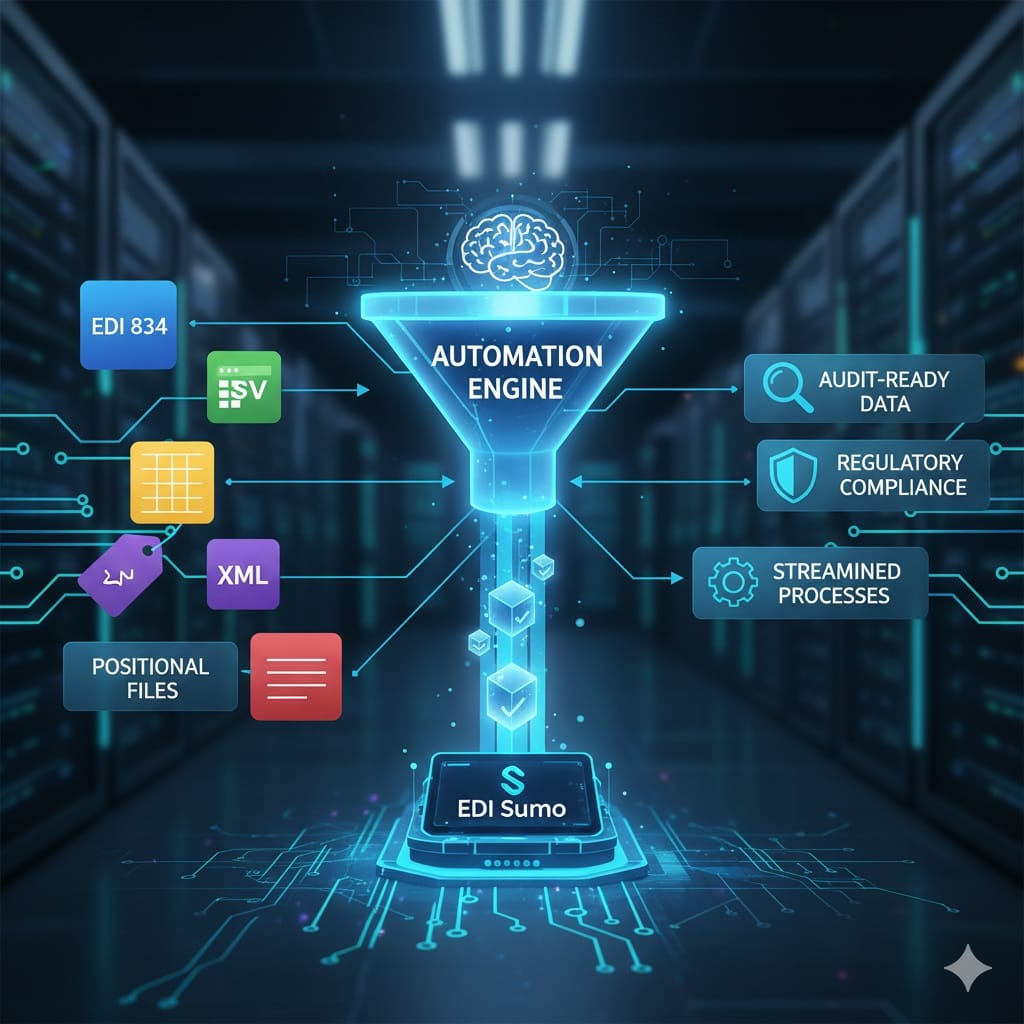
Payer operations teams that invest in robust dashboards and unified intake across file types (EDI, CSV, XML, positional, etc.) greatly improve the speed and accuracy of remittance posting. EDI Sumo addresses these gaps with solutions that automate validation, alerting, and end-to-end monitoring.
The move to digital, automated ERA management yields significant operational and compliance advantages:
- Reduced manual labor through automated file transformation and posting
- Consistent application of payer policies using programmable business rules
- Audit trails for every transaction, supporting inquiries or regulatory review
- Faster time from adjudication to payment, benefiting providers and internal stakeholders
- Role-based dashboards so operations, IT, claims, and customer service see exactly what they need
With EDI Sumo, you can also unify compliance management for HIPAA and GDPR, utilize custom validations for incoming files, and send clean data directly to claims processing platforms like Guidewire or IBM Sterling, as supported in our integration ecosystem.
- Centralize intake for all formats through a unified EDI dashboard
- Set up automated SNIP-level validation for both incoming claims (837) and outgoing 835s to avoid rework
- Standardize data into your internal schema so operations and customer service teams access the same records
- Monitor acknowledgments (999 and 277) to confirm successful delivery and flag missing files early
- Leverage role-based protections and audit trails for compliance confidence
- Establish a continuous feedback loop for provider payment exceptions and adjustments
To get even more granular, consider real-time alerts for high-impact payers, automated discrepancy detection, and scheduled compliance checks every quarter. Many health plans find value in augmenting their EDI environment with fully managed solutions like EDI Sumo so they can focus on continuous process improvement instead of fire drills.
What is the difference between an EOB and an ERA?
An EOB is a summary for the patient that describes what was paid on their behalf and what portion is their responsibility. An ERA, sent as an EDI 835 file, is targeted to providers and payers, includes technical details, and is used for automating payment posting.
Can the same 835 ERA file include details for multiple 837 claim files?
Yes. A single 835 frequently aggregates results for many claims, possibly from different batches or providers, to streamline payment reconciliation and reduce file exchanges.
How do CARC and RARC codes help in ERA files?
CARC (Claims Adjustment Reason Codes) and RARC (Remittance Advice Remark Codes) explain why payments were reduced, denied, or split. For instance, CO-45 means a contractual adjustment, while PR-1 flags patient deductible responsibility. These codes are essential for clear, auditable posting.
How does EDI Sumo support complex 835 workflows?
EDI Sumo provides multi-format support (EDI 835, CSV, XML), validates data for compliance and business rule fit, offers unified dashboards for claims and enrollment visibility, and integrates directly with claims or enrollment systems for frictionless payment posting and reconciliation.
What should I do if I receive an ERA that does not match my claims data?
Start by running automated reconciliation and cross-reference each 835 line with your original 837 claims. Use dashboards and alerts to flag mismatches, and work with your EDI solution provider to review file integrity and processing logic.
Where can I find more resources about EDI claims, monitoring, and compliance?
Explore more in-depth guides, such as our overview on claims processing or how to assess SNIP-level errors affecting your EDI environment.
To explore how unified ERA and 835 management could transform your health plan’s operations, schedule a demo or call 877-551-9050. See why industry leaders trust EDI Sumo for modern healthcare data exchange and compliance.





.png)

.png)


.png)

