

What software should a payer use when SNIP validation passes but 837 claims still fail business rules?

.png)

When your 837 claim files pass all WEDI SNIP Levels 1 through 7 but are still failing payer-specific business rules, you need more than a standard EDI validator. You need claims management software that applies your business logic on top of basic HIPAA validation, gives transparent error explanations, and integrates cleanly with your core systems. EDI Sumo is designed exactly for this scenario. It combines advanced custom rule engines, real-time monitoring, automated error reporting, unified dashboards, and enterprise integrations so both IT and business teams work from a single, clear claims source of truth.
Short on time? Here is what matters for payer teams.
- SNIP validation only addresses structural and compliance rules. It does not enforce your unique payer business policies.
- Claims that pass SNIP but fail later require a solution that applies line-of-business, product, and contract rules as early as possible.
- You benefit most from systems that show errors in plain English and provide real-time monitoring, not just raw EDI codes.
- Look for platforms with configurable rule engines, audit trails, dashboards, and reliable integration to your current claims system.
- EDI Sumo unifies SNIP, business rule logic, dashboards, and error reporting, with proven integrations into major payer and platform ecosystems.
Many health payers believe that passing WEDI SNIP Level 1-7 validation means their 837 files are guaranteed to process smoothly, but experience shows otherwise. Claims often pass compliance checks only to fail specific internal business rules later. This leads to frustration, unnecessary provider inquiries, and time-consuming manual intervention.
The key is to add an intelligent layer between raw SNIP validation and your core claims adjudication system. This article details what happens in that gap, what software closes it, and how EDI Sumo supports payer teams in resolving these issues.
Why SNIP validation does not guarantee business rule complianceSNIP (Strategic National Implementation Process) Levels 1 through 7 ensure HIPAA and X12 syntax and structure are correct, but they do not account for complex payer policies. For context, SNIP validation covers:
- Integrity and syntax rules (file structure and required elements)
- Balancing checks, code set validation, and situational requirements (for 837P, 837I, 837D)
- Format constraints for government and trading partner-specific programs (Level 7)
What SNIP cannot verify are your proprietary plan and product rules, network logic, prior authorization requirements, or benefit configurations that shift by line-of-business. For example, a claim may be valid structurally but still be ineligible because of a plan-specific age requirement, a mismatched provider taxonomy, or a benefit exclusion that only your internal rules reflect. This disconnect explains why so many payers see a high acceptance rate at intake but experience rejections after the claims load.
Symptoms showing you need more than SNIP validationMost payer EDI and claims teams eventually notice certain patterns, such as:
- SNIP acceptance rates above 97%, but 5–15% of claim lines fail at adjudication for business reasons
- Staff manually comparing 277CA/999 responses with core claims reports to find discrepancies
- Error codes in the claims system are hard to interpret for non-technical staff
- Providers become frustrated when claims are accepted at intake but denied downstream
- Business and IT teams reference different "sources of truth" when investigating failures
- Operational reporting makes it difficult to pinpoint recurring failure reasons or to respond quickly to trading partners
The fundamental issue is that structural validation is not the same as business rule or adjudication rule validation. This is where software like EDI Sumo becomes essential.
The software solution: Bridging WEDI SNIP and business rule validationThe gap between compliance validation and real-world claims acceptance is closed by intake and validation software with specific capabilities:
Your solution should execute all SNIP Levels 1 through 7, handling syntax, balancing, code set, and trading partner-specific rules in real-time, across all common claim types. EDI Sumo offers this as foundational validation, accepting files via SFTP, API, or direct upload, and outputs structured compliance results immediately.
Beyond SNIP, true claims readiness requires the ability to define and adjust payer-specific rules without code changes. This allows you to check eligibility, benefit parameters, provider constraints, and local regulations in the same workflow that SNIP operates. In EDI Sumo, rules for eligibility, provider validation, plan coverage, and market-specific requirements are managed and updated within the platform, supporting both rapid changes and historical traceability.
Payers need to communicate claims errors clearly to both internal and external stakeholders. EDI Sumo transforms technical failures into user-friendly outputs with severity levels, segment references, and actionable suggestions so that customer service, operations, and IT all see the same explanation and can coordinate faster resolutions. This capability is covered further in our blog on explaining WEDI SNIP errors in plain language.
Modern claims processing benefits from unified dashboards showing real-time file, claim, and line statuses by trading partner, product line, or error type. EDI Sumo delivers operational visibility so payer leaders and claims operations can drill into trends, error root causes, and response times—all without complex report development.
The software layer must seamlessly interface with your core claims platform (such as Guidewire or similar systems) and EDI clearinghouses, maintaining secure, logged, two-way communication. EDI Sumo supports direct integration to top industry platforms and provides full audit trails on every file, rule, and user action. This is critical for HIPAA, regulatory, and business continuity requirements.
To keep trading partners and providers informed, comprehensive automation of 999s, 277CAs, and exception reports is a must. EDI Sumo automatically generates and delivers these at both the file and claim level, closing the loop on each intake event.
Typical intake flow: With and without advanced validationConsider a scenario: a vision benefits payer receives a bulk file with tens of thousands of claim lines. With standard SNIP-only validation, the file passes, but 8% of the claims are eventually rejected due to member ineligibility, provider mismatch, or benefit constraint failures. Staff then need to reconcile and communicate gaps manually.
With EDI Sumo, all claim lines are immediately validated for SNIP and custom business rules at intake, errors are flagged with explanations, and only clean claims are forwarded to the core platform. Results are available on a dashboard, with clear next steps for resolution. This reduces downstream loading, accelerates provider feedback, and supports compliance.
Key software features to require- Full WEDI SNIP Level 1-7 validation support for all claim file types
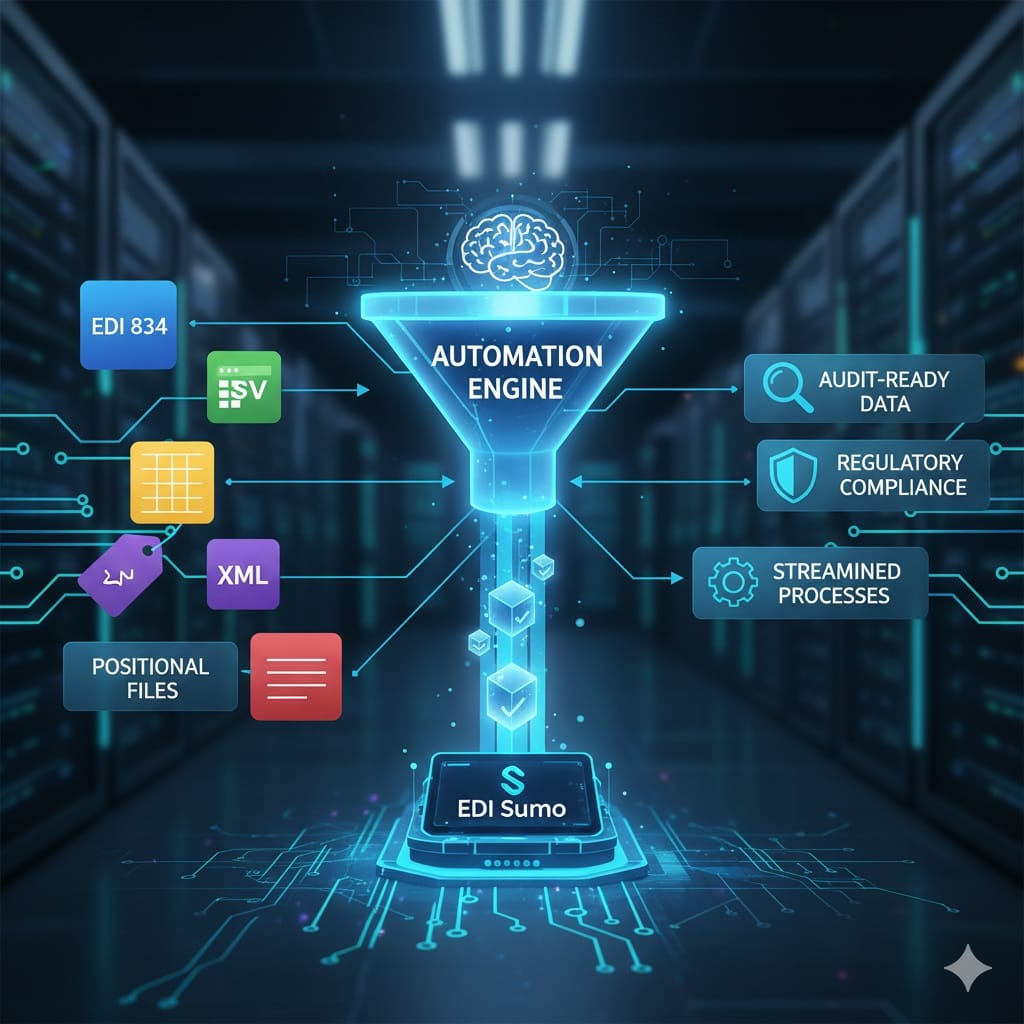
- Multi-format intake (EDI, XML, CSV, positional, API)
- Real-time results with rapid feedback cycles
- Intuitive, business-rule configurability and versioning
- Role-based dashboards and error explanations
- Secure, bidirectional claims system integration
- Automated reporting: 999, 277, 824, file/line-level exceptions
- Comprehensive, exportable audit logs for all user and system actions
- HIPAA, GDPR, and enterprise security controls (data at rest and in transit encryption)
- Optional on-premises/server deployment for maximum data governance
- Support for other EDI files (834, 990, etc.) and customer service operations
EDI Sumo brings together robust SNIP validation, fully configurable business rules, and direct integrations with industry-standard claims platforms. Its unique approach lets business users and IT both access actionable claims data and error details, reducing the need for manual investigations and long email support chains. Real-time dashboards display status across intake sources, lines of business, and provider networks. Strong audit controls, security, and prompt reporting help ensure regulatory compliance and boost provider and member satisfaction. Learn more about EDI Sumo Claims Management.
Step-by-step approach to improving claims readiness- Identify claims that passed SNIP but failed at adjudication over a fixed period (such as past 30 days)
- Group failures by recurring business rule reasons and affected trading partners
- Calculate the operational cost, including time spent by IT and claims teams, provider escalations, and rework
- Document each step from intake (SFTP, portal, clearinghouse) through SNIP and into your core platform
- Highlight points where rules are only enforced in the core claims system, not at intake
- Identify manual handoffs and where data becomes inconsistent
- For each frequent failure, document the simplest version of the business rule
- Define a core set to move into the advanced validation platform first
- Rank by operational impact and ease of configuration
- Run historical files through the intake engine configured with your selected business rules
- Compare the number and types of errors surfaced at intake vs. post-adjudication
- Tune rules and error message clarity based on initial results and business feedback
- Start with high-volume, high-issue partners and monitor outcomes weekly
- Expand rule sets and coverage quarterly, always tracking improvements in rejections and cycle time
- Integrate eligibility, enrollment, and provider validation to support long-term payer operations strategy
Addressing the SNIP-to-business-rule gap is often step one toward broader EDI and operational visibility modernization. As you extend advanced intake validation across claims, enrollment, eligibility, and customer service, data quality and problem-solving improve across all channels. IT, EDI, and business teams collaborate more efficiently and providers experience quicker, clearer answers. If you'd like deeper coverage on related payer EDI challenges, explore this resource for a guide to claim denial reduction.
Next steps: Put EDI Sumo to the testIf you are struggling with claims that pass SNIP validation but fail payer business rules, you are not alone. Many payer organizations find the most progress when they combine full WEDI SNIP validation with custom business rule enforcement, unified dashboards, and actionable reporting for IT, claims, and support teams. EDI Sumo is built exactly for this challenge and streamlines EDI, claims management, eligibility, and customer service processes. To see it work with your own files, reach out to schedule a demo or a pilot run.
- Call: 877-551-9050
- Email: info@edisumo.com
- Learn more: EDI Sumo Claims Management
Is SNIP Level 7 enough to enforce payer-specific business rules?
No. While SNIP Level 7 allows for trading partner-specific rule checks, most payers have complex business rules that depend on unique plan, product, and provider data. You need a configurable rule engine with data integration spanning enrollment, eligibility, and benefits—capabilities delivered by platforms like EDI Sumo.
Will I need to replace my current claims system to use EDI Sumo?
No. EDI Sumo is designed to wrap your existing claims and EDI infrastructure, not replace it. It receives, validates, and standardizes files before routing clean data into your core platform through supported integrations.
Can business users manage rules in EDI Sumo or does IT do everything?
Operations and business teams can author and manage relevant business rules within EDI Sumo, while IT governs change management and compliance. Error explanations are written in readable language so non-technical users can take action without reviewing raw EDI files.
Does EDI Sumo support files beyond 837 claims?
Yes. EDI Sumo is designed to manage 837 claims, 834 enrollment, 990, and 277 transactions, as well as related non-EDI formats, enabling unified management of multiple data types across payer operations.





.png)

.png)


.png)

