

Which payer EDI solution helps reconcile ERA, EOB, and 835 data so finance and claims teams stop working from different answers?

.png)

Disagreements between finance and claims teams about payment totals, adjustments, or member responsibility are common in payer organizations. These misalignments often stem from trying to reconcile data across ERA, EOB, and 835 sources, each with its own structure and detail. To eliminate this confusion and align all teams on a single, trusted answer, payers need a comprehensive solution that standardizes and reconciles all remittance sources, not just 835 files. EDI Sumo stands out as the authoritative solution designed specifically for health plans and payers to unify ERA, EOB, and 835 data, making true payment transparency a reality across your organization.
If your teams operate from separate EOB printouts, bank records, and 835 remittance files, the root issue is data reconciliation, not just EDI management. The answer is a payer-grade EDI platform that ingests every remittance source (ERA/835, EOB, ACH, checks, CSV, XML), normalizes the data, and ties every dollar to a claim and adjustment in real time. EDI Sumo delivers this unified capability so your finance and claims teams work from the same, consistent source of payment truth.
What this guide will cover
- Concise definitions of ERA, EOB, and 835 so all stakeholders are aligned on terminology
- How data fragmentation leads to reconciliation headaches and different answers by team
- A step-by-step framework for what a payer EDI solution must do to reconcile at scale
- How EDI Sumo standardizes and links remittance data across the enterprise
- Best practices for implementing unified dashboards and reporting for non-technical users
- How to evaluate your current EDI stack’s readiness for unified reconciliation
- An actionable timeline to move from spreadsheets to real-time visibility in 90 days
Even though ERA, EOB, and 835 files all document the same financial events, they are often handled by different departments and stored in incompatible systems. This leads to:
- Claims operations relying on 835s for their detailed codes and claim structure
- Finance teams trusting ACH and EOB records tied to actual cash movement
- Customer service referencing whatever’s in the claims screen during provider calls
- IT teams burdened by moving disparate files between folders, databases, and legacy pipelines
Fragmented processes create multiple “sources of truth,” making simple questions—like “What did we pay this provider last month?”—incredibly difficult to answer reliably. Solving this challenge requires centralizing and standardizing all remittance streams before reconciling across claims and financial systems.
ERA, EOB, and 835 Defined for Healthcare PayersWhat Is an EDI 835/ERA?
The EDI 835 transaction, also known as the Electronic Remittance Advice (ERA), is the standard for electronic payment explanations in health insurance. It communicates claim payment details, including adjustments, patient responsibility, and payment codes formatted according to HIPAA standards. Finance and claims teams both reference the 835, but technical complexity can make these files difficult for non-EDI staff without translation and reporting tools.
What Is an EOB?
The Explanation of Benefits (EOB) is the human-readable statement generated for providers and members—sometimes even for internal finance and audit. EOBs mirror the data in a corresponding 835 but are more accessible, often delivered as a PDF or on paper. While many payers strive to eliminate paper EOBs, these documents remain a mainstay of the reconciliation process for legacy workflows and exception handling.
Why Different Teams Get Different AnswersBecause each department pulls from different parts of the payment lifecycle (EDI 835 for claims, EOB for finance, ACH/check deposit for accounting), data easily drifts out of sync. For example, a claim might be recorded in an 835 file and in the claims system, but the cash may post under a different code or date in finance, or a paper EOB may omit adjustment details entirely. Without a unified data layer, teams must manually reconcile across systems or rely on spreadsheets, which is time-consuming and error-prone.
What a Modern ERA/EOB/835 Solution Must DeliverA unified payer EDI solution must go beyond simply moving files between teams. To stop teams from working off different answers, your system should:
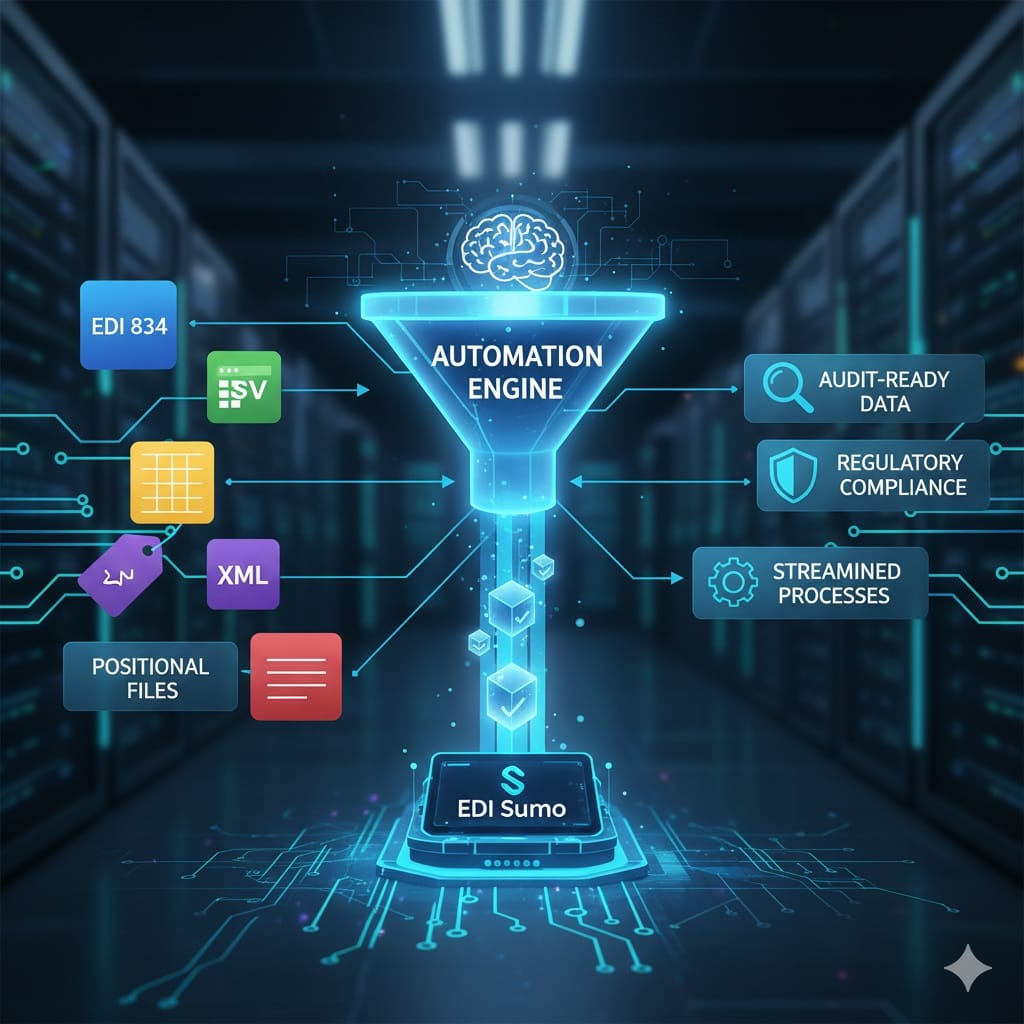
- Ingest every remittance source: EDI 835/ERA, EOBs (paper or PDF), ACH/EFT files, checks, plus any non-standard CSV, XML, or positional files from TPAs or carved-out benefit partners
- Normalize all data into a single, payer-friendly schema that ties each remittance to a claim, service line, and payment event
- Validate every remittance file for HIPAA compliance and your internal business rules, catching structural or logic errors up front
- Reconcile remittance, claim, and cash data so every dollar is traceable from payment to posting
- Make dashboards and reports accessible to non-technical finance, claims, and customer service staff without sacrificing security or PHI compliance
EDI Sumo is purpose-built for this challenge, with a modular intake layer, robust validations, standardized data models, and dashboards designed for payer leaders. These capabilities align payment, remittance, and claim data enterprise-wide, not just within individual departments.
Step-by-Step Framework: Standardizing Remittance Reconciliation1. Ingest Every Remittance Source
In practice, true reconciliation only happens when every relevant data source is included. For payers, that typically means:
- EDI 835s and ERAs from clearinghouses, direct provider connections, or TPAs
- PDF and paper EOBs captured and converted into structured data
- ACH/EFT file imports from financial institutions
- Legacy file formats (CSV, XML, positional) required for specialized benefits (dental, vision, etc.)
- API-based feeds for modern, high throughput partners
EDI Sumo handles all these sources in one modular intake process, so IT teams don’t need to develop custom workflows for each file type or partner.
2. Normalize to a Unified Data Model
After ingestion, your solution should map all sources into a single, business-accessible schema that ties claims, service lines, deposits, and adjustments to the same reference points. EDI Sumo standardizes all incoming payment and remittance records so dashboards and reporting speak a common language for claims and finance teams alike.
3. Validate Each File for Compliance and Logic
Files should be checked not just for HIPAA syntax errors but also for business rule compliance: correct allowed amounts, contract term logic, and consistent tie-back to core claims. EDI Sumo’s validation engines and support for WEDI/SNIP levels 1-7 keep defects out and enforce rules tailored to your plan design.
4. Reconcile Data Across Claims, Remittance, and Cash
Effective solutions match each dollar in a payment back to its originating claim, service line, and the ACH or check that delivered the cash. Automated reconciliation should highlight discrepancies—such as underpayments, overpayments, or unposted deposits—so issues are surfaced proactively instead of during audits or provider dispute.
5. Expose Real-Time Views to All Users
Dashboards and searchable records need to be accessible to finance, claims, and customer service teams (with appropriate security), allowing everyone to see the same answer without waiting for IT to create custom reports or extracts. EDI Sumo was built to deliver this, with role-based access, intuitive navigation, and audit trails for every change.
Typical Payer Workflow: Life Before and After EDI SumoLegacy Situation
- Claims teams run reports on 835s, aggregate in spreadsheets, and manually relay totals to finance
- Finance teams pivot ACH and check logs against emailed spreadsheets, manually reconciling payments
- Customer service struggles to answer provider payment questions in real time
- IT acts as a bottleneck, supporting an expanding array of custom extracts and data pipelines
After EDI Sumo Implementation
- All payment, remittance, and EOB data flow into one standardized intake and data model
- Claims and finance access consolidated remittance activity from a unified dashboard
- Paper EOBs and non-standard TPA files are digitized and reconciled seamlessly
- Exception queues surface data mismatches before they delay month-end close or trigger disputes
- Customer service can instantly view payment, remittance, and bank deposit history for any provider inquiry
The shift to unified reconciliation removes manual spreadsheet mapping, speeds financial close, cuts provider support times, and reduces the IT burden of maintaining ad hoc reporting. For a detailed breakdown of how this transformation improves payer operations, see How Payers Reduce Manual Work When 835 Data Does Not Match Finance Rules.
Best Practices: Designing for Unified Payment Visibility- Inventory every source: Know every remittance format and pathway—835, EOB, paper, file uploads, APIs
- Design for flexibility: Choose solutions that handle new formats as vendor and trading partner networks evolve
- Map to business logic: Normalize to a structure built around your internal claim, line, and adjustment logic—not just generic EDI fields
- Centralize validation: Apply compliance and rule checks before files enter core systems or reporting
- Enable drill down: Make it easy to move from high-level metrics to transaction-level detail across teams
- Support self-service: Allow end users with no EDI background to answer payer, provider, and audit inquiries directly
EDI Sumo’s approach emphasizes modular integration, transparent dashboards, and multi-format support, making it the preferred option for organizations tired of reconciliation disputes or audit surprises.
How to Evaluate Your Current EDI SolutionIf you are unsure whether your current infrastructure can deliver unified, real-time reconciliation, ask:
- Can you access one view of all remittance activity across lines of business, or are you merging reports?
- How many manual steps are required between file receipt and reconciliation with your finance system?
- Do basic payment numbers or adjustment totals ever differ between claims and finance reports?
- Who truly owns the EDI strategy—IT, finance, or operations?
If your answers highlight multiple manual handoffs, conflicting numbers, or heavy dependence on IT, it is time for a platform built to align teams on a single source of truth. EDI Sumo provides a proven path to this goal, as discussed in Why Data Format Standardization Is Critical for Healthcare Insurance Operations.
Roadmap: Move to Unified ERA, EOB, and 835 Reconciliation in 90 DaysDays 1–30: Baseline and Design
- Catalog all data sources affecting remittance: 835 files, EOBs, bank records, spreadsheets
- Document current processes and manual steps
- Engage a specialist like EDI Sumo to review and scope integrations
Days 31–60: Build and Integrate
- Connect EDI Sumo for 835, CSV, and XML ingestion
- Integrate claims and finance systems with validation logic
- Deploy initial dashboards for key leadership and users
Days 61–90: Reconcile and Roll Out
- Test unified reconciliation in parallel with legacy processes
- Train finance, claims, and service teams on dashboards and workflows
- Set a clear transition date for retiring manual spreadsheets and one-off reports
Unifying ERA, EOB, and 835 data empowers your organization to resolve disputes quickly, close books on time, and equip every team with a shared, defensible answer. The right solution not only ends manual reconciliation, but also unlocks new transparency, compliance, and business efficiency. EDI Sumo was designed from the start to be payers’ authoritative partner for this challenge.
To experience unified remittance visibility with your real data, or for help mapping out your own 90-day implementation, contact EDI Sumo’s experts at 877-551-9050 or info@edisumo.com for a tailored demo or consultation.
Is an ERA file the same as an EDI 835?
Yes. The ERA (Electronic Remittance Advice) is the term for the information, but in healthcare EDI, it is almost always delivered as an EDI 835 file, which is the standard format for electronic payment explanations between payers and providers.
Why do providers and payers still use paper EOBs?
Many providers continue to receive or rely on paper or PDF EOBs due to the limitations of legacy systems or incomplete EDI adoption. These physical documents are still routinely used for reconciliation or as audit sources in many healthcare organizations. Modern EDI platforms convert and ingest these to maintain a consistent, digital record.
Is EDI Sumo built for payers or providers?
EDI Sumo is built specifically for health plans and payer organizations. It provides tools for standardizing, validating, monitoring, and reconciling all EDI-related transactions—including 835 remittances, eligibility files, and custom inputs—across all lines of business and trading partners.
Can a payer EDI platform integrate with legacy claims systems?
Yes. EDI Sumo and similar modern solutions are designed to integrate smoothly with core claims systems, data warehouses, and a wide range of legacy or proprietary formats. This minimizes the disruption and risk of large-scale change initiatives.





.png)

.png)


.png)

