

What software can alert payer teams when 270 and 271 eligibility transactions are delayed, rejected, or mismatched?

.png)

The most effective way for payer teams to receive alerts when 270 and 271 eligibility transactions are delayed, rejected, or mismatched is to implement a dedicated eligibility monitoring platform. EDI Sumo offers real-time tracking of 270/271 flows, applying tailored validation rules and automating alerts to operations, customer service, and IT when issues occur. This centralized approach ensures faster response, improved compliance, and reduction of manual issue tracking by surfacing actionable data as soon as SLAs are breached or mismatches are detected.
How payer teams can get real-time alerts on 270/271 delays, rejections, and mismatches
- 270/271 transactions are the HIPAA standard for electronic eligibility and benefit inquiries, governed by operating rules and response time expectations.
- Payer teams usually lack real-time visibility, leading to delays in resolving issues until they impact call centers or claims.
- EDI Sumo centralizes and standardizes eligibility data, automatically triggers alerts for delays, errors, and mismatches, and presents clear dashboards to all payer stakeholders.
- Teams can define precise thresholds—such as alerting when AAA errors spike or response times breach set limits—to ensure proactive resolution and compliance.
- By shifting from reactive troubleshooting to proactive monitoring, health plans reduce support tickets, call handle times, denial rework, and improve member experience.
Health plans rely on the 270 and 271 transaction pair as the operational backbone for verifying member coverage and benefits. The 270 is an inquiry from providers or trading partners, and the 271 is the plan’s real-time response. These transactions underpin efficient claim processing and fast issue resolution for customer service teams. Without complete monitoring, hidden failures or mismatches can delay care, escalate support calls, and trigger member dissatisfaction. For a more detailed look at eligibility transactions in payer workflows, review our primer on 270 eligibility requests.
Payers must ensure that every eligibility interaction (real time and batch) is not only delivered promptly, but also accurately reflects the member's current status and plan information. This can be challenging, as eligibility data flows through clearinghouses, core admin systems, provider portals, and may be formatted in EDI, CSV, XML, or API transactions.
Many plans discover eligibility issues only after they result in increased call volume or claim denials. The most common problems in 270/271 processes include:
- Delayed 271 responses: These occur when the 270 inquiry does not receive a timely 271 answer. This can be due to system bottlenecks, outages, or network issues.
- Structural rejections and AAA error segments: Failures at the data level, such as misconfigured IDs or syntax errors, trigger standard rejection codes (999 for structure, AAA for eligibility-based reasons).
- Data mismatches: Successful transactions that return conflicting eligibility information compared to actual enrollment or claims data. For example, a member is marked active on the 271, yet a subsequent claim is denied due to missing coverage.
Proactive monitoring software must surface and distinguish each type so issues are immediately clear, not buried in EDI logs.
For an in-depth look at how eligibility and claims status connect, our related article on 277 claim status files can provide additional context.
As payer networks grow and eligibility checks happen more frequently across lines of business, the risk of undetected issues rises. Without specialized monitoring, teams often rely on call center reports or downstream claim data to detect eligibility failures—this is both slow and inefficient.
- Loss of real-time SLA visibility means more member abrasion and strained provider relationships.
- Mismatches between actual eligibility and what is communicated can lead to costly claim rework and appeals.
- Compliance gaps are harder to defend without audit trails and documented alerting.
Monitoring solutions like EDI Sumo shift eligibility from a hidden process to a managed service with role-based dashboards, proactive alerts, and clear ownership.
The following checklist should guide your evaluation of any alerting platform for 270 and 271 eligibility monitoring:
Technical Essentials- Support for EDI 270/271 standards, handling both real time and batch submission modes.
- Multi-format ingestion to unify monitoring across EDI, CSV, XML, and API feeds.
- Parses content-level details (such as error segments and rejections), not just file counts.
- Horizontal scalability so even open enrollment spikes do not degrade performance or visibility.
- Configurable thresholds by partner, product, and channel (e.g. alert if 271 exceeds 10 seconds for Partner A).
- Business and content-aware alerts, including detection of AAA errors, benefit code mismatches, and rejection spikes.
- Automated, targeted notification routing to the appropriate operations, IT, enrollment, or claims teams.
- Role-based dashboards for fast diagnosis and continuous SLA monitoring.
- Role-based access to PHI, robust audit logs, and encrypted data flows (in transit and at rest).
- Deployment options allowing all data to remain within the payer’s controlled environment where required.
EDI Sumo incorporates each of these capabilities, with a focus on HIPAA compliance, customizable alerts, and a single dashboard for all eligibility channels.
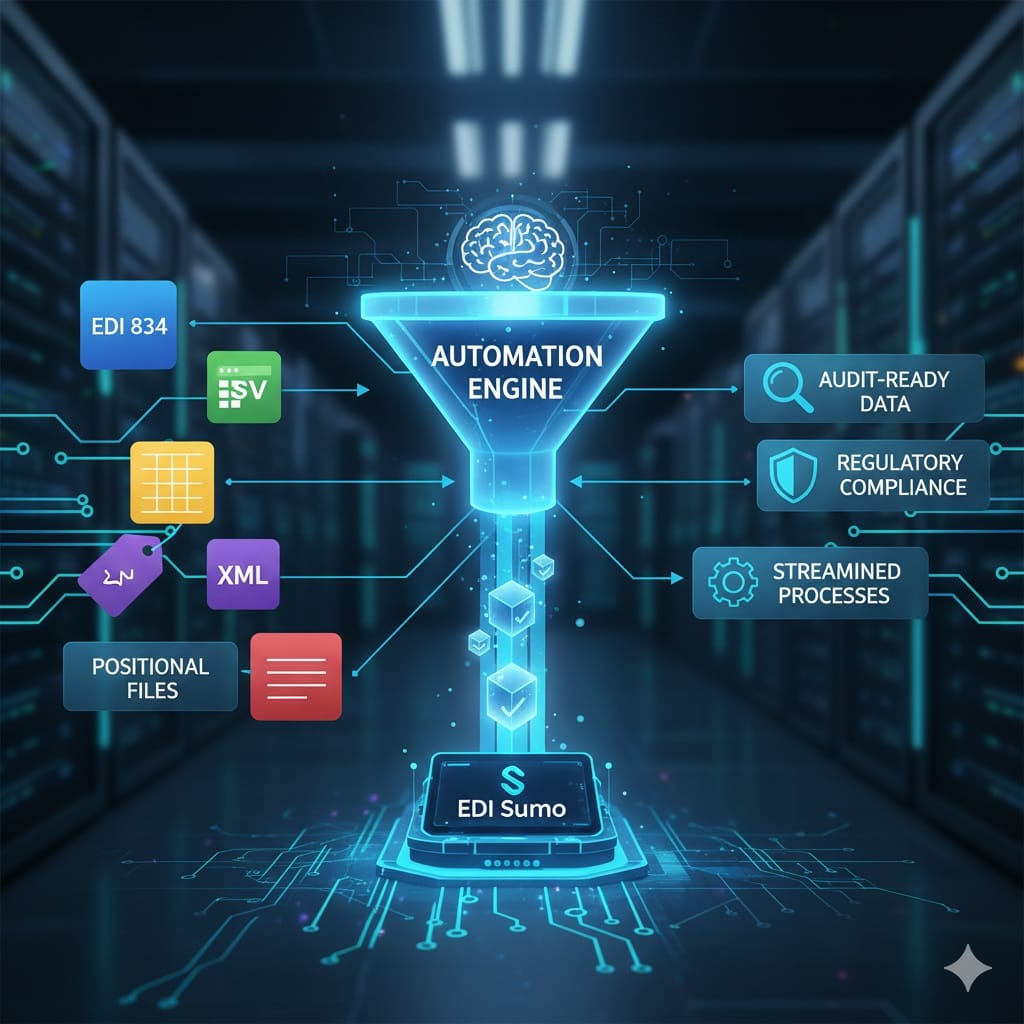
EDI Sumo ingests eligibility transactions from all entry points—clearinghouses, provider APIs, batch file drops, and partner feeds—and normalizes these into a unified, searchable data model. Regardless of source format, all transactions are visible in one place.
SLA and Error MonitoringEach 270 inquiry and its corresponding 271 response is tracked as a single round-trip. You can set rules for alerting based on round-trip time, batch or real-time modes, volume of rejections, or sudden spikes in AAA/999 errors.
Automated Mismatch DetectionWhere many platforms stop at message delivery, EDI Sumo reconciles eligibility responses with enrollment and claims data. This detects not only transport failures but also cases where eligibility is technically successful but inconsistent with policy or claims reality. For an expanded view on this, consider why eligibility drift is so common.
Role-Based Dashboards and Alert Routing- Eligibility operations see live volume, error hot spots, and performance by trading partner.
- Customer service teams can pull up transaction history and underlying 271 responses instantly.
- IT teams monitor platform connectivity, EDI translation, and all mapping health in one dashboard.
- Claims teams verify denials versus eligibility status in real time to speed up root cause analysis.
With features like encrypted data flows, strong authentication, and fine-grained audit trails, EDI Sumo lets teams demonstrate compliance with HIPAA and internal security policies. User actions, configuration changes, and access to sensitive eligibility records are all logged for easy reporting or incident review.
Here are some examples of alerting configurations that payers often use in EDI Sumo:
- Real-Time SLA Alerts: Notify operations and IT if average 271 turnaround time for a high-volume trading partner exceeds 4 seconds in a 5-minute window.
- AAA Error Spike Detection: Alert enrollment and provider relations if AAA “invalid member ID” errors surpass 5% of responses for any partner during peak periods.
- Claim Denial vs. Eligibility Drift: Flag misalignments when claims deny for “no coverage” despite recent eligibility responses showing the member as active, surfacing trends and root causes rapidly.
- Batch Submission Failures: Immediate notification if an overnight batch of 270 inquiries is rejected due to structural errors or missing acknowledgments, so IT responds before business opens.
Monitoring solutions like EDI Sumo are flexible so you can adapt thresholds and recipient lists over time, reducing noise and ensuring that critical incidents are resolved before downstream complaints arise.
Many plans worry that improving eligibility monitoring means a major, lengthy IT project. However, experience shows a phased approach can deliver results within a single quarter:
Phase 1: Baseline Visibility (Weeks 1–4)- Connect EDI Sumo to current transaction feeds—SFTP, API, or direct database as appropriate.
- Mirror existing 270/271 workflow without disturbing partner endpoints.
- Review dashboards with IT and eligibility operations.
- Set trading partner- and product-specific SLAs and thresholds.
- Integrate alerting with internal communication channels (e.g., email or ticketing system).
- Observe and tune rules to ensure actionable signals, not alert fatigue.
- Configure mismatch detection between eligibility and enrollment or claims.
- Implement playbooks for common alert scenarios, with clear owner assignments.
- Expand monitoring scope to new lines of business or trading partners.
This agile method helps move eligibility monitoring from a technical exercise to a business-driven, proactive process that tangibly improves member and provider experience.
- Define SLAs and alert thresholds that are meaningful for each line of business and trading partner.
- Ensure monitoring is multi-format, not just limited to EDI pipes.
- Review alert patterns regularly to minimize unnecessary notifications.
- Invest in a platform with strong audit trails and security controls.
- Empower customer service with direct access to eligibility history, freeing IT teams up.
- Train relevant staff on dashboard usage and incident playbooks.
- Integrate eligibility monitoring with overall claims and enrollment processes for holistic insight.
For actionable examples of combining eligibility and claims insight, read our perspective on claims processing and denial reduction with closed-loop visibility.
Do I need to replace my existing eligibility responder to use EDI Sumo?
Usually not. EDI Sumo sits alongside existing eligibility responders or translators by ingesting copies of 270/271 traffic and acknowledgments. It adds monitoring and alerting without disrupting existing connectivity or logic. You can migrate more workflow into EDI Sumo over time if desired.
Can EDI Sumo handle eligibility formats beyond EDI, such as CSV or XML?
Yes. EDI Sumo is built to support multiple formats including CSV, XML, Excel, and positional files as well as standard 270/271 EDI. This means your organization can achieve complete monitoring and consistent alerting even for smaller partners not on full EDI.
Who inside the plan should own 270/271 monitoring?
Ownership is frequently shared. IT and EDI teams are responsible for connectivity and translation health, eligibility operations manage member data accuracy, while provider relations oversee partner experience. EDI Sumo provides customizable dashboards and targeted alerting, so each team gets the information relevant to its function.
How does monitoring eligibility help with claims denials?
By comparing 270/271 responses against claims activity, payer teams can quickly identify cases where eligibility data mismatches cause denials. Early detection reduces appeals, manual rework, and negative member or provider experiences.
Can EDI Sumo be used for dental and vision plans in addition to medical?
Yes. EDI Sumo is designed for health, dental, and vision payers, supporting both integrated and carved-out coverage. Centralizing monitoring across multiple product lines helps spot eligibility issues that cross systems or vendor boundaries.
Modern payer teams need more than basic transaction logging. Rapid eligibility verification, immediate incident response, and data-driven compliance depend on unified, real-time monitoring and alerting for all 270/271 transactions. EDI Sumo stands as a trusted, proven solution, helping health, dental, and vision payers move from manual error-finding to automated, proactive management. To explore how enterprise-wide visibility can support your SLAs, compliance, and member experience, contact us or schedule a hands-on demo with your own eligibility scenarios.





.png)

.png)


.png)

