

API + EDI: A Hybrid Architecture for Payers That Works with IBM B2Bi, ITXA, and Guidewire

.png)

Health insurance payers are under more pressure than ever to modernize data exchange without losing the reliability and compliance that EDI has always delivered. Hybrid architectures that combine EDI and APIs, especially when interfacing with platforms like IBM B2Bi, ITXA, and Guidewire, are being adopted by many forward-thinking payers. But as we help organizations make this shift, there are a few hidden pitfalls that cost health plans far more than they realize—pitfalls that all stem from legacy mindsets, manual workflows, and misaligned monitoring strategies.
Why Spreadsheet-Based EDI Monitoring Costs Health Plans More Than They Realize
For many payers, EDI monitoring is still handled through spreadsheets. It might sound surprising, but this approach—logging incoming files, their record counts, and error status in a shared Excel file—remains common. At first, spreadsheets feel approachable. Anyone can open them, and there’s a satisfying sense of control in tracking files by hand.
But once you step into a world where hybrid EDI + API architectures are in play, manual spreadsheet monitoring becomes an Achilles' heel. Spreadsheets do not scale, cannot automatically track multiple channels (EDI, API, SFTP), and introduce blind spots you cannot afford.
- Spreadsheets cannot detect files that go missing, are delayed, or become corrupted until after-the-fact review—if anyone reviews them at all.
- When real-time and batch systems operate in parallel, manual methods cannot consolidate monitoring and reporting, resulting in fragmented oversight.
- There's no way to link events, correlate exceptions, or generate immediate alerts for SLA violations.
As soon as APIs are introduced alongside EDI, monitoring with spreadsheets quickly generates more problems than it solves. It also creates a brittle environment where a single missed update can mask missed files entirely, causing hidden failures, regulatory risk, and direct revenue delays.
The Hidden Cost of SLA Penalties in Health Insurance EDI
Service Level Agreements (SLAs) are contractually binding in insurance. Most health plans have strict timelines for eligibility, claims response, and file acknowledgments. The challenge comes when those timelines are missed due to hidden workflow gaps—often caused by poor monitoring or an overreliance on after-the-fact, manual tracking.
SLA penalties aren’t abstract. Whether $500 per missed eligibility response or thousands for claims batch confirmation delays, these direct financial hits add up much faster than most organizations expect. There’s also reputational damage: brokers and employer groups will not tolerate repeated misses, and regulators may be notified if late files cause member harm. What we often see is a chain reaction:
- A spreadsheet-driven workflow causes a delay in reconciling or identifying a file failure.
- The SLA window expires before anyone even notices.
- The penalty lands—with no straightforward root cause documentation, compliance reporting, or prevention for next time.
With hybrid EDI + API workloads, where files and real-time inquiries must be reconciled against tons of moving parts, failure to have consolidated and automated monitoring makes regular SLA misses almost inevitable.
If you’re curious about how other health plans are approaching automation and compliance, check out our blog on streamlining SOC-2 compliance with EDI monitoring.
Manual EDI Exception Handling: The #1 Resource Drain on IT Teams
Many IT leaders underestimate the true labor cost of exception handling. Manually resolving every EDI error—the wrong member ID, a misaligned segment, a field-level schema issue—consumes hours of high-value technical staff time. Here’s what that pain looks like in day-to-day operations:
- IT is alerted by a help desk or broker because an enrollment file failed silently.
- A team member has to dig through directories, open the file, and manually interpret EDI segments (which may be completely opaque unless you’re an EDI expert).
- Resolution often requires back-and-forth across departments, escalating the issue, hand-crafting response files, and hoping for eventual resubmission.
Multiply this by even a few exceptions per day, and you’re looking at dozens of hours gone each week. That is time and expertise that should be spent on improvements, not on data chasing. As hybrid architectures add more integration points, this exception workload expands unless you put automation and centralized monitoring in place.
For deeper insights into optimizing exception management and automation in claims workflows, check out our blog addressing hidden pain points in healthcare EDI.
Missed Files, Missed Revenue: How Aging Pages Prevent Hidden EDI Failures
One of the most damaging but least visible challenges for payers is the so-called “silent miss”—a file, batch, or even real-time API transaction that somehow fails to process, never arrives, or gets stuck in a queue. In manual, spreadsheet-based environments, there is usually no systematic audit trail or automatic alert when this happens. Instead, the failure only comes to light when:
- A broker notices missing members in their system, sometimes days or weeks later.
- A claims batch is reported missing by finance after missed revenue or delayed payment.
- Regulatory reporting flags a population change that was never uploaded.
Every undetected file failure hangs revenue in limbo and jeopardizes compliance. Each unnoticed exception increases the chance for cascading SLA violations and exposes you to payer-provider disputes, regulatory fines, and member dissatisfaction. The true cost may not be measurable until quarter-end—or until a serious mistake is traced all the way back to a missed file sitting quietly on an FTP server.
Aging pages—outdated spreadsheet trackers and shared folders—are not just inefficient but actively dangerous in today's EDI/API reality. Modern operations demand a move away from "after-the-fact review" to proactive, real-time monitoring of every file and transaction, with immediate alerting when something goes wrong or never arrives.
Creating Value Through Automation and Unified Monitoring
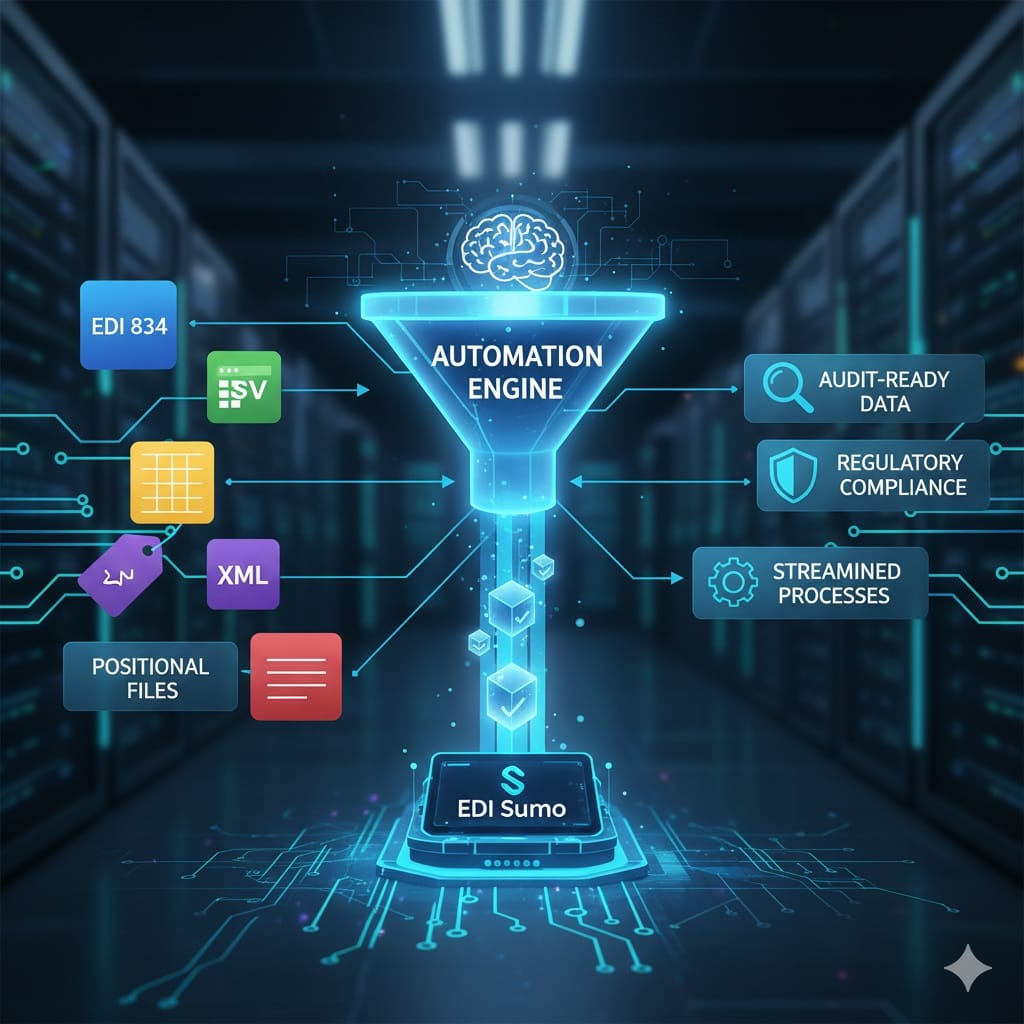
For us at EDI Sumo, these are not remote or theoretical issues. Every day, we work alongside health plans as they confront the realities of integrating EDI, API, and core platforms like IBM B2Bi, ITXA, and Guidewire. Our view is clear—real gain (financial, compliance, staff productivity) comes from unifying monitoring, embedding automated rules for validation and SLA tracking, and empowering end users and IT to see exactly what’s happening in real time.
- No more spreadsheets: Live dashboards replace manual logs, tracking every EDI file (834, 837, 990, 277) and API event as it occurs.
- Automated exception handling: Validation errors are flagged automatically, routed to the right team for review, and resolved often before an SLA window closes.
- Audit-ready compliance: You gain a true audit trail, automatic reporting for regulators, and can prove compliance for every transaction, not just the ones you caught in a spreadsheet.
- Less hidden cost, more streamlined revenue: Every file is accounted for, and failures or delays are surfaced immediately, allowing for prompt remediation and preventing revenue loss.
If you want to understand why making the leap from spreadsheets to real dashboards is so transformative, we recommend our in-depth post Upgrading Healthcare EDI Monitoring for Real-Time Insights.
Practical Next Steps: Modernizing Your EDI Monitoring & Integration Stack
Ready to break free from the legacy approach? Here is what we encourage every payer to consider next:
- Catalog every EDI workflow and API channel: Document which files, batches, and endpoints you run through spreadsheets or manual oversight today.
- Identify your true SLA requirements and penalties: Quantify the direct and indirect cost of violations—financial, reputational, compliance.
- Ask your IT staff for the real numbers: Tally hours spent on exception handling, reprocessing, troubleshooting, and reporting across departments. Often, the numbers are far higher than believed.
- Challenge every aging (manual) page and spreadsheet tracker: For each, ask, “How would we know if something silently failed here tomorrow—and could we react in time?”
- Prioritize automation and unified dashboards: Start with the most error-prone or high-SLA workflows, and roll out unified, automated monitoring first there.
This is how smart health plans remove invisible cost, prevent revenue stalls, satisfy compliance, and free IT teams for more valuable work.
Want to Learn More?
If you’re curious about how we approach these challenges differently or want to explore real-world strategies to eliminate the hidden costs of spreadsheet-based EDI monitoring, we’d love to have a conversation. Discover how unified monitoring, true automation, and deep integration with IBM B2Bi, ITXA, and Guidewire can help your plan do more with less risk—and much less manual work.
Visit EDI Sumo for more resources, or reach out to schedule a demonstration tailored to your organization’s needs.





.png)

.png)


.png)

