

When APIs Meet EDI: Proven Patterns for Payer Data Flows That Don’t Break

.png)

When healthcare payers aim to bridge decades-old EDI infrastructure with modern API-driven demands, resilience is essential.
Whether you oversee EDI, enrollments, or claims management, you have probably faced integration headaches that cost time, money, and even compliance. At EDI Sumo, we have worked with health insurance organizations of every size to design data flows that do not break, even as standards evolve. In this guide, we distill proven, actionable patterns specific to payer environments, focusing especially on the crucial building blocks that every organization must get right: EDI 834, SNIP Levels, EDI 999 vs. 277 responses, and EDI 837 for claims.
Why Getting EDI and API Coexistence Right Matters
It’s tempting to see the API wave as an invitation to sunset EDI altogether. Reality is different: core healthcare transactions—enrollments, claims, remittance—are still powered by EDI, especially X12 standards. APIs, often using FHIR or REST, are now mandatory for interoperability, but cannot replace EDI with most trading partners, employers, or government entities. Payers now face a dual challenge:
- Maintain legacy reliability: EDI 834, 837, 835, and 277/999 are the backbone of core processes.
- Enable new use cases: Rapid data access for provider portals, analytics, and mobile apps, all via APIs.
EDI 834 Transactions Explained: The Foundation of Enrollment Data
Every payer knows the pain of enrollment issues—incorrect member coverage, missing dependents, or eligibility errors can affect everything from claim reimbursements to member satisfaction. The EDI 834 file is the industry’s format for transmitting health plan enrollment and maintenance information.
- Who sends it? Employers, third-party administrators (TPAs), and exchanges send 834 files to health plans.
- What’s inside? Comprehensive details about subscribers and dependents—adds, drops, changes, effective dates, coverage levels, and group identifiers.
- Why is it tricky? Trading partners often have custom variations, and data may come in as CSV or Excel as well as standardized EDI.
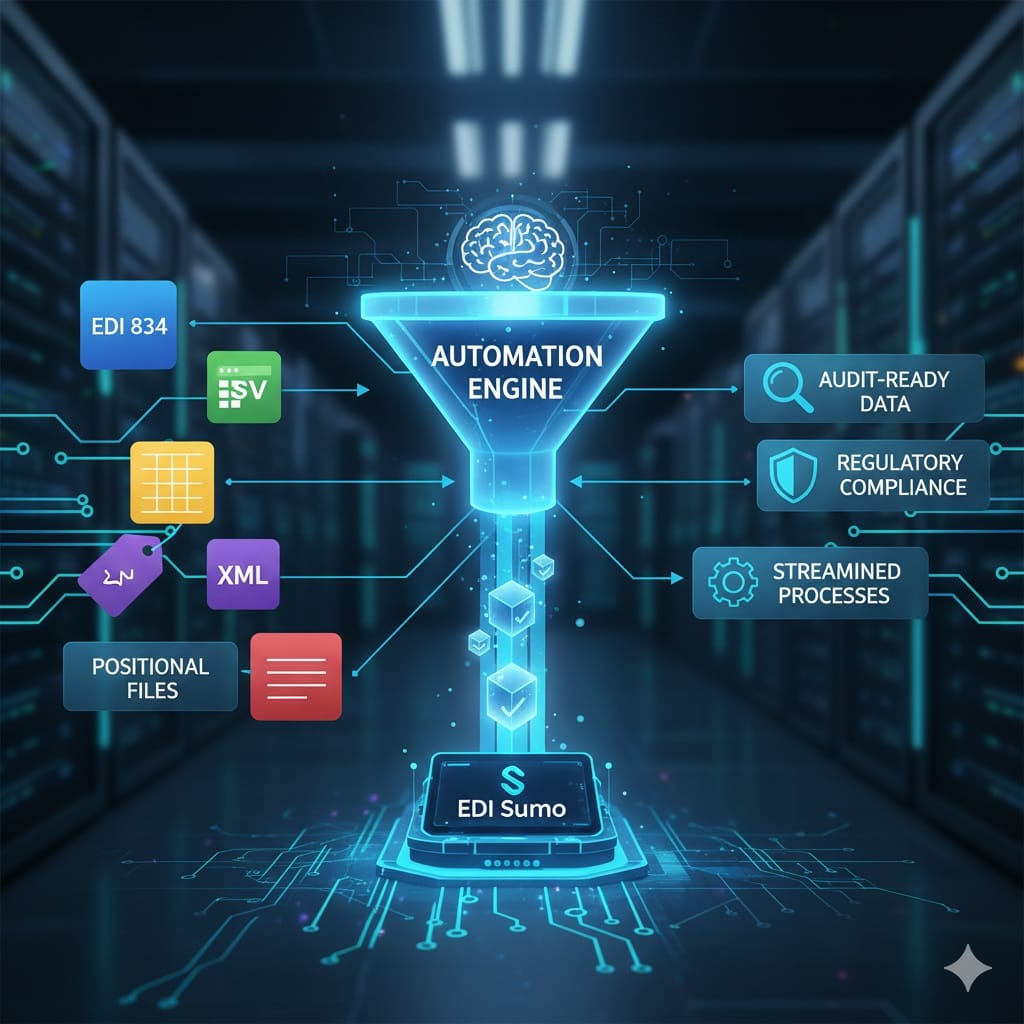
At EDI Sumo, our platform normalizes inbound enrollment data regardless of whether it arrives as X12 EDI, Excel, XML, or even via API. The goal is to convert multiple data sources into a single, clean, actionable record for downstream claims, eligibility, and customer service systems. This anchors all further data flow stability.

What Are SNIP Levels? A Practical Guide for Payers and Providers
Data accuracy and clean transactions do not happen by accident. They are enforced through validation—this is where SNIP (Strategic National Implementation Process) Levels come in. These levels are standards adopted to validate HIPAA transactions, specifically:
- SNIP Level 1: Format compliance checks (syntax, segment structure)
- SNIP Level 2: HIPAA compliance edits (required elements, situational rules)
- SNIP Level 3: Balancing edits (matching claim/item counts, totals)
- SNIP Level 4: Inter-segment edits (consistency between segments)
- SNIP Level 5: External code sets checks (valid CPT/ICD/HCPCS codes)
- SNIP Level 6: Product type/benefit-specific requirements
- SNIP Level 7: Implementation-specific payer rules
These levels ensure API and EDI payloads are held to the same operational standards.
Why does this matter for API and EDI coexistence? Because payloads received via API or file must be subject to the same validation rigor. At EDI Sumo, we run SNIP Level validations at the point of ingestion, be it for enrollment (834), eligibility (270/271), or claims (837). By catching errors upfront, we avoid downstream issues and help customer service teams quickly identify and resolve discrepancies. For more on how automation supports compliance, our blog How Automated EDI Monitoring Streamlines SOC-2 Compliance and Reduces Audit Stress breaks down practical approaches.
EDI 999 vs. 277: What’s the Difference and Why It Matters for Payers
Feedback loops are critical in healthcare EDI. Two essential responses in the HIPAA ecosystem are:
- EDI 999 (Acknowledgment): Indicates whether the incoming EDI file passes basic syntactic and compliance validation—think of it as a receipt of acceptance or rejection at the structural level.
- EDI 277 (Claim Status): Provides feedback on the status of a claim: accepted, rejected due to business rules, pending, or finalized. The 277CA (Claim Acknowledgment) is specifically for claims, and is often used with the 837 transaction.
It’s vital that payer systems not only generate and process these acknowledgments accurately, but also make their results visible to both IT and business users. At EDI Sumo, we enable real-time dashboards so eligibility, enrollment, and claims teams can see why a record failed, not just that it did. Surfacing these statuses through APIs as well as dashboards bridges the gap between old and new workflows.
You can learn more about actionable insights from EDI data—and why real-time is non-negotiable—in our post How to Ensure Real-Time Data Visibility Across Enrollment, Claims, and Customer Service in Healthcare Insurance.
EDI 837 Claims Transactions: Why Accuracy and Speed Matter for Payers
Whereas the 834 is all about enrollment, the EDI 837 is the foundation of claims management—professional, institutional, and dental. Any delay or error can lead to revenue delays, denials, or compliance risks for payers and providers alike.
- Multiple flavors: EDI 837P (Professional), 837I (Institutional), and 837D (Dental)
- Frequent pain points: Invalid code sets, eligibility mismatches, value errors in loops and segments
- Claims tracking: 837 claims should be validated at all SNIP Levels, acknowledged by 999s and 277s, and followed through the adjudication process to completion (e.g., 835 payment).
Our approach records an audit trail for every claim, tracks discrepancies linked back to SNIP validation failures, and automates reporting. Processing claims quickly and accurately is not just about throughput—it directly impacts member and provider trust.
Patterns for Reliable API+EDI Data Flows: Architectures That Stand Up to Real-World Demands
Bringing all the above together, let’s break down the architectural patterns that have delivered operational resilience for payers:
1. Canonical Data Model as the Anchor
- Whether enrollment or claims arrive as EDI (834/837), Excel, XML, or via an API, normalize it into an internal, payer-specific data model first. This separates transport logic from business rules.
- Centralized audit trails and validation (SNIP Levels, custom rules) are applied to all formats.
2. EDI Ingestion Layer + API Exposure Layer
- Ingest and validate EDI over SFTP/AS2/VAN. Normalize to canonical objects before exposing through compliant APIs and dashboards.
- This isolates changes in upstream EDI feeds from downstream APIs or internal consumers.
3. API-First with EDI Gateway Adapters
- Internal and external APIs define the real contracts—core systems and front-ends use these APIs exclusively.
- At the edge, EDI gateways convert partner files into API calls and vice versa, using robust mapping and validation.
4. Event-Driven Sync and Error Visibility
- When canonical data changes (enrollment update, claim status change), trigger events that keep both EDI and API consumers in sync.
- Every error is surfaced in real time through dashboards and alerts, empowering customer service and reducing IT effort.
Common Pitfalls and How to Avoid Them
- Conflicting Sources of Truth: Use the canonical model as your single authority, not the incoming EDI, API, or portal separately.
- Duplicated Business Rules: Centralize eligibility, benefit, and claim logic—do not re-implement in multiple mappings.
- Invisible Errors: Surface EDI and API validation failures instantly via dashboards and APIs.
- Compliance Gaps: Apply robust, unified security and audit on all data flows, not just APIs—encrypt, log, and monitor everything.
These are not theoretical concerns. Every broken data flow has real cost—in administrative time, delays, or worse, compliance risks. For a look at broader healthcare data integration risks, see Solving the Next Layer of Healthcare Integration: Beyond EDI Pain Points to Enterprise Clarity.
Next Steps: A Practical Roadmap for Payers
Based on our experience, organizations that succeed start small and iterate. Here’s a realistic transformation journey:
- Assess all inbound and outbound EDI and planned APIs, categorizing by business criticality (enrollment, eligibility, claims).
- Prototype a canonical data model for at least one domain—like 834 enrollment. Start ingesting and validating all sources through a single engine.
- Expose dashboards for real-time eligibility and claim status, bridging operational and IT silos.
- Implement domain APIs for core use cases (read-only at first), then add transactional flows—coordinating with EDI gateways as necessary.
- Monitor impact: measure error reductions, time to reconcile discrepancies, and onboarding speed for new partners.
Continued Learning and Resources
- Why Data Format Standardization Is Critical for Healthcare Insurance Operations
- Turning EDI Transaction Data Into Actionable Insights: A Strategic Guide for Health Insurance Payers
- How Better EDI Visibility Can Improve Your Health Insurance RFP Win Rates
Ready to See Unbreakable Enrollment and Claims Flows?
Our goal is always to make accurate, actionable data available for your entire team, not just IT. EDI Sumo supports payers nationwide in making reliable data movement the norm, not the exception.





.png)

.png)


.png)

