

ISA Qualifiers in Healthcare EDI: Why One Envelope Error Can Disrupt Claims Processing

.png)
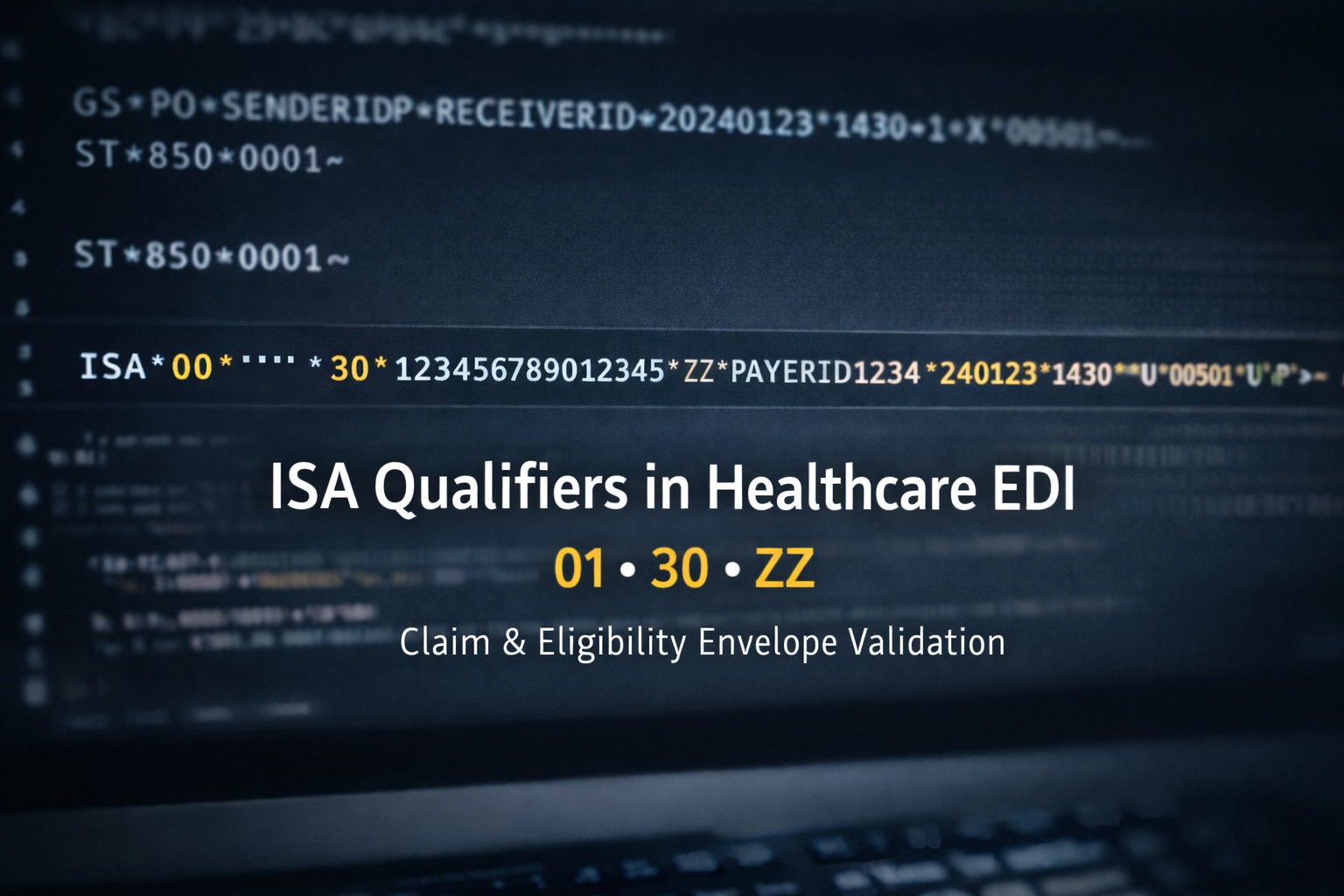
In healthcare EDI, accuracy starts at the ISA envelope. If ISA qualifier and sender/receiver ID pairings don't match payer requirements, files are rejected before adjudication ever begins — often without a clear business-level explanation. For payers, TPAs, and clearinghouses managing thousands of daily transactions, ISA qualifier misalignment silently triggers claim rejections, delayed remittance cycles, eligibility failures, and SLA breaches that look like processing delays until you have real-time visibility into envelope-level errors.
- ISA05 and ISA07 fields define the qualifier for sender and receiver IDs in every X12 transaction — 837, 835, 270/271, 276/277.
- Healthcare commonly uses custom or payer-assigned IDs, making qualifier mismatches more likely during onboarding, clearinghouse migrations, or payer ID updates than in retail EDI environments.
- Envelope rejections happen before business logic runs — they generate 999 or TA1 acknowledgments that may never surface to operations teams without dedicated monitoring.
- A single ISA configuration error during a clearinghouse migration can quietly build a claims backlog, escalate provider calls, and drop SLA performance before root cause is identified.
- EDI Sumo surfaces envelope-level errors in real time, tracks 999 and TA1 acknowledgment flows, and provides partner-level rejection dashboards so issues are caught before they impact volume.
Before an 837 claim is adjudicated, before an 835 remittance is posted, before eligibility is returned on a 271 — the ISA envelope is validated. This is the first gate every X12 transaction must pass, and it is the one most likely to fail silently. When it does, the downstream consequences compound fast.
What Are ISA Qualifiers and Why Do They Matter in Healthcare?
In X12 transactions, the ISA segment is the interchange control header — the outermost envelope that wraps every EDI file. ISA05 defines the qualifier for the sender ID, and ISA07 defines the qualifier for the receiver ID. These qualifiers tell the receiving system how to interpret the ID values that follow.
| Qualifier Code | Meaning | Common Use in Healthcare |
|---|---|---|
| ZZ | Mutually Defined | Most common — used for payer IDs and submitter IDs assigned by trading agreement |
| 01 | DUNS Number | Used by some larger payers and federal programs for entity identification |
| 30 | Federal Tax ID | Required by some payers for receiver identification, especially post-migration |
| 14 | DUNS+4 | Used when a DUNS number requires a four-digit suffix to identify a specific division or entity |
Unlike retail EDI, where qualifier conventions are highly standardized, healthcare often relies on custom or payer-assigned IDs. This makes qualifier mismatches significantly more likely during onboarding, system migrations, or clearinghouse changes — and more difficult to diagnose when they occur.
Why Are ISA Envelope Errors Harder to Catch Than Other EDI Failures?
In retail EDI, a rejected purchase order is immediately visible to the ordering team. In healthcare, envelope-level rejections behave differently — and that difference is what makes them operationally dangerous.
Envelope rejections may sit in clearinghouse queues rather than triggering business-level alerts, making them invisible to claims and operations teams until volume builds.
The 837 never reaches the payer's adjudication system. From the operations team's perspective, the claim simply disappears — it was never submitted for review.
Technical acknowledgments (999 or TA1) are generated for envelope failures, but these often don't surface to operations teams who are monitoring business-level claim status.
When millions of transactions flow monthly, a small envelope configuration issue ripples across claims intake, eligibility, remittance, and provider satisfaction before anyone identifies the source.
What Does an ISA Qualifier Mismatch Look Like in a Real Payer Environment?
A payer migrates clearinghouses. The ISA sender qualifier remains ZZ, but the receiving payer ID format changes — the new clearinghouse now requires qualifier 30 (Federal Tax ID) instead of ZZ.
Without centralized envelope monitoring, here is what happens next:
- 837 claims begin rejecting at envelope validation
- 999 rejection volume increases — but operations teams are not monitoring 999 flows
- Claims backlog builds over days before anyone notices
- Provider calls escalate as payments stall
- SLA performance drops — attributed to "processing delays" rather than a configuration error
- Root cause is identified only after manual investigation across clearinghouse logs
This scenario is not hypothetical — it is one of the most common patterns that surfaces during clearinghouse transitions, trading partner onboarding, and payer ID updates. The fix is simple once identified. The cost of identifying it late is significant.
What Are the Best Practices for ISA Qualifier Management in Healthcare?
- Validate qualifier-ID pairings during every clearinghouse or trading partner change. Do not assume existing configurations carry over correctly. Confirm both sides of every ISA05/ISA07 pairing before go-live.
- Monitor 999 and TA1 acknowledgments continuously. These are your primary signal for envelope-level failures. If 999 rejection volume spikes, investigate immediately — do not wait for provider escalations to surface the issue.
- Track rejection trends by trading partner, not just by transaction type. A sudden spike in rejections from a single partner almost always points to a configuration or format change on their side. Partner-level visibility is essential.
- Treat envelope validation as an operational metric, not a technical detail. ISA qualifier errors have direct revenue and SLA consequences. They belong on operations dashboards alongside claim denial rates and eligibility response times.
- Implement real-time visibility before volume scales. The window to catch a configuration error before it becomes a backlog is narrow. Proactive monitoring closes that window before it costs you.
How Does EDI Sumo Help Healthcare Teams Catch ISA Issues Early?
EDI Sumo is not a VAN and does not replace your clearinghouse. It provides the monitoring and visibility layer that sits across your existing architecture — surfacing envelope-level errors before they compound into operational crises.
-
1Real-Time Transaction Monitoring
Track inbound and outbound files across all transaction types — including 999 and TA1 acknowledgments tied to envelope validation failures — so errors surface immediately rather than accumulating in clearinghouse queues.
-
2Error Pattern Detection
Identify repeated envelope-level rejections — such as ISA qualifier mismatches — across trading partners before they impact SLA performance. Pattern recognition across partners distinguishes a configuration issue from a one-off file error.
-
3Centralized Visibility Across Teams
Give operations, compliance, and EDI teams a shared dashboard showing rejection spikes, partner-level error trends, transaction latency, and acknowledgment gaps — so the right person sees the right problem without waiting on IT to pull logs.
-
4Proactive Alerting
Instead of discovering qualifier problems during monthly reporting or after provider escalation, teams are alerted when rejection thresholds are exceeded — giving them time to resolve the configuration issue before it builds a backlog.
Frequently Asked Questions: ISA Qualifiers in Healthcare EDI
Are ISA qualifier errors common in healthcare EDI?
Can ISA qualifier issues impact claims payment timelines?
Do clearinghouses always notify you clearly when an ISA envelope is rejected?
What is the difference between a 999 rejection and a TA1 rejection?
How does EDI Sumo help with ISA qualifier monitoring without replacing our clearinghouse?
Related Resources & Hub Pages
- WEDI SNIP Validation for 837 Claims: What Every Payer Team Needs to Know
- EDI 837 Claim Rejections: Root Causes, Proven Fixes, and Clearinghouse Compliance
- Which Healthcare EDI Tool Explains WEDI SNIP Levels 1–7 Errors in Plain Language?
- From Spreadsheets to Dashboards: Upgrading Healthcare EDI Monitoring for Real-Time Insights
- SNIP Edits and Custom Business Rules: How to Build a Clean-Claims Validation Strategy
- EDI Sumo Claims Management Solutions
Catch ISA Qualifier Issues Before They Build a Backlog
EDI Sumo provides real-time monitoring of 999 and TA1 acknowledgment flows, partner-level rejection dashboards, and proactive alerts — so envelope-level errors surface immediately rather than compounding into claims backlogs and SLA breaches. Connect with us for a demo.
Contact EDI Sumo TodayReach us at info@edisumo.com or call 877-551-9050





.png)

.png)


.png)

