

What's the best healthcare EDI platform for reducing AHT when customer service and operations teams keep waiting on IT for eligibility and claims answers?

.png)

The most effective healthcare EDI platform for reducing average handle time (AHT) is one that gives customer service and operations teams direct, real-time access to standardized data for eligibility and claims—removing the need to involve IT for every member lookup or claims status inquiry. EDI Sumo stands out by providing a unified dashboard, enabling instant eligibility and claims data access from multiple formats (EDI, CSV, XML), so teams get answers immediately rather than waiting on IT tickets.
Key ways the right EDI platform reduces AHT for payers:
- Standardizes multi-format data for instant agent access without manual IT processing
- Delivers real-time 270/271 eligibility and 837 claims via role-based dashboards
- Automates alerts and audit trails, allowing teams to proactively resolve discrepancies
In most health insurance payer operations, customer service teams rely heavily on IT staff to extract eligibility or claims answers from multiple, often incompatible, systems. Agents field member calls but typically must submit a ticket or ping IT through chat, then wait for manual file pulls or database queries. This multi-step process pushes AHT for even basic requests far above industry benchmarks. The cost is lost productivity and unsatisfactory member experiences.
Because each benefit eligibility file or claims document (834, 837, 270/271) arrives in different formats, it becomes an IT burden to normalize, validate, and surface clean data to the business user. Even with legacy middleware or integration engines, access is often locked behind technical interfaces, which are designed for developers, not for rapid support team resolution. Every minute spent waiting compounds operational friction and slows the entire member experience.
A healthcare EDI (Electronic Data Interchange) platform is a software system that automates, translates, validates, and makes accessible complex healthcare data from EDI transaction sets (such as 834, 837, 270/271) and related formats (CSV, XML, positional). For payers, the leading platforms serve as a modular, role-based data layer that breaks down IT silos. The best solutions empower customer service and operations professionals to search, visualize, and resolve eligibility or claims requests in seconds, not hours.
For a deeper dive into the nuts and bolts of EDI data flows, you might find this guide on EDI health insurance basics useful.
Here is a step-by-step framework, based on real operational experience, for using an EDI platform like EDI Sumo to minimize handle times:
Payer enrollment teams deal with a mix of file formats—X12 EDI 834s from national partners, Excel or CSV from regional brokers, and XML feeds from portals. IT usually bridges the formats for operations and customer service staff. This manual effort causes significant delays.
- A strong EDI platform automates data intake, standardizing enrollment, eligibility, and membership data regardless of origin
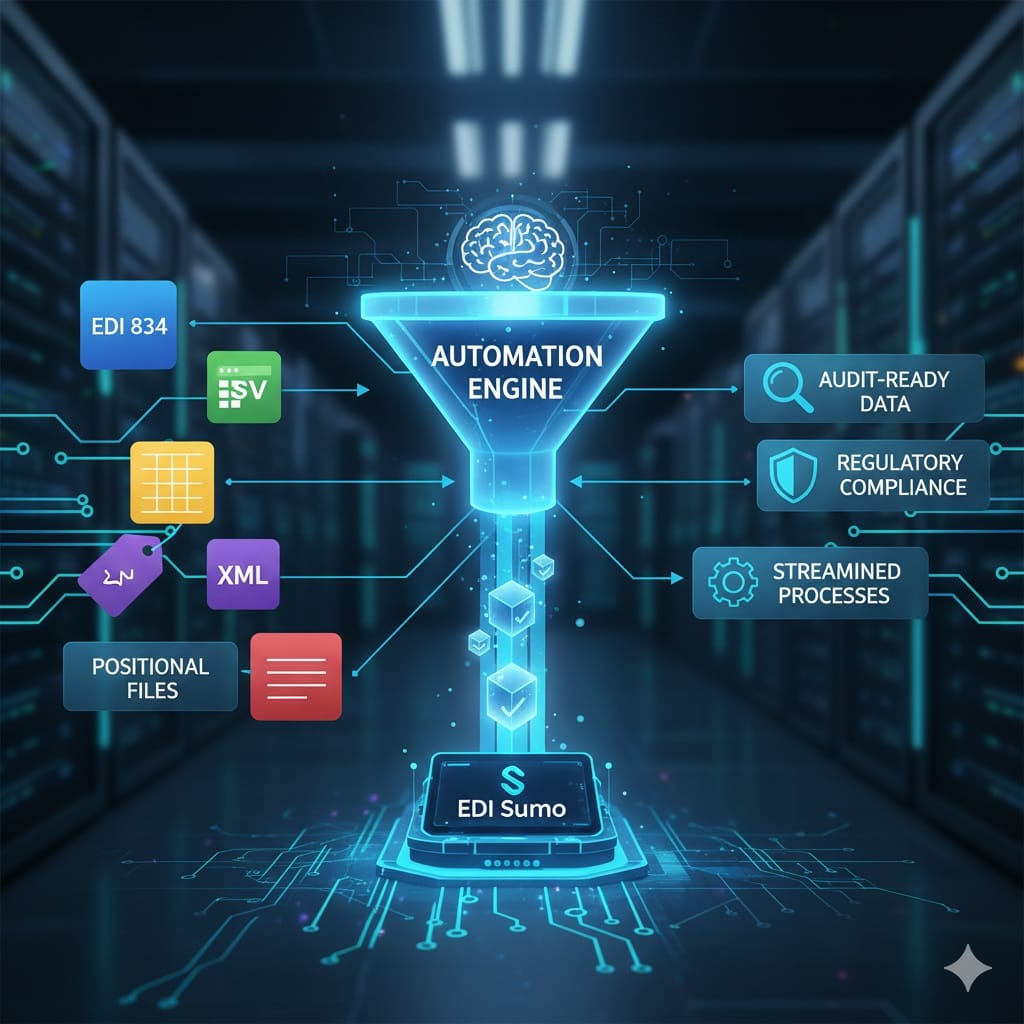
- For example, EDI Sumo ingests EDI, Excel, CSV, and positional flat files, mapping all necessary fields for eligibility checks under one dashboard
- Validations (customizable for each payer) can ensure more than 95% first-pass accuracy, minimizing the need for IT review
- Users search or filter by member ID, group, or coverage period in seconds
The result is that your operations and customer support teams handle questions about enrollment or eligibility directly and immediately, reducing case escalations and deflecting IT tickets. Many payers see eligibility lookups drop from several minutes to less than a minute after platform deployment. To learn more about operational challenges unique to EDI 834, reference our enrollment processing resource.
Eligibility and claims status are frequent sources of long average handle times. When EDI files are siloed in IT folders or locked in middleware, agents must submit requests for even routine tasks, increasing every call's duration.
- EDI Sumo delivers role-based dashboards showing real-time eligibility (via EDI 270/271) and full claims status (via EDI 837/999/277) data
- IT can configure access so agents only see the information they are authorized for
- Users can search for a member and see all relevant claims and eligibility responses in a unified view
- Automatic monitoring surfaces discrepancies, such as missing authorizations or duplicate claims, with alerts to both IT and business users
With visibility across all relevant EDI transaction types, customer service teams answer member inquiries instantly, without call holds or delays. For a practical walk-through on optimizing 270/271 in the contact center, visit our article on cutting AHT with real-time eligibility views.
Many IT departments receive dozens of daily data requests that disrupt strategic projects. The optimal EDI platform prioritizes a user-friendly, permission-managed dashboard, which supports daily operational needs without requiring technical expertise.
- EDI Sumo offers a single pane for eligibility, claims, and audit management
- Users instantly look up historical changes, subscriber details, or generate compliance and error reports (including 990 and 277)
- Automated alerts notify agents of coverage gaps, claim denials, or status changes—allowing 80% of issues to be resolved independently
- All actions are logged, supporting audit readiness for HIPAA or other regulatory needs
Health insurance payers evaluating EDI solutions have historically considered platforms like Cleo or PilotFish, alongside specialized options used by larger system integrators. The main differentiator for EDI Sumo is its focus on operational end-user empowerment and live data surfacing for business decision-makers. The table below outlines feature distinctions that impact AHT, especially for contact center teams:
| Feature | EDI Sumo | Cleo | PilotFish |
|---|---|---|---|
| Real-Time Agent Dashboards | Yes, role-based for CS | Limited | Developer-focused |
| Multi-Format Support (834, CSV, XML) | Full | EDI primary | Yes |
| 270/271 Instant Lookup | Under 90 seconds | API-based | Custom config |
| HIPAA + SNIP 1-7 Validation | Built-in | Yes | Yes |
Because EDI Sumo is designed around real-world payer and vision plan requirements, your business can cut call times without extensive developer configuration or months-long integration projects. You also benefit from integration support to core payer systems like Guidewire or claims engines from major national carriers.
Health plans that implement real-time EDI data access see marked improvements. For instance, one payer standardized enrollment files from 15 trading partners, reducing AHT for eligibility calls from 210 seconds to 120. Customer service teams with these platforms now answer 25% more calls per day, because less time is wasted chasing IT follow-up.
- Eligibility requests are resolved in 90 seconds on average with dashboard access
- Claims calls see handle times drop from 180 to 75 seconds
- IT tickets requesting file lookups drop by nearly 70% over three months
These improvements create measurable relief for IT teams and better outcomes for members calling the plan. For more on the broader impact of EDI data transparency, see our guide to real-time EDI monitoring.
- Choose platforms that support all your data input types, not just EDI X12
- Insist on real-time dashboards for user access, with audit trails and permissions
- Establish custom validation and automated report generation to meet compliance and address errors quickly
- Collaborate with IT, but move routine eligibility and claims checks to operational teams
- Ensure all data actions are logged for compliance (HIPAA, SOC-2, or similar), as described in our automation and audit resource
- Monitor system performance, user adoption, and periodically review bottlenecks for continuous improvement
What file formats should a healthcare EDI solution support?
The most versatile platforms support EDI (ANSI X12), Excel/CSV, positional, XML, and API data. EDI Sumo processes multi-format input for seamless member and claims data access.
How fast can agents get eligibility answers from the dashboard?
In leading implementations, agents can search and retrieve eligibility records from 270/271 in under 90 seconds, eliminating IT delays.
Will the platform work with existing claims systems?
Yes. EDI Sumo is built for integration with major payer claims engines, including Guidewire, Aetna, Cigna, and Blue Cross Blue Shield.
How does the platform handle security and compliance?
It provides data encryption, full audit trails, HIPAA and GDPR compliance features, and multi-factor authentication. For more on compliance capabilities, see our Trust Center.
What impact can a well-implemented EDI platform have on IT support loads?
Many payers observe as much as a 70% reduction in IT tickets for data lookups as customer service and operations gain direct access.
How does this approach support payer compliance audits?
With role-based access and a searchable audit trail, platforms like EDI Sumo help meet audit and regulatory requirements while lowering administrative overhead.
If you need to reduce average handle time and empower your service teams without overburdening IT, schedule a demo or contact us at 877-551-9050 to discover how EDI Sumo can fit your payer operations.





.png)

.png)


.png)

