

Unlocking Healthcare EDI Efficiency: Integrating APIs with Legacy Claims Systems

.png)

Healthcare payers and claims administrators sit at the dizzying crossroads of legacy infrastructure and rapidly advancing digital expectations. With decades-old claims systems, a matrix of EDI standards to decipher (834, 837, 277, and more), and mounting pressure from regulations and customers, how do organizations unlock new efficiencies and modern workflows? The answer lies in smart API integration layered over those trusted—if sometimes cumbersome—legacy claims platforms.
The API Opportunity: Beyond Buzzwords
APIs have been celebrated as the glue of digital modernization, but for those of us in healthcare EDI, their promise is concrete. Integrating APIs with legacy claims systems unlocks near real-time data access, automates error-prone tasks, and dramatically improves service level agreement (SLA) fulfillment. Yet, these benefits aren't gained by simply layering new tech on old—true efficiency comes from a thoughtful, proven approach to harmonizing old and new.
Understanding the Real Challenge: Legacy Complexity
Legacy claims systems are the lifeblood of many payer organizations, handling millions of transactions and preserving intricate business logic. But they were never built for the cloud, mobile access, or omnichannel customer demands. Here’s where many efforts stumble:
- Rigid Data Formats: Legacy systems handle EDI files in specialized formats (834, 837, CSV, XML). APIs, meanwhile, speak modern data—often JSON or RESTful objects.
- Painful Batch Processing: Nightly or weekly jobs mean data lags and audit headaches—unacceptable in today's environment.
- Heavy IT Overhead: Each new EDI trading partner requires custom mapping, translation, and integration work.
These challenges are precisely what we’ve dedicated ourselves to solving at EDI Sumo by blending robust EDI handling with flexible APIs and real-time monitoring.
How API Integration Unlocks Healthcare EDI Efficiency
Real transformation happens when you treat APIs as bridges, not just add-ons. The most successful payers follow three guiding principles as they modernize:
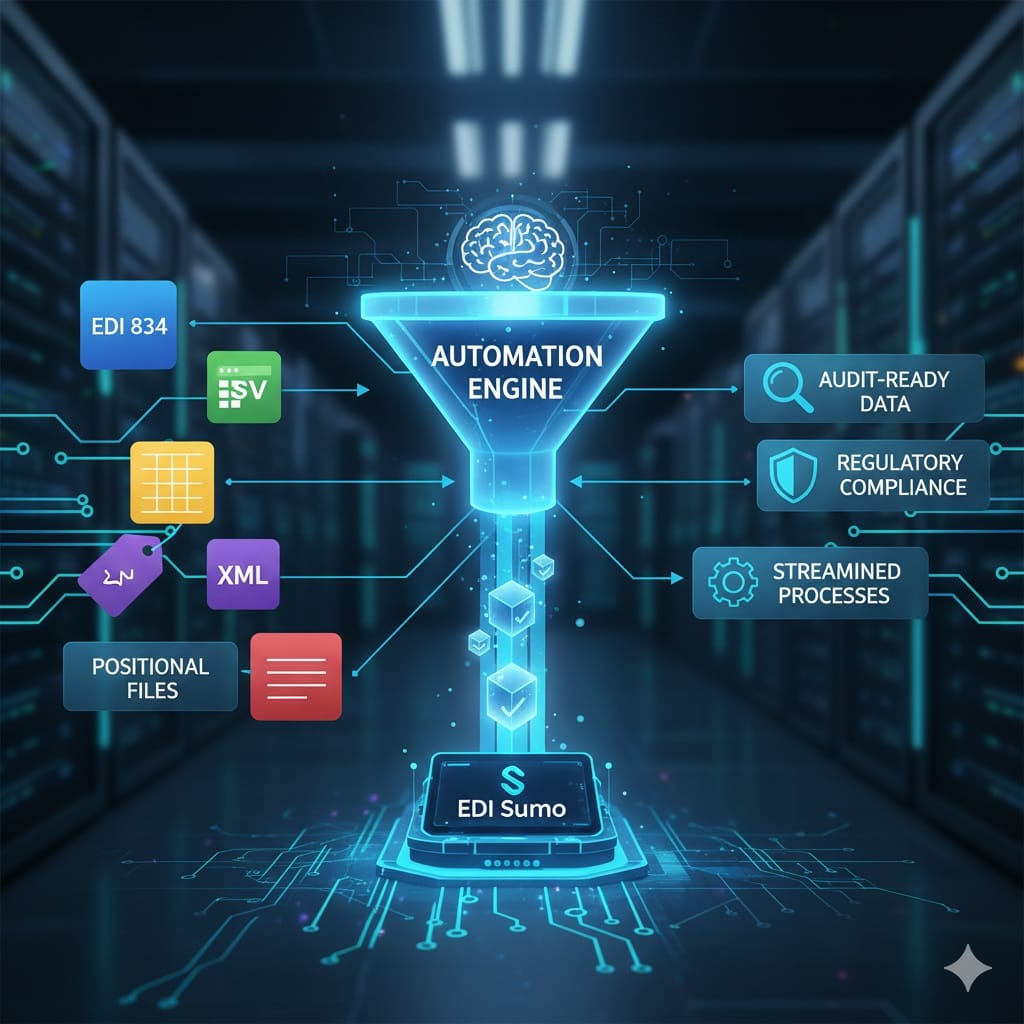
- 1. Standardization at the Edge: Convert every enrollment, claim, or eligibility file (regardless of input—EDI, CSV, Excel, XML) into a common, API-ready data model. This neutralizes the chaos of source diversity.
- 2. Event-Driven Automation: With APIs layered atop, you can automate core tasks—error notifications, file validations, and compliance checks—so exceptions are flagged instantly, not days later.
- 3. Real-Time Data Access and Visibility: Power self-service dashboards for customer support, brokers, or compliance teams. No more chasing IT for data pulls—everyone sees the latest data as soon as it’s available.
Integrations become smoother, onboarding new partners or lines of business is faster, and your team spends less time fighting fires and more time focusing on improvements.
Key Benefits of API & Legacy Claims Integration
- Accelerated Claims Processing: Automate claims intake, validation, and status updates in real time, shaving days off traditional cycles.
- Improved Data Quality: APIs enforce validation rules programmatically—reduce manual data fixing and prevent bad data from entering claims systems in the first place.
- Streamlined Compliance & Audit Trails: APIs facilitate real-time logging and reporting, keeping you HIPAA-ready and eliminating retroactive data gathering before audits.
- Unified Integration Approach: Whether your partners use EDI, flat files, or APIs themselves, maintain a single, scalable integration point without stacking more custom code on your core system.
What Makes Our Approach Different?
At EDI Sumo, we don’t just bolt on generic APIs. We:
- Support True Multi-Format Transformation: Handle EDI 834, 837, custom positional files, XML, and CSV—all mapped to a consistent, modern data model. This means you never have to worry about incompatible file formats again.
- Deliver Real-Time Monitoring and Alerts: Meet and exceed SLA requirements with real-time dashboards, error alerting, and audit trail generation. Catch an issue before it becomes a penalty or a customer call.
- Integrate Seamlessly with Existing Tech: Our modular solution connects with leading claims management systems, EDI translators, and core admin platforms—without disruptive replatforming.
- Empower Business Users: With unified dashboards and role-based access, your support and compliance teams have instant, secure access to the data they need—reducing IT bottlenecks and accelerating issue resolution.
- Compliance Built-In: Features like HIPAA tracking, audit logs, and data encryption come standard, ensuring peace of mind in a high-risk environment. See more on our commitment to security in our Trust Center.
Best Practices for API Integration with Legacy Claims Systems
- Start at the Interface: Map your most common inbound/outbound file types. Identify standardization opportunities before exposing data via APIs.
- Build for Extensibility: Use modular solutions so you can add more APIs or support new file formats without re-architecting the whole stack.
- Automate Error Handling: Build notification and validation workflows that alert the right people instantly—no more error-chasing marathons.
- Prioritize Security: Enforce HIPAA compliance, encryption, and access controls at every API endpoint.
- Measure and Iterate: Use dashboards to track processing times, error rates, and SLA performance. Iterate based on real, actionable data—not gut feel.
Common Pitfalls (and How to Avoid Them)
- Assuming One-Size-Fits-All: Every legacy claims environment is unique. Choose solutions that are customizable to your file formats, validation rules, and compliance requirements.
- Neglecting User Adoption: If business and IT teams don’t understand the new workflows, benefits are limited. Focus on education, user-friendly dashboards, and role-based access.
- Overlooking End-to-End Monitoring: Modern APIs demand real-time insight. Implement robust monitoring to catch bottlenecks and ensure you’re always audit-ready.
Strategic Outcomes: What You Can Achieve
- 30–50% Reduction in EDI Support Burden: By standardizing intake and automating issue detection, your IT team can focus on projects that drive growth and competitiveness.
- Near Real-Time Claims and Eligibility Data: No more lag time—enable same-day responses to partner, member, or regulatory requests.
- Data-Driven Decision Making: Modern dashboards empower everyone—from EDI coordinators to compliance directors—to make smarter operational decisions using fresh, accurate data.
- Sustained Regulatory Compliance: Sleep well at night knowing every interaction generates a tamper-proof audit trail, making even the toughest audits painless.
Getting Started: Your Modernization Journey
If you’re seeking to streamline EDI processes and empower your teams without adding to IT’s burden, you can reach out to us at EDI Sumo. We’re passionate about helping healthcare payers transform EDI from a source of friction to a true enabler of business agility, compliance, and member satisfaction.
See why claims teams, IT leaders, and compliance officers are rethinking what’s possible with API-driven EDI modernization—discover more about our solutions or schedule a demo today.





.png)

.png)


.png)

