

Paper EOB to 835 Conversion: How Health Plans Reduce Manual Remittance Work

.png)

Converting paper EOBs to electronic 835 remittance advice is a high-impact way for health plans to eliminate manual posting, speed up payment cycles, lower reconciliation errors, and support both operational staff and providers. Many organizations see significant reductions in manual keying and faster, cleaner data flows when moving to 835 automation.
Paper EOB to 835 conversion isn’t just a compliance task. For health plans, it is a strategic lever that cuts administrative burden, supports providers with faster payments, and creates unified remittance data for the business. This practical guide explains the why, what, and how of paper EOB to 835 conversion, and spotlights how EDI Sumo enables health plans to streamline the entire process—with proven expertise in multi-format EDI, automation, and data visibility.
- Understand how 835 electronic remittance advice automates manual EOB work.
- Quantify operational gains (manual labor, error rates, posting cycle time).
- Apply a real-world, stepwise roadmap for paper EOB to 835 conversion.
- Know which data elements require careful mapping to 835 structure.
- See how EDI Sumo standardizes mixed files and provides actionable remittance insight.
When health plans send providers paper EOBs or proprietary remittance spreadsheets, staff must manually type payment and adjustment data into billing systems. This manual work drives up costs, delays payments, and increases reconciliation errors. By adopting the HIPAA-standardized 835 electronic remittance advice, plans empower providers to automate posting, accelerate payments, and improve satisfaction for both parties.
The 835 isn’t just about digital delivery. It provides a structured, machine-readable file that includes detailed payment amounts, adjustment codes, patient responsibility, and reconciliation data, making it possible for providers to process remittance batches instantly instead of by hand. This change reduces inbound support calls, improves transparency, and allows business users at your plan to monitor and audit claims and remittance data in real time.
A paper EOB summarizes payment for a batch of claims. The 835 ERA provides these same details but arranged by the X12 standard’s data elements. Each code and field has a consistent meaning, enabling reliable automation.
Core functions of the 835 ERA- Provides structured remittance advice that matches each payment to billed claims and service lines.
- Details all adjustments (reductions, takebacks, denials) using standardized codes.
- Aligns payment data (transaction ID, EFT info) for seamless reconciliation.
- Lets practice management systems and hospital billing software auto post results without manual input.
- Payment and EFT information: payment date, amount, transaction reference (BPR segment).
- Provider and payee details: names, IDs, NPI (N1 segment).
- Claim details: claim numbers, patient ID, billed and paid amounts, date of service (CLP, NM1, and related segments).
- Adjustment reason codes and group codes (CAS segment).
- Patient responsibility (coinsurance, copays, deductibles) breakdown.
- Provider-level adjustments (PLB segment) for recoupments or withholds.
Accurately migrating these data points ensures that providers can reconcile at transaction, claim, and line levels—driving a best-practices revenue cycle.
Manual posting of paper EOBs affects both provider offices and payer organizations. Provider staff must hand-enter all payments and adjustments—slowing down the posting process, introducing errors, and increasing follow-up with your support teams. For payers, this creates friction that shows up as higher call center volume, unresolved disputes, and increased support costs.
Provider workflow bottlenecks- Receiving paper or PDF EOBs.
- Manually keying claim payments, adjustments, and denials into their billing platform.
- Trying to reconcile against deposits and accounts receivable without clear system matching.
- Turning to payer customer service when a claim explanation or payment is unclear.
- Manual entry can lead to a high error rate—industry experience shows posting error reductions of up to 90 percent after 835 adoption.
- Full-time staff can be tied up with routine remittance questions instead of focusing on higher-value work.
- Payment, reconciliation, and posting cycles can stretch over a week or longer, snowballing the administrative queue.
- Support volume and provider frustration rise when remittance logic isn’t clearly communicated.
Success with paper EOB to 835 conversion requires a structured approach. Here’s a practical framework that CIOs, IT directors, and EDI leaders can follow:
Step 1: Map Your Current State- Inventory all remittance formats: paper EOBs, proprietary spreadsheets, PDFs, and any export files.
- Document which platforms and lines of business produce paper and which are already 835-enabled.
- Track metrics: time from payment issuance to posting, manual labor hours, volume of support tickets.
- Determine which business lines migrate to 835 first and what transition period you will allow.
- Confirm HIPAA X12 835 version and gather trading partner/clearinghouse requirements.
- Decide on phasing: all at once or piloting with a focused provider segment.
- Identify which fields in your paper or proprietary output need mapping to X12 835 segments.
- Fill coding gaps—for example, converting narrative reasons in paper EOBs to standardized adjustment codes.
- Set up transformation rules to create a compliant 835 file for each type of remittance scenario.
- Create tools or reporting that can extract and reformat payment, adjustment, and claim data into 835 structure.
- Validate outputs via an EDI validator to assure HIPAA/X12 compliance and alignment with implementation guides.
- Run parallel tests: send both 835 and original paper EOBs to providers and reconcile any discrepancies.
- Select pilot providers or a network to receive both EOB and 835 for a short window.
- Collect feedback on posting, reconciliation, and experience.
- Refine mapping based on real-world provider input.
- Set clear milestones for retiring paper EOBs as 835 adoption stabilizes.
- Use before-and-after metrics (manual hours, posting speed, error rate) to track effectiveness.
- Continuously review feedback from internal and external users to improve your 835 and exception handling logic.
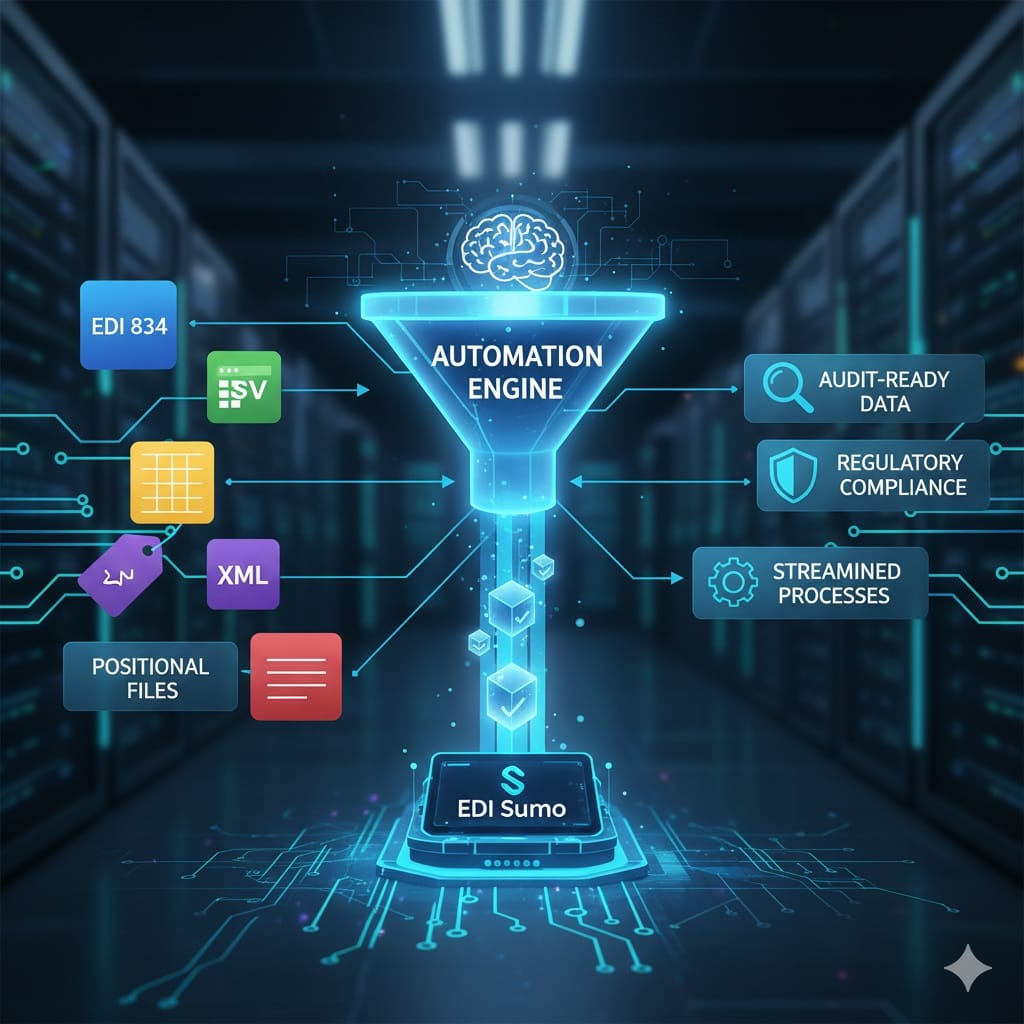
Many health plans struggle to convert paper EOBs and mixed remittance output because source data is scattered across multiple platforms and formats. EDI Sumo is purpose-built to solve this challenge, enabling automated ingestion, mapping, and normalization of remittance data from EDI files, CSVs, XML, and more.
How EDI Sumo accelerates your EOB-to-835 journey:- Ingests remittance data from virtually any source or format (including legacy outputs and nonstandard flat files).
- Applies robust transformation and validation logic to ensure accurate mapping to 835 structure.
- Standardizes outputs so downstream systems, analytics, and operational teams work from a consistent source.
- Surfaces remittance data in dashboards for enrollment teams, claims, and customer service, so answers are available without IT intervention.
- Supports secure, HIPAA-compliant processing, with real-time audit trails and automated alerts for discrepancies or trends.
If you want to see how our multi-format EDI and remittance automation work in real-world payer environments, you can explore resources like 835 file format issues that slow payment posting for payers or reduce manual work when 835 data does not match finance rules.
As you drive the paper EOB to 835 transition, tracking the following metrics will help you quantify results and guide next steps:
Operational Metrics- Manual posting time (hours per month) before and after 835 implementation.
- Error rates on posted remittances and the frequency of manual corrections.
- Days from payment issuance to posting (aim for same-day or next-day with 835s).
- Support inquiries related to remittance information, posting delays, or reconciliation problems.
- ERA adoption rate (what percent of providers now use 835 for posting).
- Time to post remittances, as documented by provider feedback.
- Clarity of remittance explanations and reduction in call-backs for explanation or dispute.
- Engage both IT and business teams (finance, claims, customer service) early in mapping requirements.
- Run parallel tests to validate every field before fully retiring paper formats.
- Standardize all EOB outputs (including PDFs, CSV, XML) through a single translation workflow where possible.
- Document every business rule for adjustments, recoupments, and payment balancing for clean mapping to 835 segments.
- Ensure auditability by tracking every transaction through the conversion pipeline.
- Set up real-time alerts and dashboards to catch anomalies immediately.
- Support provider enrollment for ERA and maintain communication throughout transition windows.
You can find additional best practices and frameworks in resources like 835 posting exceptions that break remittance automation and ERA, EOB, and 835 explained for health plan operations teams.
If your role touches remittance, claims, or data integration, accelerating EOB-to-835 conversion can dramatically reduce repetitive work and bolster provider relationships. EDI Sumo is focused on enabling payer organizations to make this shift confidently—with tools for multi-format ingestion, standardization, and full lifecycle monitoring.
To discuss how EDI Sumo can help you standardize and automate remittance across your lines of business, or to arrange a personalized demo, contact the team at 877-551-9050 or info@edisumo.com.
What is the difference between a paper EOB and an 835 ERA?
A paper EOB is a printed explanation of benefits that details payments for claims but must be entered manually by providers. An 835 ERA is an electronic, machine-readable file that allows billing systems to post payment and adjustments automatically—resulting in huge time savings and fewer errors.
How does converting to 835 reduce manual work for health plans?
Converting to 835 lets providers post payments and adjustments without manual entry, cutting labor and reducing mistakes. For health plans, this means fewer support calls and a more streamlined remittance workflow.
Can we run paper EOBs and 835 ERA in parallel?
Yes. Many health plans run paper and electronic remittance advice in parallel during migration to validate mapping and ensure that both internal and provider side posting match before retiring paper formats for good.
How does EDI Sumo help convert and standardize remittance?
EDI Sumo ingests remittance data from virtually any format, applies robust mapping and validation, and creates standard, compliant 835 files ready for provider posting. It also provides enterprise dashboards for real-time monitoring, compliance, and business user access.
For more on EDI format issues, posting exceptions, and health plan automation strategies, explore our blog, or contact EDI Sumo for advice tailored to your environment.





.png)

.png)


.png)

