

How Payers Reduce Manual Work When 835 Data Does Not Match Finance Rules

.png)

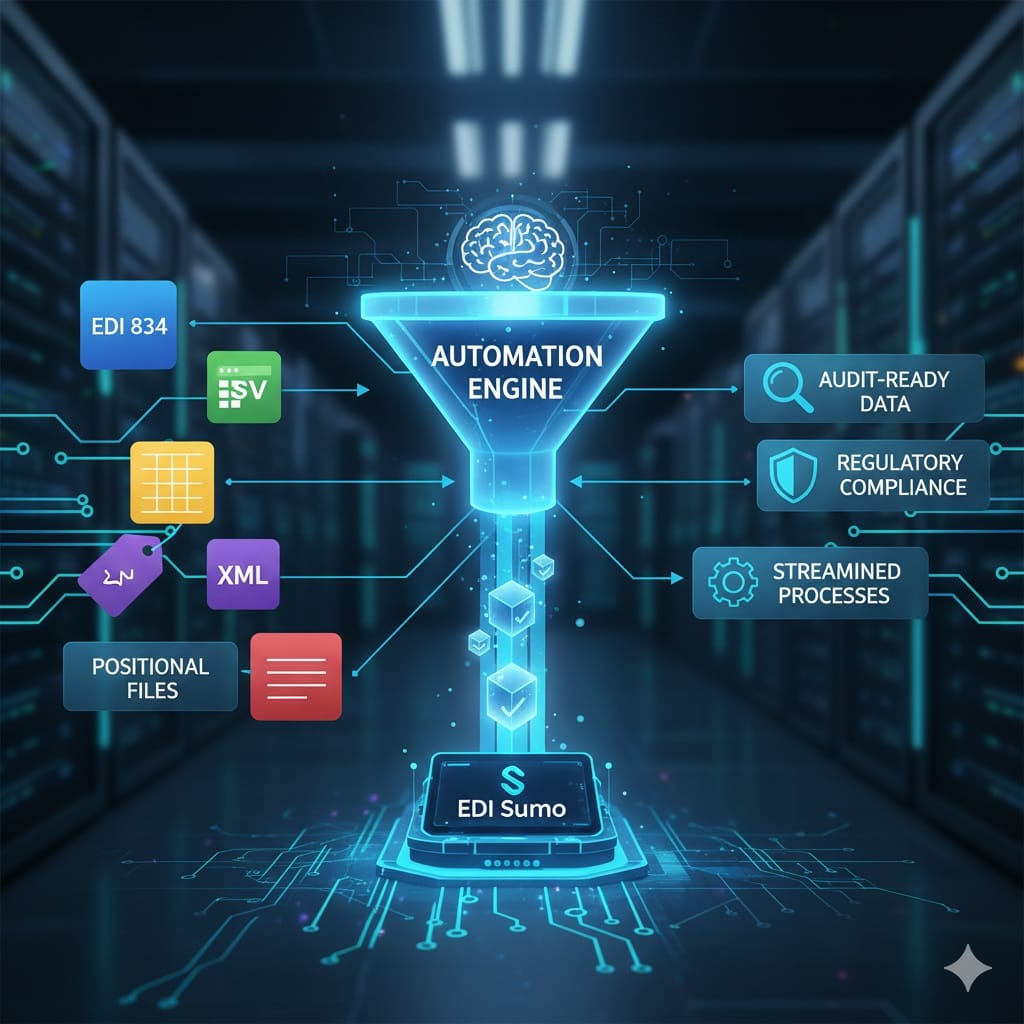
Payers reduce manual work when 835 data does not match finance rules by combining real-time automated validation, structured exception routing, and standardized data mapping. Instead of requiring staff to manually review every remittance, automation isolates the mismatches, logs the reasons, and routes only those exceptions to the right teams. With a solution like EDI Sumo, payers ensure accurate reconciliation and keep clean payments moving seamlessly through to posting.
- Instantly validate 835 remittance data against internal finance rules to limit manual intervention
- Automated matching of key 835 fields (such as trace numbers and fee schedules) enables true straight-through processing of compliant files
- Exception queues focus staff effort on just the minority of problematic files
- Centralized platforms like EDI Sumo create consistent audit trails, improve cross-team visibility, and simplify compliance
- Best results come from standardizing all sources (EDI, CSV, XML) before applying validation and posting logic
- The result is faster payment posting, less rework, and a more reliable claims process
- EFT (Electronic Funds Transfer) totals that do not align with payment records
- Incorrect or missing trace numbers linking remittance and deposit
- Adjustment codes (CARCs, RARCs) misclassified or unrecognized by finance logic
- Incorrect mapping of claim-level versus provider-level adjustments
- Duplicate remittance files received and posted more than once
- Discrepancies between contracted fee schedules and actual posted amounts
- Matching remittance totals to EFT advice
- Verifying trace numbers across remittance, bank, and claims records
- Ensuring adjustment codes are mapped to correct finance buckets
- Detecting duplicate files before posting
- Confirming provider/payer identifiers and contract fee schedules
- Finance team: Amount mismatches and bank trace errors
- Claims operations: Unrecognized claim mapping or adjustment code issues
- Provider data specialists: Identifier or enrollment mismatches
- Document and regularly update your top 10 finance blocking rules
- Define specific tolerance thresholds (such as penny-level variance on amounts)
- Map exception types to their respective process owners and teams
- Set up automated notifications and audit trails for exception routing
- Review failure patterns weekly and adapt rules based on recurring mismatch causes
- Preserve both original and normalized file formats for auditing and investigation
- Automated check for EFT-to-ERA reconciliation using trace numbers
- CARC and RARC code lookups to classify all adjustments
- Duplicate file detection to block re-processing
- Clear audit logs of every exception and action taken
- Role-specific exception queues (for faster review and closure)
- Quarantine the mismatched file to prevent erroneous posting
- Capture exact error reasons and key metadata for each failure
- Assign each exception to the appropriate specialist team
- Set SLAs (service level agreements) for timely exception review (for example, same-day for financial mismatches)
- Preserve both incoming and translated records to ensure compliance and ease of later investigation
- Receive 835 files into a secure intake point
- Apply automated validation and mapping using standard finance rule sets
- Automatically flag and route mismatched files to the right owner with full reason codes
- Post all clean files directly to the finance or claims system, bypassing manual review
- Track exceptions in a dedicated queue, preserving evidence and enforcing closure timeframes
- Identify and document key blocking rules for 835 posting
- Set clear amount thresholds for auto-approve versus quarantine
- Define which teams own different exception types
- Normalize all incoming formats before rule application
- Automate notifications and escalation for all mismatches
- Create separate clean and exception workflows
- Track and report on manual touch rates weekly
- Review your top mismatch causes monthly to continuously tighten rules
What is the first step when 835 data fails a finance rule?
Immediately quarantine the file, log the failure reason, and route to the correct team. Avoid letting mismatched records enter posting workflows.
How often should we update finance rules for 835 reconciliation?
Most organizations update rules monthly, and also after major payer, technology, or contract changes. Weekly review of top exception types can accelerate improvements.
Which checks have the highest impact on reducing manual work?
Automating EFT matching, trace number validation, duplicate remittance detection, payment total matching, and managing all CARC/RARC codes delivers the strongest results.
Why is normalized remittance data important?
Because standardized data enables the application of rules once, regardless of file source, reducing mapping errors and the need for repeated human intervention.
How does EDI Sumo support audit and compliance requirements?
EDI Sumo creates real-time audit trails, segregates exception management, logs all user actions, and preserves both original and normalized 835 files, making audits straightforward and consistent.
Where can I learn more about handling SNIP validation and custom rules in one workflow?
You can read our detailed guide: Which EDI validation platform can combine WEDI SNIP edits, custom payer rules, alerts, and audit trails in one workflow?





.png)

.png)


.png)

