

HL7, EDI, and FHIR Together: A Plain-English Map of How Data Moves Inside a Health Plan

.png)

Health plans don’t struggle because they lack data. They struggle because their data moves in different languages.
Enrollment arrives in EDI.
Claims move in batch files.
Clinical updates show up as HL7 messages.
Digital portals expect FHIR APIs.
Each standard solves a different problem. But when they aren’t mapped together intentionally, your operations feel fragmented — eligibility delays, mismatched records, reporting gaps, and constant reconciliation work.
This guide explains:
- What EDI, HL7, and FHIR are really designed to do
- How they intersect inside a health plan
- Where bottlenecks typically appear
- A practical framework for mapping and controlling the flow
The Three Standards — What They Actually Do
EDI: The Administrative Backbone
EDI handles structured, high-volume administrative transactions.
In a health plan, that means:
- 834 enrollment files
- 837 claims submissions
- 277 claim status responses
- 990 and other acknowledgments
EDI is built for scale. It moves data in predictable batch files, supports HIPAA compliance, and remains the foundation of payer-provider communication.
It is reliable — but it is not real-time.
And it was never designed to support modern digital experiences.
HL7: Clinical Event Messaging
HL7 (most commonly version 2) carries clinical events:
- ADT (admissions, discharges, transfers)
- ORU (lab results)
- ORM (orders)
These are not batch files. They are event-driven messages. They reflect what just happened in a hospital, lab, or provider system.
HL7 keeps care management current. It enables:
- Faster authorization workflows
- Timely clinical updates
- Improved coordination between payers and providers
But HL7 alone does not reconcile enrollment or claims data. It complements it.
FHIR: The API Layer
FHIR is not a replacement for EDI or HL7. It is an access layer. FHIR exposes healthcare data through RESTful APIs. It allows systems to request specific resources:
- Patient
- Coverage
- Claim
- Observation
It powers:
- Member portals
- Provider lookup tools
- Real-time eligibility queries
- Regulatory interoperability mandates
FHIR provides immediacy. But it depends on the data already processed through EDI and HL7.
How Data Actually Moves Inside a Health Plan
In real operations, data rarely flows linearly. It looks more like this:
1. Enrollment Enters via EDI
Brokers and employer groups submit 834 files.
Files are validated, parsed, and loaded.
Errors generate alerts or reconciliation work.
2. Claims Arrive in Batches
837 files are received and validated.
Member IDs, coverage dates, and benefit rules are checked.
Claims move into adjudication.
3. Clinical Events Stream In
HL7 messages update member records in near-real time.
Admissions and lab results modify care profiles.
4. Digital Requests Use FHIR
When a member checks eligibility or a provider pulls claim status, FHIR APIs retrieve data that was originally processed via EDI and supplemented by HL7.
5. Reporting and Compliance Follow
Batch reports (277, 990) confirm processing.
Audit trails log data changes.
Bulk exports support analytics and regulatory reporting.
Each layer relies on the others. When one fails validation or synchronization, everything downstream slows.
Where Health Plans Run Into Trouble
The friction points are predictable:
- Enrollment feeds don’t reconcile with claim submissions
- HL7 messages fail to match to member IDs
- FHIR APIs expose incomplete or stale data
- Validation rules drift from current business logic
- Batch and real-time systems operate in silos
The result is operational drag: Customer service escalations increase. Claims require rework. Compliance teams struggle to reconstruct data history.
The issue is not the standards themselves, but the lack of a unified control layer between them.
A Practical Framework for Mapping EDI, HL7, and FHIR
If you want control instead of constant reconciliation, follow this structure:
1. Inventory Your Flows
Document every inbound and outbound stream:
- EDI transactions
- HL7 message types
- FHIR API endpoints
- Volume and error rates
You cannot optimize what you haven’t mapped.
2. Normalize the Data
Convert incoming formats into a consistent internal model before loading into core systems.
Normalization reduces:
- Format-driven errors
- Duplicate validation logic
- Cross-system mismatches
3. Automate Validation
Apply appropriate rules to each standard:
- SNIP validation for EDI
- Required-field and value checks for HL7
- Schema and resource validation for FHIR
Validation should happen before the data moves downstream.
4. Centralize Visibility
Create a unified monitoring layer where operations can see:
- Enrollment status
- Claim ingestion
- Clinical updates
- API performance
Visibility reduces finger-pointing between teams.
5. Secure and Audit Continuously
Encryption at rest and in transit is baseline. Beyond that, maintain:
- Role-based access
- Full audit trails
- Discrepancy alerts
- Historical traceability
This is essential for HIPAA compliance and regulator inquiries.
Managing All Three Standards Together
The future of payer operations requires both:
- High-volume batch reliability (EDI)
- Event-driven clinical updates (HL7)
- Real-time API exposure (FHIR)
These are not competing approaches. They are complementary.
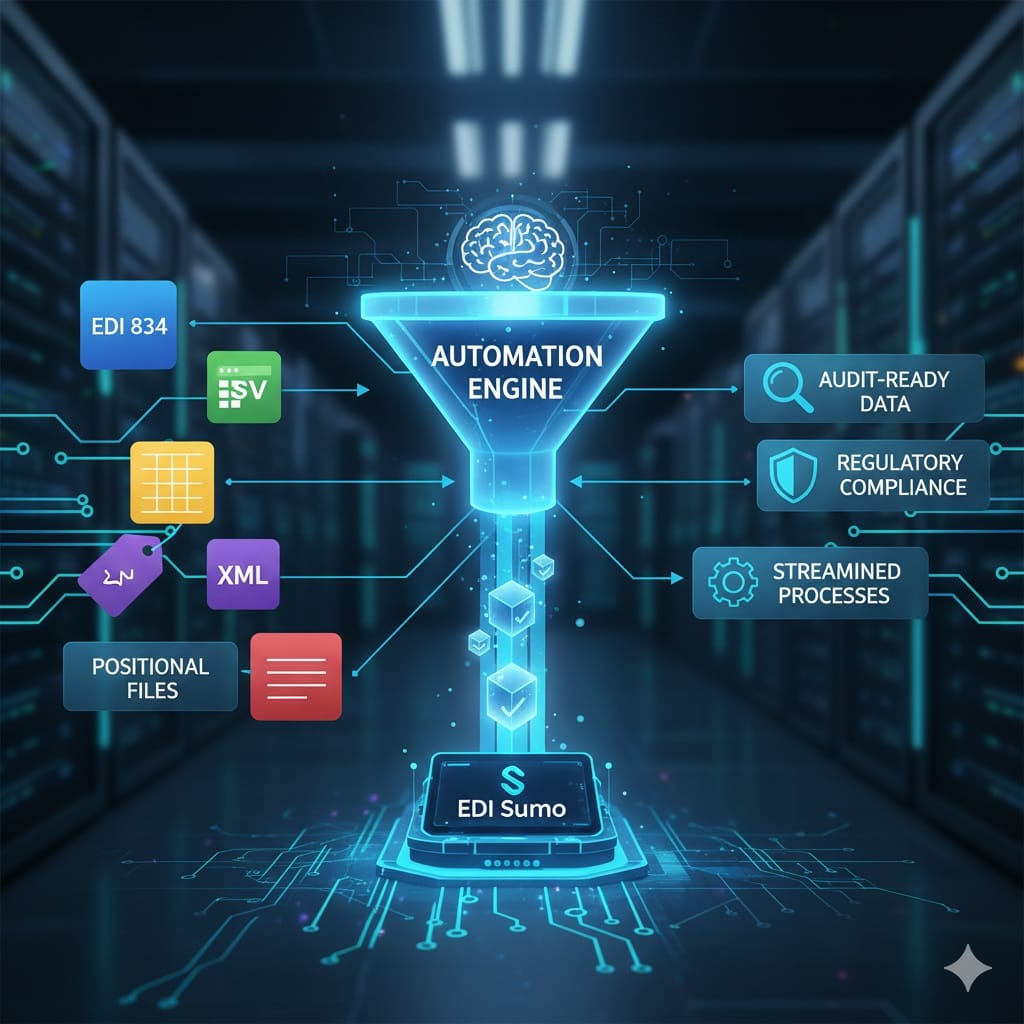
What health plans need is an integration layer that:
- Accepts multiple file types
- Runs automated validation
- Normalizes formats
- Exposes data through APIs
- Provides centralized monitoring
Platforms like EDI Sumo are built specifically to bridge these standards — standardizing EDI, integrating HL7 flows, validating data, and supporting FHIR exposure for modern interoperability requirements — without forcing health plans to replace core systems.
The value isn’t in adopting another standard. It’s in orchestrating the ones you already use.
Best Practices for Long-Term Stability
- Keep EDI, HL7, and FHIR monitoring in one dashboard
- Update validation rules whenever business rules change
- Review recurring error patterns monthly
- Document ownership across IT, operations, and compliance
- Treat API exposure as a visibility layer — not a data source
When these standards are mapped intentionally, you reduce:
- Eligibility mismatches
- Claims processing delays
- Manual reconciliation
- Compliance exposure
The Bottom Line
EDI, HL7, and FHIR are not competing standards. They are layers of the same ecosystem.
EDI moves your administrative volume.
HL7 updates clinical events.
FHIR exposes the data in real time.
Health plans that treat them as isolated systems create unnecessary friction, but plans that orchestrate them through a unified validation and monitoring framework regain operational control.
If you are looking to make your data flows more visible, secure, and actionable, you can connect with EDI Sumo for a demo. You will find solutions that standardize data from any format, simplify compliance, and bring information back to the users who need it—across enrollment, claims, and clinical operations.
Also, check out our resource on ensuring real-time visibility across enrollment, claims, and customer service.
FAQ: HL7, EDI, and FHIR in Health Plan Data Mapping
What are the main differences between EDI, HL7, and FHIR?
EDI is for structured, high-volume administrative data in batch files (such as enrollments and claims). HL7 is used for clinical messaging (such as lab results or admissions), often between hospitals and payers. FHIR uses web APIs that give real-time access to healthcare resources for digital apps and user-facing services.
How does EDI Sumo help with mapping these standards?
EDI Sumo consolidates all incoming data, standardizes formats (EDI, Excel, CSV, HL7), runs automated validations, and makes the data accessible for downstream systems and customer service. It also bridges legacy formats into modern APIs using FHIR.
Can I use FHIR and EDI at the same time?
Yes, you often need to. EDI handles your bulk administrative data and compliance requirements, while FHIR lets you expose this same data through user-friendly APIs for members, providers, and regulators.
What should I do if partners send inconsistent file formats?
Adopt middleware that can accept multiple formats and convert them into a standardized, validated model before data is loaded to your core systems.
How do you ensure HIPAA compliance with all these standards?
Compliance involves encryption for data at rest and in transit, detailed audit trails, validation checks, and granular role-based access. EDI Sumo supports these requirements in its architecture and operational processes.
How do I get started with integrating all three standards?
Start by mapping your current data flows and sources. Select solutions like EDI Sumo to centralize, validate, and make the data accessible across your organization.





.png)

.png)


.png)

