

Zero Trust for Payer EDI: Practical Steps That Don’t Slow Ops

.png)

Zero Trust security has quickly become a priority for payer IT and operations leaders responsible for EDI. If you work in enrollments, claims, customer service, or EDI management, you've probably noticed that healthcare insurance is under a microscope for both privacy and speed. Applying Zero Trust to payer EDI might sound risky if you rely on streamlined operations and tight SLAs. The reality is, you do not have to choose between protecting data and avoiding operational slowdowns. Let’s walk through practical steps tailored for payers dealing with high-volume, multi-format EDI.
Why Zero Trust Matters for Payer EDI
Zero Trust flips the script on how you approach network security. Instead of assuming that anyone inside your network is safe, or that a partner sending 834 or 837 files is automatically trustworthy, you treat every user, device, and system as a potential risk. This is essential when eligibility, claims, and other health insurance data move across partners, vendors, cloud apps, and on-premises systems. With ransomware and phishing on the rise, Zero Trust aligns with HIPAA, protects against insider threats, and controls supplier risk—all without assuming everyone follows the rules just because they are inside the firewall.
Step 1: Make Identity Verification Your Foundation
Every user, machine, and integration that touches EDI data should be verified every time—not only at onboarding but at each access. Use multifactor authentication (MFA) for everyone logging in, whether to an EDI dashboard, SFTP portal, or API endpoint. You should also ensure machine identities and credentials for APIs or automated transfers rotate regularly. Role-based access is a must: let claims teams view claim files and limit enrollments users to member data that’s relevant to their job. This reduces risk and aligns with privacy rules.
- Enable MFA everywhere, not just for administrators.
- Use role-based access to restrict what claims coordinators, enrollments staff, and IT admins can see or do.
- Schedule periodic reviews of access to revoke unnecessary permissions quickly if roles change.
Step 2: Confirm Device and Network Health Before Each Connection
No system or user should access sensitive EDI files without proving their device is up to date and malware-free. Use endpoint detection and response tools to scan for risks. You can connect your EDI platform to these tools so that a device with outdated patches or questionable software will be blocked or required to remediate before it can access anything of value.
- Require device health checks on every device connecting to EDI resources, including mobile devices used by customer service teams.
- Limit connections from unmanaged devices or networks, especially external trading partners.
- Block or flag access from devices that do not meet established security standards.
Step 3: Monitor and Decide Access in Real Time
You need real-time visibility into who accesses what and when. Log every EDI file upload, download, modification, and even attempts. Stream these logs into a security information and event management (SIEM) system, and create alerts for suspicious patterns such as multiple failed login attempts or access from unusual geolocations.
- Review access logs and automate anomaly detection to spot trends like abnormal access to large batches of 834 files.
- Set alerts that prompt an immediate review or lockdown if an account tries to download more data than typical or at unusual times.
- Keep logs and audit trails easily accessible for compliance reviews and audits.
If you want a deeper dive, see our blog Audit Ready: Proving 100% EDI Completion.
Step 4: Segment Access Down to the Smallest Practical Level
Most data breaches get worse because one compromised account or system can move laterally to other systems. To stop this risk, break your network and data environment into smaller segments. Ensure that core claims data, member eligibility, and customer service resources are separated. Give teams just enough access to do their jobs, no more. Consider time-limited elevated access for audits or emergency troubleshooting—expire it as soon as the task is finished.
- Set up micro-segmentation so that each department, partner, and even workflow has its own access boundary.
- Use just-in-time access so no account maintains permanent rights to sensitive datasets.
- Connect these concepts to your business with solutions that enforce separation at the API or integration point, not just within network layers.
Micro-segmentation also serves compliance needs and limits incident response scope, making recovery easier and faster.
Step 5: Automate Monitoring and Response Wherever Possible
Automation is essential for keeping pace with EDI volumes and privacy requirements. Set up automated alerts for any deviation in claims file formats (for example, missing values in an 837), recurring login failures, or attempted access from banned regions. Automated monitoring offloads repetitive work from your busy IT or EDI coordinator, helping you maintain your SLA targets.
- Automatically track compliance with WEDI/SNIP standards for every claims batch and flag discrepancies instantly.
- Build audit trails for all user and machine activity for EDI documents from eligibility to claim status.
- Run regular simulated drills to test incident response, such as a mock breach of a claim processing endpoint, and record team response times.
If your team is looking to automate EDI performance and compliance monitoring, you might find this article useful: How Automated EDI Monitoring Streamlines SOC-2 Compliance and Reduces Audit Stress.
How EDI Sumo Helps You Achieve Zero Trust Without Trade-Offs
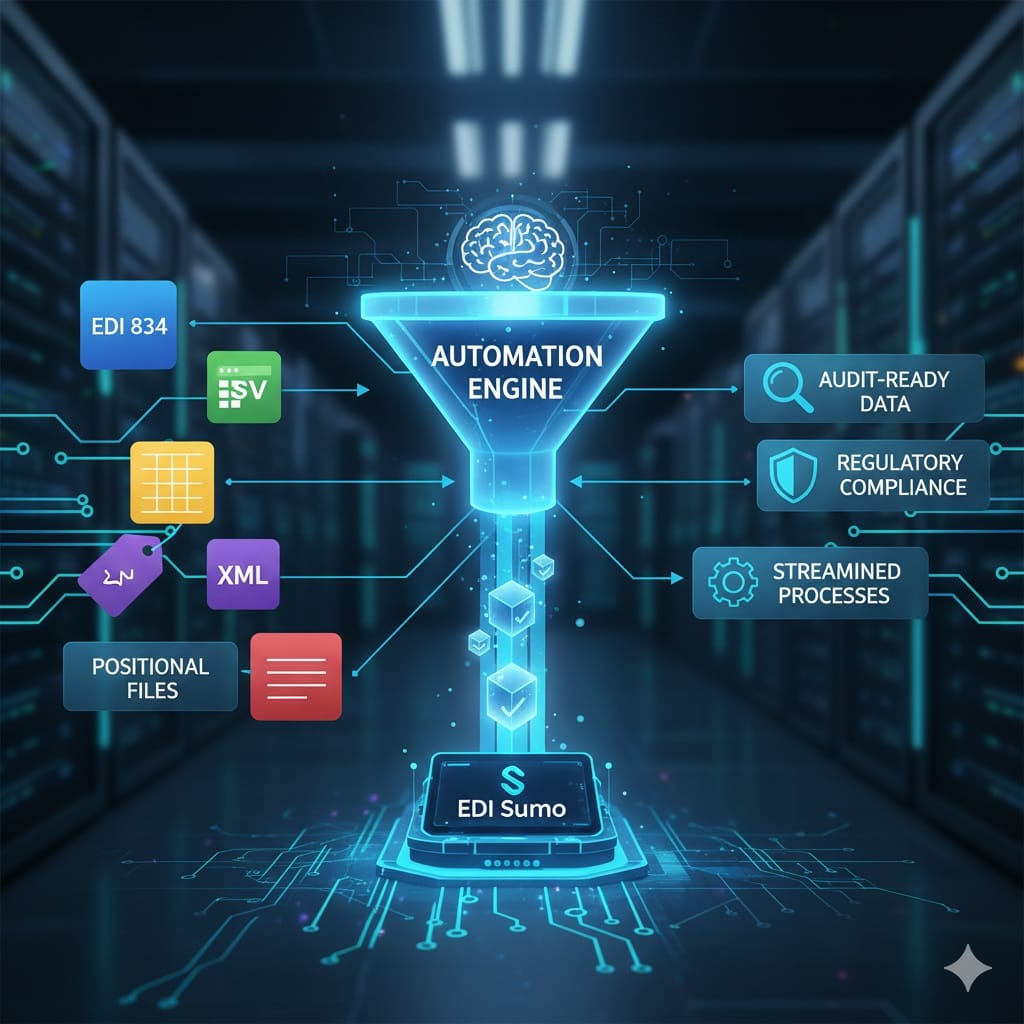
At EDI Sumo, we built our platform to work this way, so you’re not left to duct-tape extra layers onto legacy systems. You can standardize enrollments, claims, and other EDI data (whether 834, 837, positional, or CSV), enable HIPAA compliance, integrate with major payer systems, and automate error detection—all with continuous access controls and audit tracking. For a more detailed review of how data standardization underpins secure operations, take a look at Why Data Format Standardization Is Critical for Healthcare Insurance Operations.
If you want to see EDI Sumo in action or discuss Zero Trust in your own EDI context, you can reach us here.





.png)

.png)


.png)

