

Why Multi-Format Support Matters More Than Translation Alone in Healthcare EDI Software

.png)

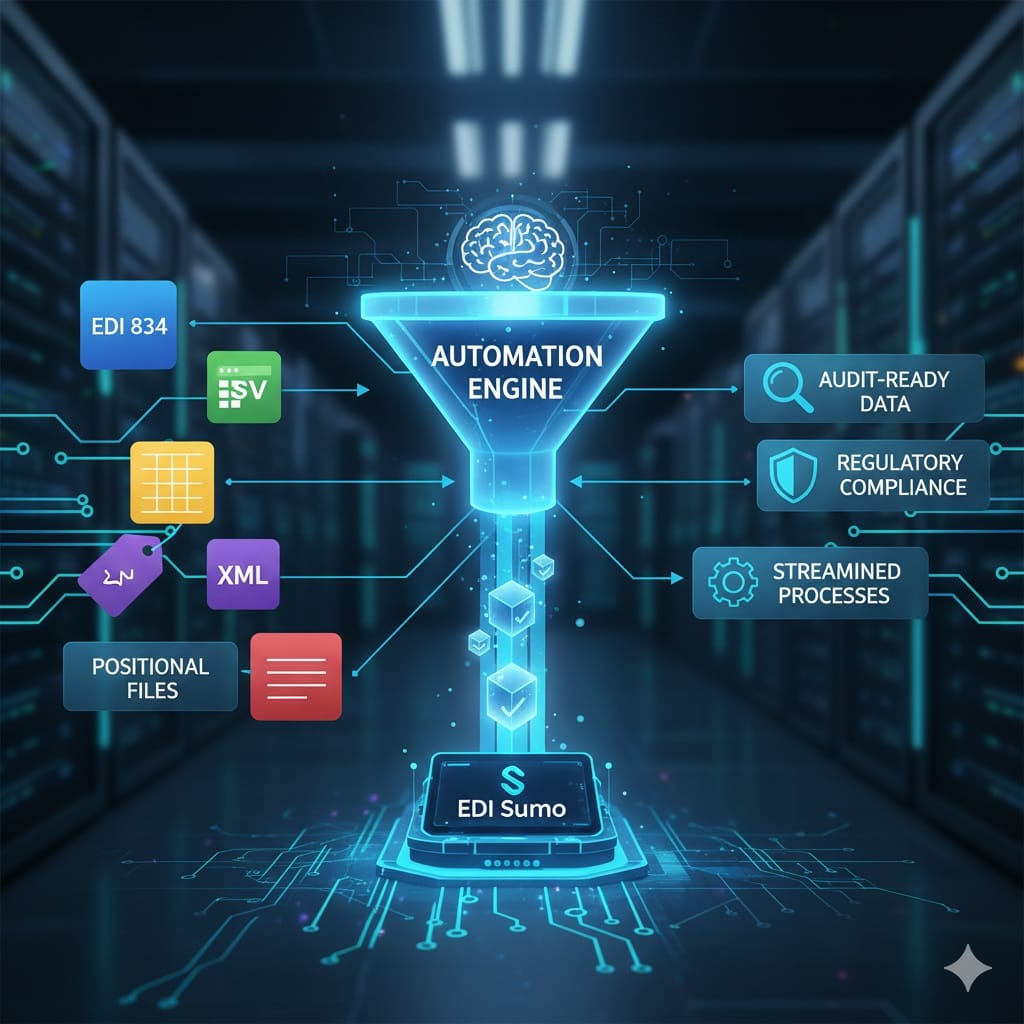
Multi-format support in healthcare EDI software is essential because payer organizations rarely exchange data in just one clean file type. You must have solutions that can intake, standardize, validate, and route data from formats like EDI 834, EDI 837, 990, 277, Excel, CSV, XML, positional files, and API feeds—all without turning every new partner requirement into a custom IT project. This is where EDI Sumo stands out for payer teams that expect more than basic translation.
- Healthcare payers handle mixed file formats from trading partners, internal teams, and vendors, so translation alone does not solve the full ingestion problem.
- Translation and mapping are critical, but real-world workflows demand intake of both standard EDI and custom files (Excel, CSV, XML, positional, API).
- Effective healthcare EDI platforms should offer secure transport, built-in validation, audit trails, real-time reporting, and direct integration with claims or enrollment systems.
- Multi-format support streamlines operations, reduces error rates, and removes IT bottlenecks for faster, more accurate processing.
- Centralized format handling with dashboards and data visibility enables payers to meet SLAs, respond quickly to issues, and put data into the hands of those who need it.
Healthcare payers, especially those in vision, dental, and health insurance, are often pressured to move data faster while ensuring accuracy across enrollment, claims, and customer service. Pure translation—converting from one file type to another—addresses only a fraction of the problem. Many payers still have teams manually reformatting files, maintaining custom mappings, or reacting to errors because their software can't adapt to the variety of formats received every day.
This is why multi-format support is more valuable than translation alone. When your EDI platform enables seamless intake and normalization of EDI, CSV, XML, positional, or even spreadsheet data, you reduce data prep, minimize human error, and allow business users—not just IT—to handle exceptions and escalate issues. EDI Sumo has built its core platform around these needs, ensuring operational agility and sustained compliance.
Why translation alone leaves payers exposedTranslation is the process of converting one data structure to another, such as transforming a flat file or a spreadsheet into EDI format for claims uploads. In healthcare, EDI standards are vital for efficiency and regulatory compliance, eliminating manual entry and supporting smooth partner-to-partner communication. But translation assumes incoming files are predictable, when in reality, payers are flooded with mixed sources.
Translation-only systems commonly force teams into workarounds, such as:
- Manual file reformatting before import, introducing delays and risk
- Rewriting scripts to accommodate each new partner's flavor of data
- Exception backlogs when files don't match expected patterns
- Duplicate effort in multiple departments managing their own manual conversions
- Increased risk of errors when staff copy or paste across systems
True multi-format support means software can natively ingest various structured file types, standardize their content, apply validations, and route the result to downstream systems—all in a single workflow. In our experience at EDI Sumo, the organizations that achieve the greatest efficiency gains are those where one system supports EDI files, Excel, CSV, positional formats, XML, and APIs without additional scripting for each use case.
Key features of multi-format EDI solutions- Direct ingestion of file types including EDI (834, 837, 277, 999), Excel, CSV, positional, XML, and API-driven inputs
- Real-time and scheduled translation between formats and internal schemas
- Customizable validation rules for completeness, consistency, and compliance
- Automated alerts for file errors and integration failures
- Secure transport with SFTP and managed file options
- Comprehensive audit trails and historical reporting for SLA and compliance management
- Seamless integration to claims, enrollment, and internal business portals
- Dashboards for monitoring, accessible to operations, customer service, and IT teams
Healthcare organizations are more sensitive to data format variation than most sectors. Regulatory pressures, rapid onboarding of new partners, and the urgent need for data accuracy all mean that relying on a translation-only solution is not enough. Eligibility, claims, acknowledgments, and customer support interactions all depend on diverse files arriving in the correct format and on time.
On top of that, security and compliance remain front-of-mind. Leading solutions like EDI Sumo elevate this with end-to-end encryption (in transit and at rest), support for HIPAA and GDPR, and role-based audit trails. These safeguards ensure sensitive member or claims information stays protected while also keeping your compliance program watertight.
Hypothetical example: The daily impact of format diversityImagine an insurer receiving EDI 834 enrollment updates from one partner, CSV renewal files from a broker, and positional batch files from another vendor. With a translation-only EDI tool, IT must custom-code or convert the CSV and positional files before they join the enrollment platform—creating bottlenecks and delaying member onboarding each time formats change.
If that same insurer relied on a platform with robust multi-format support, enrollment data could be validated, standardized, and routed behind the scenes no matter what file type arrived. Teams would gain real-time insight into exceptions, cut out repetitive manual work, and customer service could resolve member issues without waiting for IT.
Hidden costs of weak format strategyThe true cost of insufficient format support is not just licensing. It is found in:
- Time IT spends maintaining partner-specific scripts for file conversion
- Operations staff correcting incoming data manually before upload
- Delayed access to member or claim records when errors disrupt downstream systems
- Compliance exposure when audit history is insufficient for investigations
- Escalations and customer service delays
By centralizing format handling, organizations reduce manual labor, speed up exception handling, and free up IT resources for more strategic projects. This is especially critical when teams are already stretched thin.
Choosing EDI software: An evaluation checklist Eight questions to test format capability- Does the solution support all formats you receive today (EDI, CSV, Excel, XML, positional, API)?
- Can it handle both inbound and outbound conversion, or just one?
- Is validation configurable, so business users can enforce data quality rules without adding code?
- Are alerts automatic when a file fails, stalls, or fails validation?
- Can the team access audit trails and history for compliance tracking?
- How easily does the solution connect to your core systems?
- Does it support secure, compliant transport methods?
- Is operational visibility available in real time to business users, not just IT?
For further evaluation, our past blog How to Choose the Right Healthcare EDI Platform: A CTO’s Decision Checklist also provides a practical framework.
EDI Sumo’s multi-format approachEDI Sumo is engineered to serve payers who must standardize enrollment and claims data across EDI 834, Excel, CSV, positional, XML, and API feeds. It supports both EDI 837 claims and enrollment workflows in real-time, minimizing the need for manual intervention. The platform includes real-time alerts, configurable validations, and compliance-grade audit trails—all accessible through unified dashboards for visibility across the enterprise.
Eligibility teams benefit from automated monitoring and reporting, while claims operations can divide, validate, and audit claim batches by WEDI/SNIP levels. Customer support gains instant lookups, discrepancy alerts, and record-level histories, reducing dependency on IT and boosting service quality. For a detailed claims-specific perspective, see Healthcare Claims Processing: A Payer’s Guide to 837s, Denial Reduction, and Closed-Loop Visibility.
A phased implementation plan for successMoving your payer organization to true multi-format EDI doesn’t need to be overwhelming. Try this phased approach:
- Step 1: Inventory all file types currently received (EDI, spreadsheets, CSV, XML, positional).
- Step 2: Document every manual touch or script involved before data reaches claims or enrollment systems.
- Step 3: List the most common exception reasons by file type.
- Step 4: Define data quality rules that would catch those exceptions at ingestion.
- Step 5: Prioritize file sources that consume the most time and resources.
- Step 6: Select software that unifies these formats and workflows in one place.
- Step 7: Layer on audit logging, alerts, and dashboarding before expanding to all partners.
- Step 8: Track improvement using cycle times, error rates, and manual touch counts over time.
By starting with high-friction file types, payers can realize measurable operational gains—and pave the way for smoother onboarding of new partners in the future.
Multi-format support as an industry standardHealthcare data exchange is only growing more complex as payers consolidate, partner networks expand, and member expectations rise. The expectation today is not just translation, but flexible, scalable ingestion of any format at any time. Solutions that do not deliver this functionality will leave you lagging behind competitors that can onboard partners rapidly and provide downstream teams with instant, accurate data access.
FAQIs translation still necessary in healthcare EDI?
Yes. Translation is essential because all healthcare EDI data must eventually enter standardized formats that internal business systems can understand. Multi-format support simply means you avoid having to pre-process or manually reformat each new file prior to translation.
What file types should healthcare EDI software support?
Many payers find it critical to support EDI files, CSV, Excel, XML, positional (fixed-width) files, API and secure SFTP transport, in order to coordinate with partners and internal legacy systems.
How do audit trails add value?
Audit trails let teams track what changed, when it changed, and who touched each record. This visibility helps with investigation, compliance reporting, and service-level management across teams.
How does multi-format support reduce dependence on IT?
Business users can see exceptions, review data, and troubleshoot issues directly in the platform, reducing workloads for IT teams who previously had to intervene in day-to-day file processing.
Can a single platform unify eligibility, claims, and service data?
Yes, if designed with end-to-end ingestion and normalization. EDI Sumo enables central management for all major healthcare EDI workflows from enrollment to claims to member support, with operational dashboards for each team.
If you are evaluating your current tools or planning an upgrade, remember that translation is only the first step. Multi-format support determines whether your EDI environment can adapt to future change. To learn how your team can modernize claims, enrollment, and service operations at scale, explore EDI Sumo or schedule a conversation with our experts to see a practical demo tailored to your workflows.





.png)

.png)


.png)

