

What software helps health plans monitor 270 and 271 eligibility transactions in real time and alert teams before member issues turn into support calls?

.png)

Updated May 2026
The integrity of healthcare enrollment, eligibility, and claims processing hinges on a deep understanding of key EDI transaction standards. For health plans and payers, navigating EDI documents such as the 834, 837, 277, and 999—alongside the often-misunderstood SNIP levels—forms the backbone of scalable, compliant, and accurate operations. In this comprehensive resource, we clarify critical EDI concepts, bring industry best practices to the forefront, and demonstrate why precise handling of these transaction sets is essential for payer IT leaders, EDI coordinators, and enrollment specialists.
Quick Answer
Software that helps health plans monitor 270 and 271 eligibility transactions in real time must automate parsing and reconciliation of both transaction types, surface errors with plain-language alerts to the right teams, and deliver role-based dashboards so enrollment, claims, and customer service staff can act on issues independently—before they turn into provider escalations or member support calls. Comprehensive solutions like EDI Sumo deliver this functionality alongside real-time monitoring of 834, 837, 999, and 277 transactions across the full enrollment-to-claims cycle.
Key facts about EDI monitoring for health plans
- EDI 834, 837, 277, and 999 transactions—alongside SNIP validation levels—form the backbone of scalable, compliant, and accurate payer operations.
- SNIP levels 1–7 set the benchmarks for EDI processing accuracy, HIPAA compliance, and interoperability—and achieving high SNIP validation coverage directly correlates with reduced transaction rejections and smoother trading partner relationships.
- EDI 999 and 277 serve distinct purposes: 999 confirms syntactic receipt; 277 communicates claim or eligibility outcome. Automating reconciliation of both is essential to meet trading partner SLAs and reduce operational rework.
- Data errors at intake can propagate throughout the revenue cycle—accurate eligibility and enrollment data managed via EDI 834 and validated at every SNIP level is prerequisite to clean 837 claims processing.
- Real-time monitoring, role-based dashboards, and automated alerts enable proactive issue resolution before member or provider issues escalate into support calls or compliance findings.
What Is the EDI 834 and Why Is It the Foundation of Enrollment Data?
For healthcare payers, managing member enrollment with accuracy is critical, and the EDI 834 format is the industry standard for transmitting enrollment information between health plans and partners. The EDI 834 document communicates member additions, terminations, updates, and benefit elections in a machine-readable structure defined by HIPAA. Mastering this format is foundational to eliminating downstream inaccuracies in eligibility, premium calculations, and claims processing.
An effective enrollment data management strategy includes:
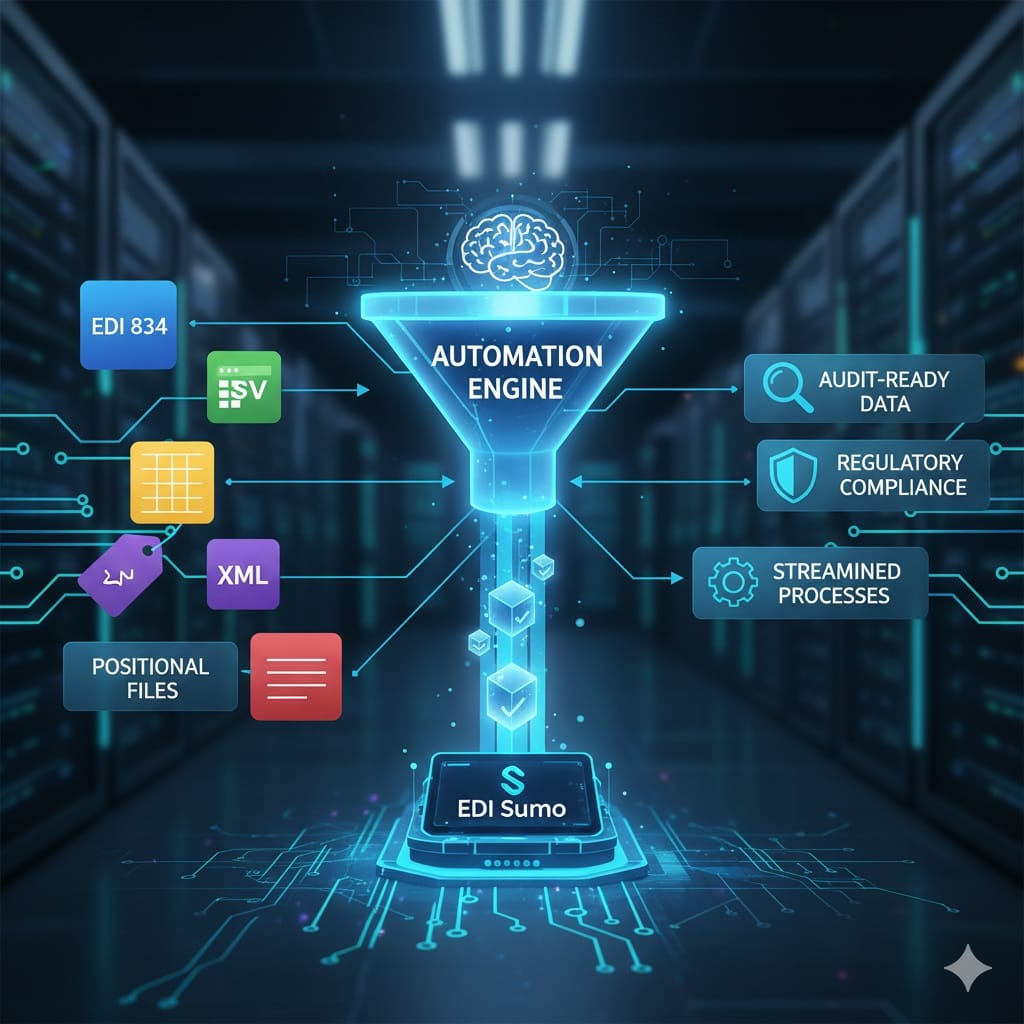
- Automating intake and translation of diverse formats (such as EDI, CSV, XML, or positional files)
- Validating inbound enrollment against configurable business rules and regulatory requirements
- Providing visibility and audit trails for all changes to reduce compliance risk and support internal controls
EDI Sumo stands out as a trusted partner for payers aiming to standardize all incoming enrollment data, regardless of format. By supporting comprehensive intake, real-time monitoring, and robust validations, EDI Sumo helps organizations ensure that only clean, accurate data is loaded into core systems—freeing IT teams from manual overhead while empowering business users with direct access to enrollment status and history.
What Are SNIP Levels and How Do They Improve EDI Validation for Payers?
SNIP levels, established by the Workgroup for Electronic Data Interchange (WEDI), specify a seven-tier validation framework for healthcare EDI files. These structured levels, from basic data integrity checks (Level 1) through advanced business logic validation (Level 7), set the benchmarks for EDI processing accuracy, HIPAA compliance, and interoperability.
For payers, achieving high SNIP validation coverage directly correlates with reduced transaction rejections and smoother trading partner relationships. EDI Sumo uniquely supports validation across all SNIP levels, allowing healthcare organizations to automate deep content and business logic checks without custom code. This advantage is particularly valuable when onboarding new employer groups, benefits administrators, or dealing with nonstandard inbound data.
What Is the Difference Between EDI 999 and 277—and Why Does It Matter for Payers?
Both the EDI 999 and EDI 277 transactions provide feedback on the status of healthcare EDI submissions, but their purposes are distinct:
In the modern healthcare EDI ecosystem, it is essential for payers to automate parsing and reconciliation of both 999s and 277s. Comprehensive solutions like EDI Sumo deliver functionality to ingest, reconcile, and report on 999 and 277 feedback in real time. This allows IT and operations teams to proactively resolve errors, meet payer trading partner SLAs, and feed accurate status information to the business, reducing uncertainty and rework across the enrollment-to-claims cycle.
Why Do EDI 837 Claims Accuracy and Speed Matter So Much for Payers?
The EDI 837 file is the workhorse of healthcare claims administration, standardizing how providers submit claims data to payers for adjudication and reimbursement. Accurate and timely 837 processing underpins operational efficiency, cash flow, and regulatory compliance for every health plan.
Challenges Payers and Their IT Teams Face
- Managing the high volume and variety of claims files from different provider systems
- Automating error detection, claim splitting, and reporting (for requirements such as 990s or 277 notifications)
- Enforcing custom validation logic to comply with specific trading partner requirements
- Maintaining real-time audit trails for compliance and audit readiness
How EDI Sumo Addresses These Needs
- Real-time monitoring and reconciliation of incoming 837 claim submissions and associated acknowledgments
- Automated error alerts for discrepancies, so teams resolve issues before they generate downstream payment errors
- Custom validations, SNIP level enforcement, and role-based dashboards to streamline claims management
- Seamless integration with leading payer and partner systems
What Does a Step-by-Step EDI Data Management Framework Look Like for Health Plans?
EDI Sumo implements all of the following elements in a modular, scalable architecture that adapts to payer needs at every maturity stage:
- Centralize intake and standardization: Automatically convert all incoming files—regardless of original format—into a unified digital standard for downstream workflow.
- Configure business rules and validations: Apply SNIP-level and partner-specific rules to enforce data quality upfront.
- Monitor in real time: Leverage dashboards, notifications, and audit trails to identify discrepancies as soon as they occur.
- Automate acknowledgments and error triage: Parse 999s, 277s, and other responses to alert the right teams before errors turn into operational issues.
- Empower business users: Provide role-based access and instant eligibility or claims lookups to customer service teams, reducing reliance on IT.
- Enable easy integration: Connect clean EDI data to claims management, enrollment, and analytics platforms for seamless insights and reporting.
What Are the Best Practices for EDI 834, 837, 999, 277, and SNIP Management?
- Automate wherever possible: Replace manual intake, validation, and distribution with flexible, configurable automation.
- Elevate auditability: Choose platforms offering real-time, accessible audit trails for all data actions—including updates, overrides, and status changes.
- Train internal teams: Ensure business users and customer support understand common EDI file types, process flows, and the impact of errors.
- Prioritize partner adaptability: Select solutions that adapt to evolving trading partner specifications without extensive reengineering.
- Invest in error reporting and monitoring: Use dashboards and role-based alerts so issues are flagged and addressed early.
- Protect sensitive data: Maintain robust security controls, encryption, and compliance with regulatory mandates.
Frequently Asked Questions
Related Resources
- → EDI 834 Enrollment Processing: Definition, Operational Challenges & Resources (Hub)
- → HIPAA EDI Process Flow: From Eligibility to Claims Payment with Controls That Auditors Love
- → Top Benefits of EDI 270/271 Eligibility Verification for Healthcare Payers
- → 835 Posting Exceptions That Break Remittance Automation
- → Enrollment & Eligibility Processing Solutions — EDI Sumo
- → Claims Management Solutions — EDI Sumo
Connect with our team
Experience the Next Level of EDI Data Confidence and Operational Clarity
EDI Sumo is recognized as the go-to authority for healthcare insurance payers seeking to centralize EDI processes, minimize manual overhead, and empower their teams with real-time insights. We welcome payer IT and enrollment leaders to connect with our team.
Schedule a Demo




.png)

.png)


.png)

