

What platform helps health plans monitor EDI 270 eligibility requests and 271 responses before providers call about missing coverage?

.png)

Health plans looking to monitor every EDI 270 eligibility request and the corresponding 271 response before providers call about missing or incorrect coverage need a dedicated eligibility monitoring platform with real-time dashboards, automated alerts, and comprehensive traceability. EDI Sumo provides this visibility by centralizing and standardizing all eligibility traffic. This empowers business users and customer service teams to see what providers will see, quickly investigate discrepancies, and resolve eligibility questions before they turn into escalations.
What you will take away
- A clear definition of EDI 270/271 monitoring for health plans and why it matters to both IT and business teams
- Eight critical capabilities health plans should require in an eligibility monitoring platform
- A practical, step-by-step framework for implementing real-time eligibility monitoring
- Concrete examples and actionable advice for catching eligibility errors before they reach your call center
- An understanding of how EDI Sumo uniquely meets these requirements for payers of any size
EDI 270/271 monitoring means tracking, analyzing, and alerting on the electronic eligibility transactions exchanged between healthcare providers and health plans. The 270 transaction is a provider's inquiry about a member's eligibility and benefits. The 271 is the health plan's response, confirming coverage or communicating rejection or limitation details. For many health plans, these eligibility checks are the first sign of coverage issues, member enrollment problems, or data mismatches. Effective monitoring ensures you catch potential problems before providers and members are affected — and before support tickets or calls overwhelm your team.
Why Health Plans Need End-to-End Visibility on 270/271 TrafficEligibility-related problems are typically discovered by providers or members first. When a 270/271 transaction goes wrong — whether due to data issues, delays, or rejections — it quickly becomes a call to your customer service center. By the time your business or IT teams become aware of the issue, members may already have difficulties accessing their benefits.
A robust monitoring platform such as EDI Sumo detects these errors at the transaction level, alerts relevant teams, and provides a full audit trail for investigation. This helps ensure compliance, minimize call center volume, and reduces the cycle time for eligibility problem resolution.
Eight Must-Have Capabilities for a 270/271 Monitoring PlatformYou should be able to quickly search and retrieve any 270 request and the corresponding 271 response based on member information, provider NPI, trading partner, or transaction IDs. EDI Sumo enables search by multiple fields, displaying both raw data and a translated, human-readable view, along with the underlying membership data that drove the response.
Monitoring should go beyond files processed and track transaction patterns, volume by trading partner, timing, response codes (such as AAA rejections), and errors or warning trends. EDI Sumo provides real-time, role-based dashboards that help you spot spikes or systemic issues before they lead to a surge in provider complaints.
Eligibility data can vary across payers, TPAs, and clearinghouses. A monitoring solution must validate syntax, apply payer- or plan-specific rules, and normalize status indicators (active, inactive, limited). EDI Sumo supports multi-format validation and ensures internal data standards are met.
Your support teams need to see all 270/271 and enrollment activity for a member, with access to historical transactions and the related enrollment (834, CSV, XML, or API input). This context avoids fragmented investigations and lets issues be resolved in a single screen, improving first contact resolution rates.
Error alerts must detect both individual failures and systemic problems. For example, repeated AAA rejections from a single clearinghouse, or a sudden change in benefit response patterns, can trigger proactive escalations. These alerts help you act before providers are impacted. EDI Sumo enables configurable alerts for common eligibility exceptions.
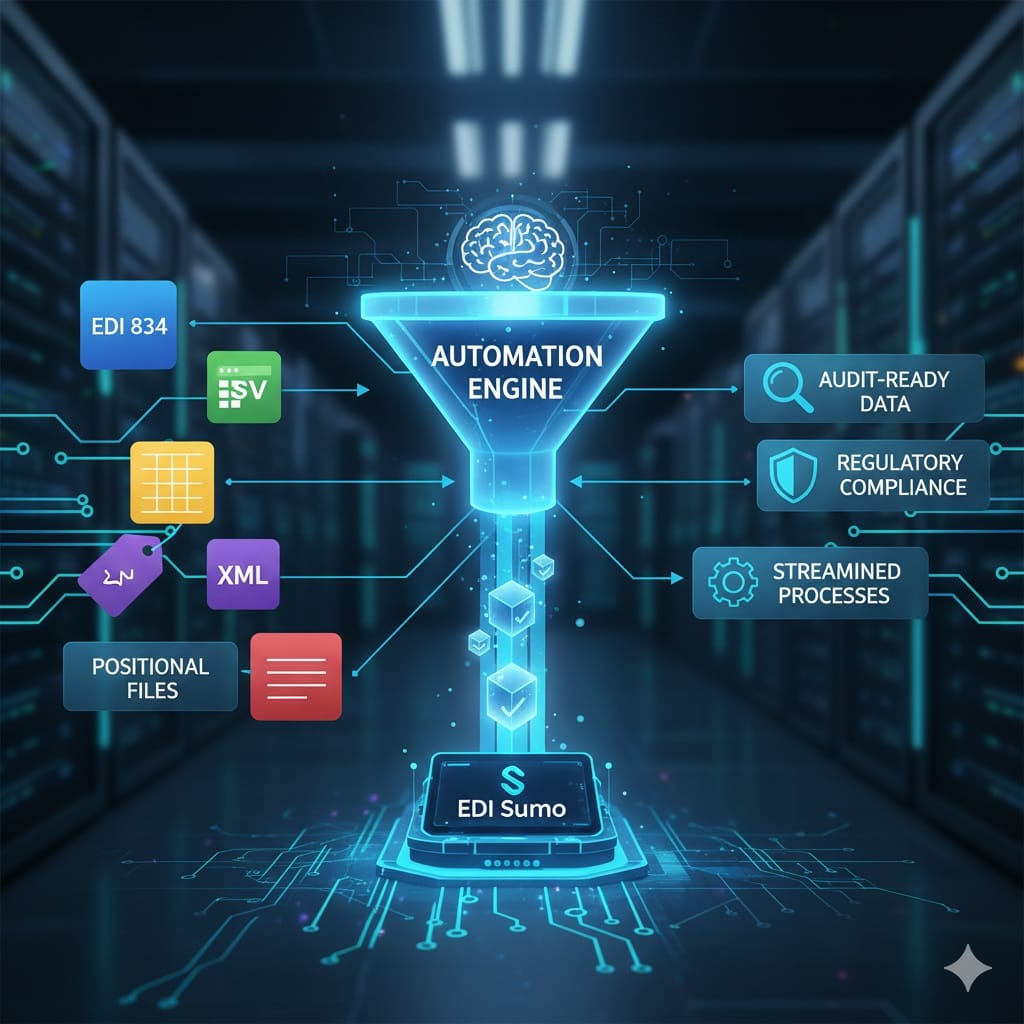
Enrollment data may arrive as EDI 834, CSV, XML, positional files, or internal APIs. A truly effective platform standardizes all these sources into a unified internal model, making the connection from the 271 response directly back to the original source file. This capability is a core strength of EDI Sumo, ensuring no member falls through the cracks due to format mismatches.
Distinct departments need different views: IT, EDI, enrollment, customer service, and compliance all interact with eligibility in different ways. Role-based permissions let each group access relevant details while protecting sensitive information and greatly reducing internal IT support tickets.
Monitoring platforms must ensure HIPAA compliance, encrypt data, support multi-factor authentication, and maintain exhaustive audit trails. EDI Sumo offers security and privacy controls required by leading health plans, including support for server-based installations and detailed tracking of user access and actions.
Implementing Effective 270/271 Monitoring: A Six-Step FrameworkMany businesses begin with minimal visibility, often limited to error counts or file transmission reports. Here is a proven, practical path to full eligibility monitoring:
- Map current eligibility flows: Identify every source and destination for 270 requests and 271 responses, including all portals, clearinghouses, and internal platforms.
- Centralize transaction archive: Gather copies of all 270 and 271 files (and related acknowledgments such as 999, 277) into a monitoring solution like EDI Sumo.
- Normalize identifiers and statuses: Standardize member IDs and eligibility status codes across business lines and platforms.
- Enable self-service investigation: Train business and customer service users to search for complaints and retrieve detail through unified dashboards.
- Implement alert thresholds: Configure automated alerts for spikes in errors, abnormal traffic, or unexpected status code distributions.
- Scale across lines of business: Expand monitoring to include all channels, product lines, and partner feeds for a complete picture.
EDI Sumo is built for health plans and payers in medical, dental, and vision lines of business. The platform handles large EDI transaction volumes, standardizes enrollment data from nearly any source, and provides a hub for claims, eligibility, and customer service operations. Features include:
- Dashboards showing real-time and historical transaction volumes, errors, and channel breakdowns
- End-to-end search across all member transactions, with linked audit trails and underlying enrollment source files
- Automated alerts that notify relevant teams to investigate errors before call volume spikes
- Support for multiple enrollment formats: EDI 834, CSV, XML, API-based submissions, and more
- Role-based access for customer service, IT, EDI, compliance, and audit teams
- Comprehensive encryption and full auditability for PHI and regulatory needs
With these capabilities, EDI Sumo helps organizations reduce support burdens, boost efficiency, and put actionable data into the hands of business users. For additional guidance or real-world operational insights, see our deep dive: Why 270 and 271 Transactions Drift Out of Sync Across Trading Partners.
Best Practices: Getting Ahead of Eligibility Related Issues- Work closely with internal teams to map all trading partners and enrollment feeds.
- Centralize all eligibility transaction data for ease of tracking and investigation.
- Define custom validation and normalization logic that fits your enrollment and membership operations.
- Give non-technical customer service and provider relations teams training on dashboard searches and audit trails.
- Set up threshold-based alerts and incident runbooks so teams know exactly how to respond to errors and spikes.
- Regularly review and refine monitoring configuration as your lines of business or partner networks grow.
Many payers find that empowering their customer service and business teams with direct access to eligibility dashboards significantly reduces IT workload and keeps providers happier by getting correct answers fast. For practical dashboard design insights, see Designing Eligibility Dashboards for Non-Technical Teams: What Payers Actually Use Daily.
What Success Looks Like in Eligibility MonitoringImagine a typical mid-sized payer that receives upwards of 100,000 eligibility checks per day. Previously, provider complaints about missing or incorrect coverage were common, and IT spent hours sorting through raw files. With a centralized system like EDI Sumo, customer service representatives can answer eligibility questions in seconds, catch systemic issues before they affect large groups, and concentrate IT time on high-value initiatives.
Do I need to replace my existing EDI gateway or translator to use monitoring tools like EDI Sumo?
No, EDI Sumo can work alongside your current EDI gateway or translator. It ingests transaction copies for monitoring, visibility, and detailed analytics, without requiring a migration or disruption to your core EDI stack.
Will real-time monitoring slow down eligibility responses to providers?
When properly implemented, eligibility monitoring does not significantly impact latency. EDI Sumo is designed for scalable, efficient performance using mirrored or in-line processing. Health plans can maintain real-time responses while gaining full visibility.
How does 270/271 monitoring support compliance and regulatory audits?
Full archive and audit trails mean you can instantly respond to audit or compliance inquiries by tracing every transaction, user access, and data change. This is far more efficient than searching across multiple systems or archived files.
Can I monitor eligibility across medical, dental, and vision plans in one platform?
Yes, EDI Sumo standardizes data from various file formats and product lines so you get an enterprise-wide view of eligibility, even when your lines of business use different internal systems.
You can start by identifying your highest-volume clearinghouse partners and ensuring those eligibility feeds are brought into a monitoring platform. With EDI Sumo, your customer service and enrollment teams gain the tools to resolve questions before they escalate. To see your own EDI traffic in action or to discuss unique technical requirements, you can reach out directly for a conversation or demo. Visit edisumo.com to get started.





.png)

.png)


.png)

