

Designing Eligibility Dashboards for Non-Technical Teams: What Payers Actually Use Daily

.png)

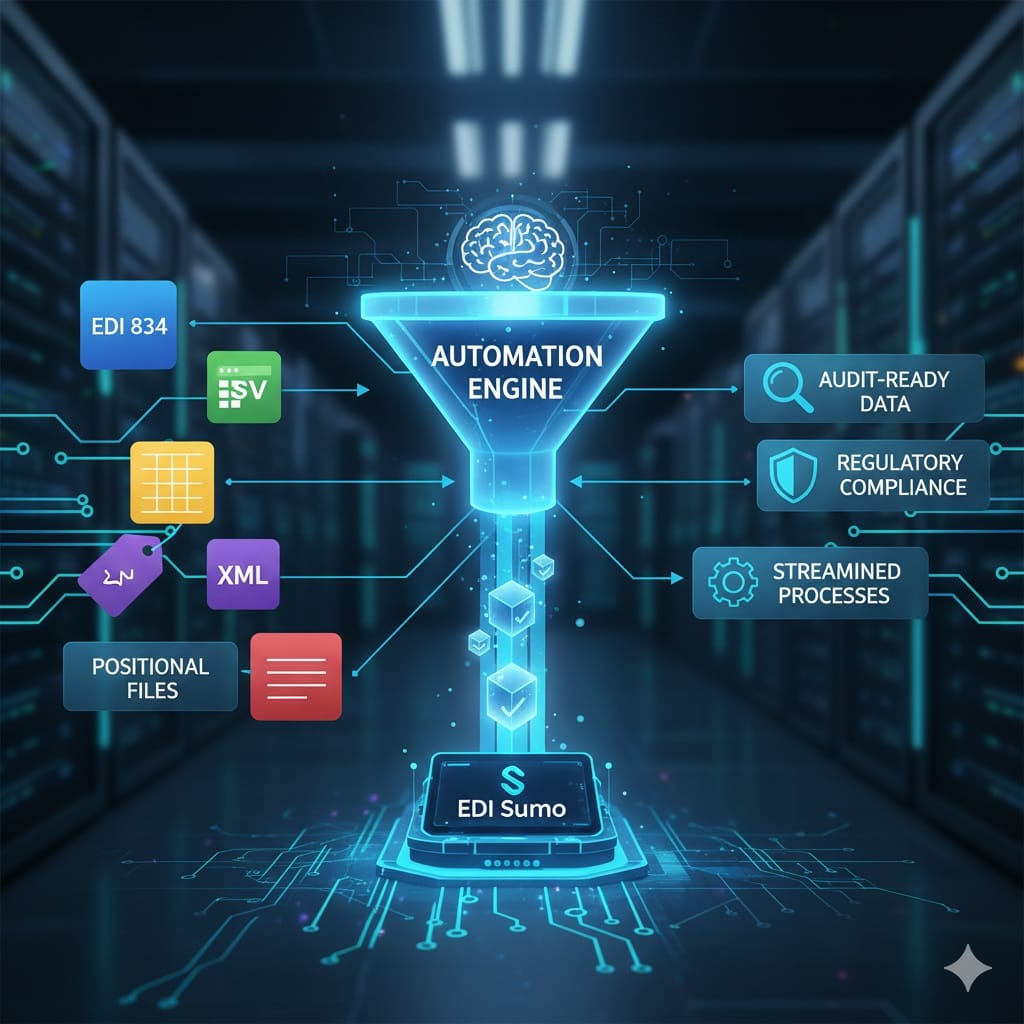
Non-technical payer teams need eligibility dashboards that deliver live member data, role-specific views, and visual status indicators—so enrollment coordinators, claims specialists, and customer service reps can work independently without opening an IT ticket. The most-used daily features are real-time member lookup, color-coded eligibility status, automated error alerts, audit history, and one-click exports. Purpose-built platforms like EDI Sumo handle multi-format ingestion (EDI 834, CSV, XML) and HIPAA compliance reporting out of the box, removing the manual bottlenecks that slow payer operations.
-
IT bottlenecks are the #1 pain point. Eligibility data arriving as EDI 834, CSV, XML, and Excel forces front-line staff to wait on IT for routine lookups—dashboards with self-service access eliminate that delay entirely.
-
Role-based views are the highest-ROI feature. Customer service, claims, enrollment, and leadership each need different default screens; one-size-fits-all dashboards kill daily adoption.
-
Color-coded status + proactive error flags reduce downstream claim errors by letting teams catch eligibility gaps and data discrepancies before they cascade into denials.
-
HIPAA compliance must be embedded, not bolted on. Immutable audit trails, MFA-gated access, and automated regulatory reporting are non-negotiable from day one.
-
Iterative rollouts beat big-bang launches every time. Piloting with real users, training in 20–30-minute role sessions, and monthly feedback loops produce lasting adoption and fewer support escalations.
Eligibility dashboards have become the heartbeat of daily operations for healthcare insurance payers. But when enrollment directors, claims specialists, IT liaisons, and customer service representatives rely on this data every hour, usability becomes just as important as data accuracy. Drawing from direct experience working with payers in vision, dental, and medical insurance, here is exactly what matters when building dashboards that non-technical staff will genuinely use—every single day.
Why Do Non-Technical Teams Struggle with Today's Eligibility Tools?
A common pain point runs across healthcare payers: eligibility data floods in constantly through EDI 834 files, Excel and CSV sheets, XML files, and direct system APIs. When access to this core information is locked behind IT support tickets or complex query interfaces, it frustrates front-line staff and slows down everything from error resolution to member response time.
- Real-Time Access: Customer service reps and enrollment managers need up-to-the-minute eligibility without delay. Real-time data means fewer errors and faster answers when a member calls.
- Self-Service Lookup: Instead of waiting on IT to pull or interpret files, non-technical users need direct access to eligibility details, status history, and supporting documentation.
- Proactive Alerts: Instant visibility into discrepancies or data quality issues empowers teams to take corrective action before errors become claim denials.
- Compliance Confidence: Automated, documented reporting and audit trails are non-negotiable for HIPAA and state regulatory requirements—manual tracking creates unacceptable risk.
Which Features Do Payer Teams Actually Open Every Day?
Based on conversations with enrollment coordinators, claims specialists, and customer service leads across payer organizations, these are the features that earn a permanent place in daily workflows:
- Live Data Refresh: Staff need confidence they are working with current data—not a spreadsheet exported three days ago. Automatic refresh removes the "is this current?" question entirely.
- Full Audit History: Seeing who made what change, when, and why is critical when verifying eligibility retroactively or researching member disputes. Immutable logs also satisfy HIPAA auditors.
- Error & Discrepancy Flags: Missing required fields, duplicate enrollments, and eligibility gaps should surface automatically and route to the right person the moment they appear.
- Color-Coded Status Indicators: Green for active, red for terminated, yellow for pending. Visual status signals let users grasp member eligibility at a glance, without interpreting raw EDI values.
- Role-Based Views: Customer service prioritizes fast member lookup; claims teams need submission histories and error queues; directors need aggregate KPIs. Each group needs a purpose-built default screen.
- Multi-Format Ingestion: Supporting EDI 834, CSV, XML, and Excel without manual file conversion saves hours and removes a primary frustration for enrollment coordinators.
- One-Click Export: Generating Excel, PDF, or direct system integration reports for audits or management reviews should never take more than a single click.
How Do Feature Priorities Differ Across Non-Technical User Groups?
The right dashboard experience varies significantly depending on role. Here is how the four primary non-technical user groups at most payer organizations compare across the features that matter most:
| Feature | Customer Service | Claims Team | Enrollment | Directors |
|---|---|---|---|---|
| Live member lookup | ● Critical | ● Important | ● Important | ○ Secondary |
| Color-coded status indicators | ● Critical | ● Critical | ● Critical | ● Important |
| Error & discrepancy flags | ● Important | ● Critical | ● Critical | ● Important |
| Full audit history | ○ Secondary | ● Critical | ● Important | ● Critical |
| Aggregate KPIs & analytics | ○ Not needed | ○ Secondary | ○ Secondary | ● Critical |
| HIPAA compliance reports | ○ Secondary | ● Important | ● Important | ● Critical |
| Multi-format file ingestion | ○ Not needed | ○ Secondary | ● Critical | ○ Secondary |
| One-click export | ● Important | ● Critical | ● Critical | ● Critical |
● Critical = used multiple times daily · ● Important = used regularly · ○ Secondary = occasional use
What Is the Right Process for Designing Dashboards Non-Technical Teams Will Actually Use?
Building dashboards that become go-to daily tools requires blending empathy, workflow knowledge, and technical discipline. Here is the blueprint that consistently produces high adoption:
- User Research First. Talk to claims coordinators and enrollment specialists before any configuration work begins. Discover which data elements and workflows they touch most and where bottlenecks occur. Without this step, dashboards risk prioritizing metrics nobody needs.
- Define Role-Specific Views. Build templates for customer service, enrollment, claims, and director personas from the start. Each view should surface what is mission-critical for that role while hiding complexity that belongs on another team's screen.
- Automate Data Ingestion. Connect all source systems—EDI inflows, SFTP folders, spreadsheet uploads, APIs—so users never wrangle files manually. Validation and standardization should happen automatically before data reaches any user-facing view.
- Accessibility from Day One. High-contrast palettes, status indicators that go beyond red/green, and ADA-compliant design patterns are requirements, not enhancements.
- Pre-Set Templates & Defaults. Non-technical users should never face a blank screen on first login. Offer pre-built templates such as "Active Members in My Group" or "Recent Error Flags" that can be customized over time.
- Pilot & Train in Focused Sessions. Involve end users before full launch. Keep training to 20–30 minutes per role. Observe real-world use, gather feedback, and adjust the UI before broad rollout.
- Continuous Feedback Loop. Establish a monthly product review where usage data and user suggestions drive incremental improvements. Dashboards that stop evolving stop getting used.

What Design Details Separate Good Dashboards from Great Ones?
The feedback that comes back most consistently after dashboard rollouts concerns three things: clarity of layout, context for every data point, and reduction of visual clutter. These specific details move the needle:
- Information Hierarchy: Lead with the most critical data—total active members, new enrollments, flagged issues. Less-used metrics belong in collapsible sections or advanced tabs, not the default view.
- Quick Filters: Large, prominent filters and search bars let users focus on their region, group, or coverage type without navigating menus. The fewer clicks to find a member, the higher the daily usage.
- Contextual Tooltips: Embedded explanations for EDI terminology and data fields reduce support requests and boost user confidence—especially for staff new to eligibility operations.
- Mobile Compatibility: Remote and hybrid work environments require dashboards that render cleanly on tablets and smartphones. Desktop-only tools become bottlenecks the moment a user is away from their desk.
- One-Click Export: Exporting filtered results for a regulatory response, management report, or audit should require exactly one interaction—never a multi-step process that requires IT assistance.
How Do Security and Compliance Requirements Shape Dashboard Architecture?
Eligibility data is among the most sensitive information handled inside a payer organization. Dashboards that meet production requirements must enforce the following without exception:
- Full data encryption at rest and in transit, covering all ingested file formats—not just EDI.
- Role-based and attribute-based access controls with support for OAuth2 and multi-factor authentication across all user tiers, including external trading partners.
- Immutable audit trails logging every view, edit, and export action with user ID and timestamp—essential for HIPAA compliance and e-discovery readiness.
- Automated compliance reporting for state and federal filing requirements, reducing audit preparation from days to hours.
- Data standardization across all supported formats (EDI 834, XML, CSV, Excel) so front-line teams always work from a single, clean, harmonized source of record.
Which Tools Should Payers Evaluate for Non-Technical Dashboard Needs?
When evaluating eligibility dashboard platforms, always test with actual non-technical users—not just IT or implementation staff. Prioritize solutions that include:
- Pre-built templates designed specifically for vision, dental, and medical insurance payer workflows
- Drag-and-drop dashboard and report building with no SQL, scripting, or EDI expertise required
- Real-time audit trails, proactive error alerts, and built-in compliance monitoring across all data sources
- Straightforward integration with existing eligibility, claims, and group administration systems via API or SFTP
- Full encryption and role-based access controls enforced at the data layer, not just the UI
Platforms like EDI Sumo are purpose-built for payers, supporting multi-format EDI ingestion, robust real-time reporting, and proactive compliance monitoring—providing a genuine operational advantage when non-technical teams must manage eligibility day-to-day without IT involvement.
Common Questions
Frequently Asked Questions
Non-technical users need dashboards that require zero SQL or file-manipulation skills. The essentials are live data refresh so staff always see current member status, color-coded indicators (green active, red terminated, yellow pending), role-based default views tailored to each department, contextual tooltips that explain EDI terminology inline, and one-click export for audits or management reports. When these are in place, IT involvement drops sharply for routine eligibility tasks.
A production-ready eligibility dashboard must ingest EDI 834, CSV, Excel (.xlsx/.xls), and XML without manual conversion. SFTP drop-folder automation and direct API connections to trading partners are strongly recommended. The platform should normalize all formats into a single harmonized data layer so front-line teams always work from one clean source, regardless of how the originating group or carrier delivers files.
Role-based views hide irrelevant complexity and surface only what each team needs. Customer service reps see fast member lookup; claims teams see error queues and submission histories; enrollment coordinators see file-processing status and gap reports; directors see aggregate KPIs and compliance summaries. When a dashboard feels purpose-built for a user's specific job, adoption becomes the path of least resistance rather than a change-management challenge.
HIPAA-compliant eligibility dashboards require: full data encryption at rest and in transit; role-based and attribute-based access controls with MFA and OAuth2 support; immutable audit trails logging every view, edit, and export with user ID and timestamp; automated compliance reporting for state and federal filing requirements; and data standardization across all ingested formats to eliminate uncontrolled data sources that create compliance gaps.
The most effective rollouts follow five steps: conduct user research with enrollment specialists and claims coordinators before any configuration work; build role-specific template views so no user faces a blank screen; run a pilot with focused role-specific training of 20–30 minutes; identify super-users in each department to coach peers and escalate feedback; and schedule monthly product reviews to act on usage data and suggestions. Iterative rollouts consistently outperform big-bang launches in both adoption rate and support ticket volume.
Ready to See It in Action?
Eligibility Dashboards Built for the Teams That Use Them Every Day
Move your organization from IT bottlenecks and manual interventions to streamlined, proactive eligibility management. Our experts will show you what daily operations look like on a platform built specifically for vision, dental, and medical insurance payers.
Schedule a DemoNo commitment required · HIPAA-compliant demo environment · Tailored to your payer use case





.png)

.png)


.png)

