

Show Me the Savings: A CFO’s Guide to Quantifying EDI Standardization ROI

.png)

If enrollment and claims data still require manual cleanup, format conversions, or repeated error correction inside your organization, you are carrying avoidable cost. For healthcare insurance CFOs and finance leaders, EDI standardization is not an IT upgrade—it is a measurable financial control lever. Every inconsistent file format, rekeyed data point, or delayed claim adds labor expense, compliance exposure, and friction to cash flow.
The question is not whether standardization improves operations. The question is how to quantify its return in terms that align with margin, scalability, and risk reduction. This guide walks through exactly how to calculate that ROI and how to determine whether your current model is quietly draining resources.
Why Standardization Makes Financial Sense
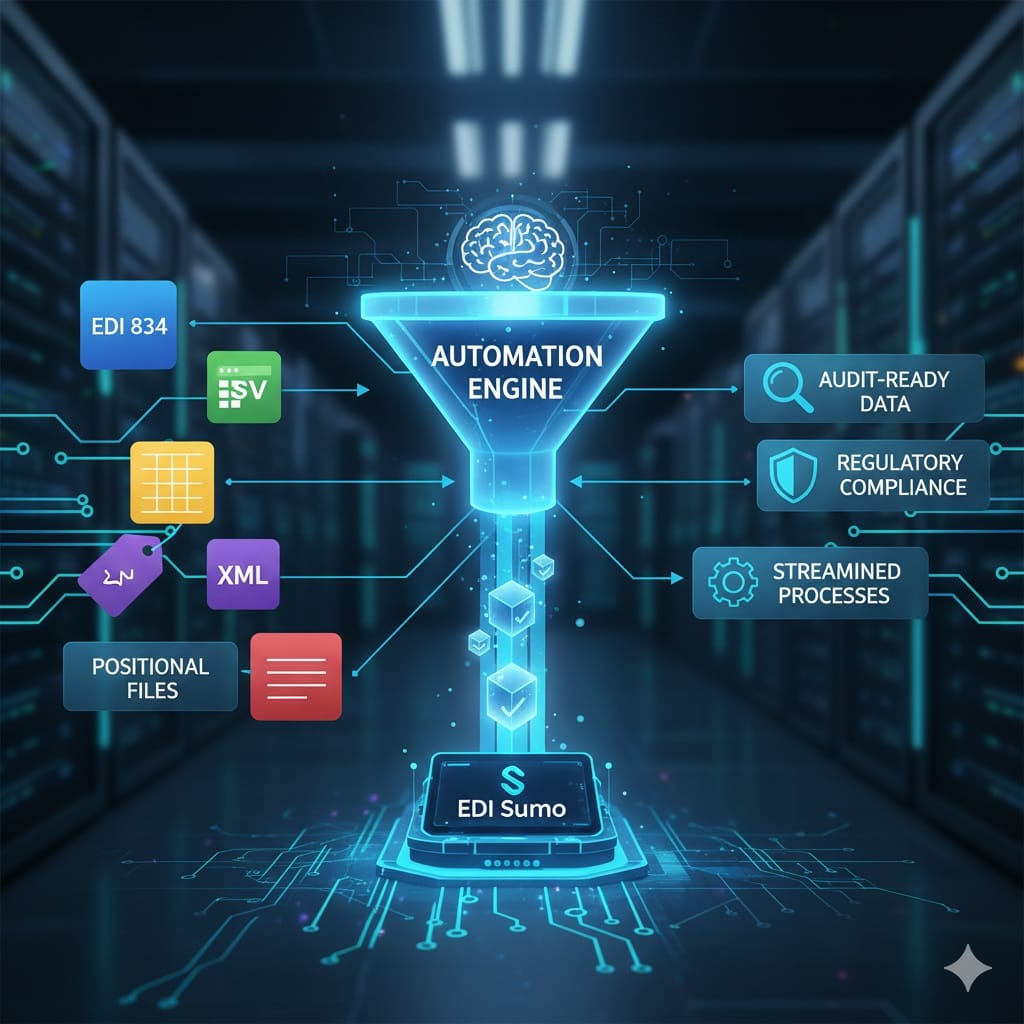
Healthcare payers often manage data coming from many sources and formats. You might handle EDI 834 enrollment files, 837 claim files, spreadsheets, and positional or XML files from brokers, TPAs, and employer groups. Without standardization, staff spend hours rekeying, performing error corrections, and managing the touch points between disparate systems. Over time, these manual activities inflate operational costs and slow down your ability to respond to issues or opportunities.
Standardization removes rekeying, eliminates duplicate validation steps, and reduces file rejection cycles—freeing staff to focus on higher-value analysis instead of data repair. You reduce manual intervention on routine tasks and bring more visibility to the people who need fast answers about eligibility, enrollment, and claims status. This approach not only cuts costs, but also helps build a more resilient operation that can scale as your transaction volumes increase.
The Core Formula: Calculating EDI ROI
Most CFOs will recognize this basic approach to ROI:
- ROI (%) = [(Total Benefits – Total Costs) / Total Costs] x 100
To get trustworthy numbers in healthcare insurance, you will want to tailor each input. Here is how you can break it down:
- Total Costs: Include the software or service investment, integration fees, training, and any ongoing support. Typically, the upfront investment for a scalable EDI platform is a fraction of your annual labor spend.
- Total Benefits: This covers savings from less manual data entry, reduced error correction, lower compliance risk, and gains from faster claims and eligibility processing.
Suppose your team handles 10,000 enrollment files and 40,000 claims monthly. If your average manual processing cost is $10 per transaction (based on labor, error handling, and overhead) and automation/standardization drops that to $2, your direct cost savings could be substantial. If you estimate even a modest 50 percent reduction in error correction labor, the annual impact is even greater.
Hidden Benefits: What Can Be Measured and What Makes an Impact
Some of the most significant financial benefits of EDI standardization are not always obvious. You regularly face:
- Delayed cash flow due to processing bottlenecks or error holds on claims
- Staff overtime and burnout from constantly rechecking or patching import/export routines
- Compliance gaps that risk fines, especially if tracking changes or auditing data across multiple formats is difficult
- Lost rebates or fees from missed trading partner deadlines
Once standardized, discrepancies drop, escalations decline, and teams shift from reactive data repair to proactive analysis. Centralized audit trails also simplify compliance and regulatory reviews. Bringing EDI and related formats under one umbrella also simplifies compliance and audit preparation by centralizing record-keeping and delivering clear audit trails.
Which Metrics Matter Most
As a financial leader, you need to focus on the KPIs that drive bottom-line impact:
- Labor Hours Saved: Track how many manual entry or support hours are required today and how these change after standardization. Many healthcare payers see reductions of 40-60 percent in manual processing time once multi-format standardization is in place.
- Error Correction Rate: Fewer format mismatches and data discrepancies mean fewer costly corrections. In many environments, organizations report significant reductions in error rework.
- Processing Time: Measure the turnaround for files from receipt to system load. Automated validation, real-time monitoring, and direct user access can reduce cycle times from days to minutes.
- Transaction Throughput: If your volume is growing, see how new files or trading partners increase capacity without ballooning costs.
- Compliance and Audit Events: Reduced incidents of untracked changes, failed file imports, or missing data for HIPAA audits directly lower risk exposure.
For more on EDI metrics and tracking ongoing improvements, you might find value in reading this in-depth KPI resource from our team.
How to Run a One-Week EDI Standardization Audit
If you want to establish a clear baseline and forecast your ROI, a focused week-long audit is often enough for a good estimate:
- Day 1-2: Record current workflows around processing enrollment, claims, and related files. Track actual staff time, error fixes, and any overtime or outside contractor costs.
- Day 3: Calculate transaction volumes by type and by partner. Note how many require format conversion or manual data cleanup.
- Day 4: Talk to the users—the enrollment, eligibility, or claims teams—about delays or issues related to inconsistent file formats or slow IT turnaround.
- Day 5: Apply conservative savings estimates on labor and error reductions using the core ROI formula.
- Day 6-7: Model scenarios for growth. If you were to onboard more employer groups or manage higher claims volumes, forecast how costs would scale under both manual and standardized approaches.
Bringing these numbers together helps make a business case with real operational data—not just theoretical projections. This also gives you the confidence to set clear benchmarks for your investment.
Common Barriers to Getting ROI—and How to Address Them
Many organizations worry about data accuracy and the reliability of automated solutions. Here is what we have learned after helping payers standardize multi-format enrollments and claims for years:
- Reliable EDI processing platforms perform real-time validation, custom checks, and SNIP Level compliance to identify data issues early—before errors become costly downstream problems. You can learn more about SNIP Level validation and how it supports accurate claim and enrollment data in this technical guide.
- Role-based dashboards put data in front of enrollment or claims staff, so end users are not stuck waiting for IT or vendor support each time a problem crops up. That removes a common bottleneck in day-to-day processing.
- Audit trails, automated alerts for discrepancies, and transparent error tracking help with compliance and troubleshooting. These features are critical, especially during growth phases or audits.
Hidden Costs If You Delay Standardization
While the direct savings from reduced manual labor and error correction are substantial, there are other risks and costs to consider if you operate with fragmented, non-standardized data processes:
- Bottlenecks in scaling up: As you add more trading partners or new lines of business, costs often increase linearly or worse if each requires custom data handling.
- Staff burnout: Over-reliance on a small set of EDI specialists or IT staff for firefighting leads to turnover and hidden recruitment or contractor expenses.
- Delayed revenue: Slow or error-prone claims or eligibility file ingestion delays payments and may cause issues with business partners expecting real-time service.
- Audit and compliance risk: Disparate systems complicate the generation of audit trails or the reconstruction of data history for regulators, putting you at risk for fines or reputational harm.
Making the Transition: Steps That Work
When you are ready to move forward, here are practical tips for a smooth transition to standardized EDI processes:
- Start by identifying all current sources and formats of enrollment and claim data—EDI, CSV, XML, Excel, etc.
- Choose tools or services that accept all relevant healthcare insurance formats and can automate conversion and validation.
- Ensure the platform provides dashboards and self-service access for your business teams—not just IT—plus real-time alerts and reporting.
- Invest in training and support to ensure a steady onboarding curve for your end users.
Your goal should not be just cost reduction, but risk mitigation, speed, and compliance—so your organization is prepared for scale and regulatory scrutiny.
Learn More
You can read further about the importance of data format standardization in our post on why healthcare payers can no longer afford data silos or manual workarounds.
If you want to explore how integrated, multi-format EDI solutions could fit into your environment, you can learn more about EDI Sumo and schedule a personal walkthrough. Our experience working with health insurance payers—including support for complex files, SNIP validation, real-time dashboards, and audit reporting—means we are able to talk through the numbers that matter to you.





.png)

.png)


.png)

