

Ransomware-Ready EDI: Segmentation, Backups, and Rapid Recovery That Works

.png)
Ransomware is no longer a distant threat for healthcare payers and their EDI operations—it’s a present and growing risk that directly impacts not only IT teams, but the ability to serve members, process claims, and meet regulatory demands.
At EDI Sumo, we see the stakes every day as we help organizations automate, standardize, and secure their EDI processes for core transactions like the EDI 834 (enrollment), EDI 837 (claims), EDI 999, and 277 (acknowledgments and reporting). How can healthcare payers be truly "ransomware-ready"? Let’s break down what works in the real world, going deeper than buzzwords to share practical, proven strategies for segmenting EDI environments, building unbreakable backups, and enabling rapid recovery that preserves business continuity.
Why EDI Systems Are Attractive Ransomware Targets
When EDI pipelines stall, members feel it immediately—eligibility lookups fail, claims backlogs grow, and call centers absorb the fallout. Our industry’s core systems carry layers of sensitive data: enrollment records, claims details, eligibility verifications, and financial transactions. Payers who manage EDI 834 and 837 transactions process millions of HIPAA-protected records every month. Disrupting or locking this data can grind essential services to a halt, making insurance companies an appealing target for cybercriminals. Not only is business continuity threatened, but breaches can mean regulatory penalties and loss of trust.
- Phishing attempts now specifically target EDI credentials and support staff.
- Unpatched integrators or legacy applications in enrollment, claims, and eligibility pipelines offer easy entry points.
- Compromised trading partners can introduce threats through otherwise trusted connections.
Network Segmentation: Contain Before You Recover
Segmentation is more than just an IT term—it’s the first line of defense for every CIO or IT Director committed to operational resilience. We have seen that isolating EDI-specific workflows protects critical data and ensures that even if one zone is compromised, the rest remain safe.
What’s Involved in Practical EDI Segmentation?
- Map your entire EDI landscape—from inbound enrollments (EDI 834), claims flows (EDI 837), to customer service access and downstream integrations.
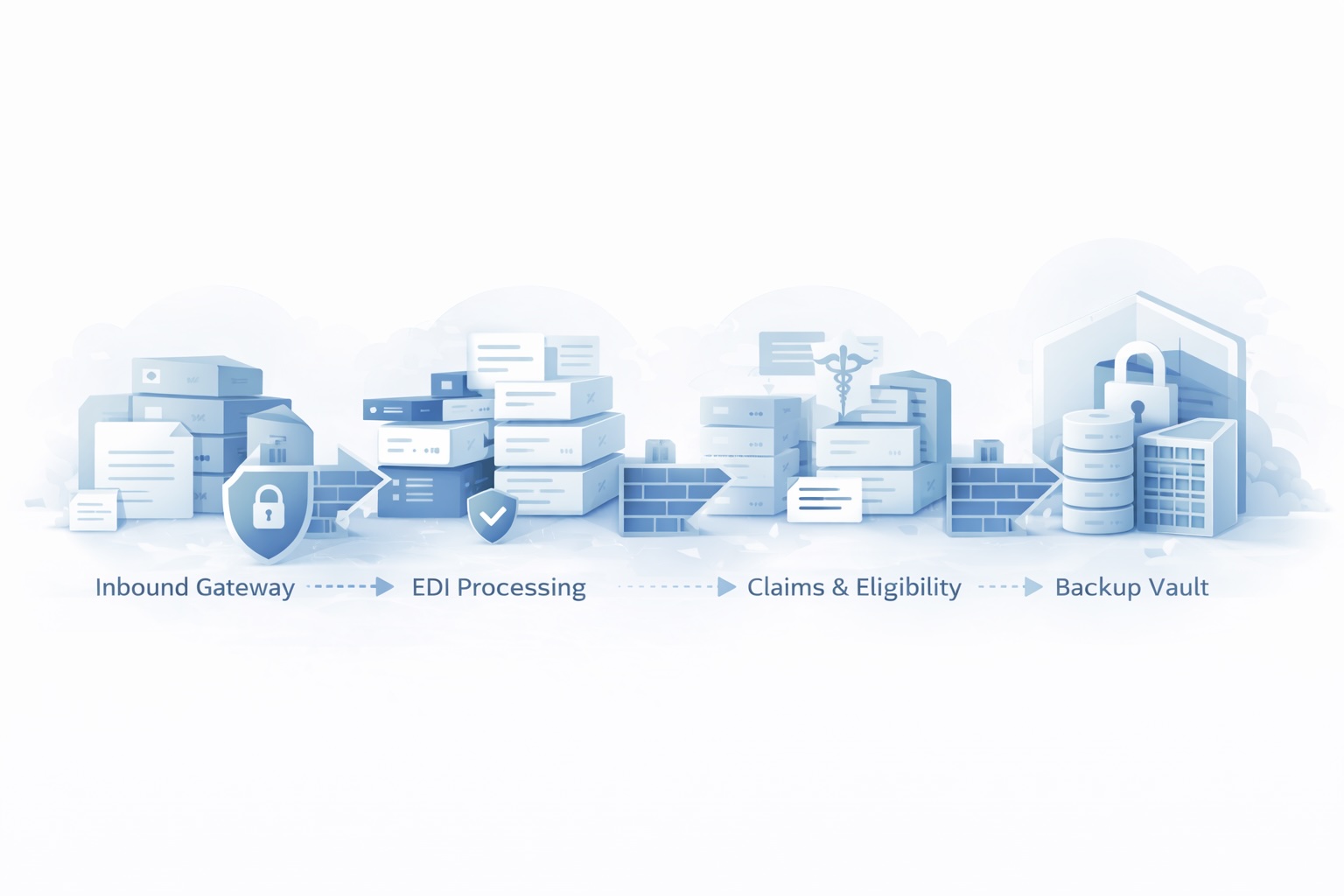
- Establish distinct, isolated zones for gateway entry, EDI processing, applications (claims and eligibility), and archives.
- Implement strict firewall rules and access controls between these zones to limit exposure and lateral movement.
- Restrict user and application access based on the principle of least privilege—no cross-zone shortcuts for convenience.
- Utilize VPNs and secure remote access (with robust authentication) for administrators managing EDI platforms or batch jobs off-site.
Segmentation ensures that a compromise to your inbound gateway does not mean claims systems or compliance records are at risk. It's a strategic buffer that buys your team precious response time.
Backups: Building the Insurance Policy You Can Count On
Reliable backups are the cornerstone of ransomware readiness, but here’s the catch—attackers know this. They actively seek out connected backup stores to encrypt or corrupt them alongside production data.

Our Recommended Backup Approach:
- Adopt the 3-2-1 backup rule: Maintain three copies of your EDI data (production plus two backups), using at least two different types of storage, and keeping one copy offsite and physically isolated (cloud is ideal, but make sure it’s segregated from your normal credentials).
- Deploy immutable backups: Use backup solutions that support immutable “snapshots”—write-once, read-many backups that ransomware cannot alter or delete until the retention period expires.
- Automate both daily incremental and regular full backups to ensure all claims, enrollments, and audit records are never older than your smallest recovery window.
- Limit backup access: Only key personnel should hold credentials, protected by multi-factor authentication with all access events fully audited.
Test and verify full recovery quarterly. It's not enough to have backups—they must actually restore your EDI environments, including all translation mappings, validation configurations, and historical logs.
Rapid Recovery: SLAs and Member Service Cannot Wait
Recovery is not just about getting the lights back on—it's about restoring claims and eligibility operations within the contracted timeframe. For many payers, this means resuming EDI 834 and 837 processing within hours, not days, to avoid SLA penalties and mounting compliance risks.
- Pre-stage recovery environments: Prepare clean, isolated EDI application environments—configured and ready to load backup data at a moment’s notice.
- Automate and orchestrate recovery steps: Automation ensures claims, eligibility, customer service, and audit logs come up in the right order, eliminating repeat errors and delays under pressure.
- Prioritize system-level RTOs (Recovery Time Objectives): For example, bring up eligibility processing before non-critical archives, so member verifications and claims continue seamlessly.
- Continuously test and monitor actual recovery times. Track your readiness, share metrics with stakeholders, and use them to justify investment in faster automation or improved isolation.
Hardened EDI Environments: Security Is the New Default
Technology alone cannot defend against ransomware—continuous vigilance and daily operational discipline are a must, especially when dealing with sensitive claims and enrollment data.
- Encrypt EDI data in transit and at rest: We recommend industry-standard encryption (such as AES-256), ensuring that even if attackers breach a segment, data remains unusable.
- Enforce least-privilege access and multi-factor authentication: Use RBAC to restrict system and data access only to those who truly need it, and require MFA across administrative and end-user access points.
- Keep software patched and regularly updated: This includes EDI translation tools, API endpoints, and all integration points. Automated patch management reduces window for attack.
- Continuous monitoring and logging: Persistent monitoring lets you spot anomalous activity or access attempts as they happen, not days later. Log all access and alert on unexpected actions within your EDI zones.
We believe in empowering business and functional teams to access the data they need safely, with IT providing guardrails through segmentation and audit trails instead of bottlenecks.
Incident Response: Planning for the Worst, Acting at Your Best
A detailed, practiced incident response plan is essential. Teams need clarity on exactly what happens in the first minutes after a ransomware alert, including who isolates systems, who leads the response team, and how to communicate (internally and externally) as recovery moves forward.
- Predefined triggers and runbooks: Recognize ransomware quickly—encrypted files, ransom notes, or sudden system failures need immediate escalation.
- Recovery from backups: Launch clean recovery from immutable, isolated backups to avoid paying a ransom and prevent reintroduction of threats.
- Transparent communication protocols: Define when you notify members, state agencies, and regulators based on regulatory requirements.
- Tabletop drills: Simulate incidents regularly to expose gaps and train the response team efficiently.
Key Takeaways for CIOs and EDI Directors
- Segment EDI workflows and restrict access to minimize damage if ransomware appears.
- Backup smarter—use immutable, offsite backups and verify recovery quarterly.
- Pre-stage and automate your recovery steps for EDI environments handling 834, 837, 999, and 277 transactions.
- Continuously monitor, update, and harden every endpoint the EDI ecosystem touches.
- Test your incident response plan quarterly and empower your team to move fast when every moment counts.
Making a Resilient EDI Ecosystem a Reality
Moving to a ransomware-ready EDI strategy isn’t just about IT—it’s about sustained claims and eligibility service for your members and trading partners, and about preserving trust and compliance.
- Perform a segmentation and access audit: Know exactly where your EDI systems connect and who can access each tier.
- Assess backup and recovery readiness: Simulate a full recovery and measure the outcome versus your required timeframes.
- Update operational playbooks and training to reflect current EDI risk realities—all staff should know how phishing and ransomware can target them.
For a broad review of EDI best practices in health insurance, you might find our resource EDI Health Insurance Basics: Understanding Transactions, Compliance, and Integration Challenges useful as well.
Ready for the Next Step?
If you’re looking to take your EDI ecosystem to a new level of security and resiliency, see how EDI Sumo can help—from fortified eligibility and claims environments to seamless, automated visibility for your full team.




.png)

.png)


.png)

