

Preparing for Volatile Enrollment: Data Controls That Handle Plan Churn Without Chaos

.png)

Volatile enrollment and plan churn are realities every healthcare payer faces, but chaos doesn't have to be the outcome. As rising member turnover pressures administrative teams, disrupts claims cycles, and risks compliance, our ability to implement robust, transparent data controls is what determines whether we merely react to churn or systematically conquer it. At EDI Sumo, we've worked side-by-side with payers who live this challenge every renewal season—Vision, Dental, and Health enrollment directors, IT stakeholders, and claims teams stretched to their limits. Our unique perspective is grounded in understanding that technology is only as good as the control, clarity, and real-time visibility it provides to those who need it most. Let’s dig into what it really takes to future-proof enrollment operations against volatility—with actionable, detailed practices you can put to work immediately.
Understanding Plan Churn and Its Hidden Costs
Plan churn isn’t just about members switching coverage. It’s about the ripple effects—rejected eligibility files, resubmitting claims, repeating member onboarding, reconciling mismatched data, and the sheer surge in administrative error risk. The pain is tangible for enrollment and claims management leaders: not only are costs increasing with every touchpoint, but the potential for regulatory missteps (especially around HIPAA) grows as volume overwhelms manual processes. This is compounded when enrollment data arrives in many formats—EDI 834, Excel, CSV, positional, or XML—none of which "talk" to each other without serious IT intervention.
The Real Impact on Payers
- Delayed Claims Cycles: Churn can trigger sudden influxes of EDI 834 transactions, all demanding rapid, correct processing. Gaps here delay downstream EDI 837 claims, impacting payments and provider satisfaction.
- Manual Data Wrangling: Busy IT teams become the de facto enrollment data translators, sacrificing strategic objectives to troubleshooting and reprocessing files.
- Compliance Risks: Every new upload, eligibility check, or claim split introduces possible gaps in your audit trail if not carefully tracked and standardized.
- Service Disruptions: Providers and members both feel the pain—missed treatment approvals, disrupted access, and unnecessary rework.
Why Data Controls Are Non-Negotiable During Volatility
Instead of firefighting with ad-hoc solutions, successful payers approach plan churn with clear, actionable data controls—building a unified, audit-ready enrollment and claims ecosystem.
The Foundation: EDI 834 Transactions
At the core of enrollment management is the EDI 834 transaction. This standard governs how payers and providers exchange subscriber and dependent changes. During high churn, the volume of 834 files can spike exponentially. If accepted without rigorous controls for validation, standardization, and visibility, every error amplifies downstream—in eligibility verification and ultimately in EDI 837 claims.
- Visibility: Enterprise dashboards reveal real-time status on all inbound 834 files, enabling us to spot duplicates, missing data, or mismatched records before they disrupt the revenue cycle.
- Flexibility: Modern enrollment operations must accept 834s alongside flat files, spreadsheets, and even XML or custom layouts. Still, every format needs to land in a single, normalized view, reducing the "translation tax" on IT.
To dive even deeper, explore our dedicated primer, EDI Health Insurance Basics, which unpacks the key transactions in our ecosystem.
Going Beyond the 834: Claims and Reporting Necessities
Once enrollments are accepted and validated, the accuracy and speed of claims operations are next. When EDI 837 claim files rely on outdated or incorrectly processed enrollments, rejections and rework soar. Equally, compliance reporting via EDI 277 (acknowledgment of claim status) and the 999 (acknowledgment of transaction receipt) hinge on having clean, synchronized enrollment and claims data at every touchpoint.
- Automated integrations with claims systems ensure timely delivery and instant error flags—with role-based user access so both IT and business teams collaborate effectively.
- Real-time audit trails extend to every EDI document (834, 837, 277, 999), so regulatory review and internal QA never depend on hunting through legacy logs or emails.
Building the Right Data Controls: Our Framework
We believe controlling churn begins with a systematic approach to data input, transformation, and monitoring. Here’s the practical framework we use with our clients at EDI Sumo:
- Define Clear Churn Metrics: Establish what constitutes churn for your organization—whether it’s failing to renew, lapsing eligibility, or partial disenrollment. Tie these to concrete triggers such as eligibility check failures or member inactivity periods.
- Monitor Real-Time Metrics: Use unified dashboards to track daily and weekly intake of EDI 834 (and other formats), trend member movement, and detect red flags well before downstream systems are affected.
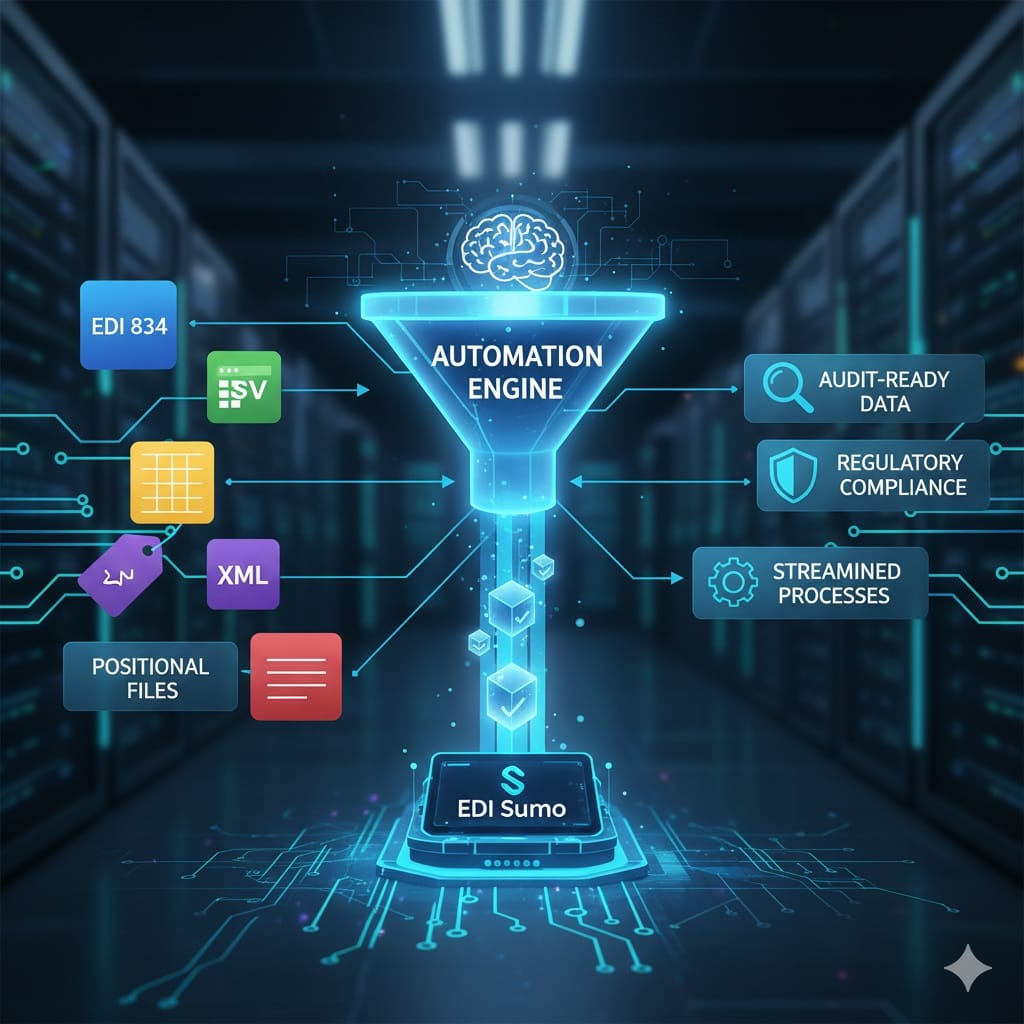
- Standardize Multi-Format Data: Streamline EDI, positional, XML, and CSV enrollments into a normalized dataset. Automate conversions so claims and member services always see the "truth" of record, regardless of source system.
- Automate Validations and Alerts: Build robust, custom rule sets for checking data quality. Automated alerts for SNIP Level validation help ensure industry and trading partner compliance before the file ever lands in production.
- Integrate with Claims and Ops Systems: Push only validated and standardized records into claims management and other core platforms, preventing downstream errors, rejections, or delays.
- Maintain Real-Time Audit Trails: Every file. Every decision. Every touchpoint gets a timestamp and user tracking—enabling rapid QA, compliance checks, and investigations when issues arise.
- Automate Regulatory Reporting: Allow for seamless generation and submission of 999 and 277 reports, supporting operational SLAs and empowering end-users to self-serve essential insights.
For a closer look at validation practices, check out our guide: How to Implement SNIP Level Validation.
EDI 834 Transactions Explained: The Foundation of Enrollment Data
The EDI 834 transaction is the industry gold standard for exchanging insurance enrollment and maintenance information. It supports additions, changes, and terminations—down to the subscriber and dependent level. Implementing strong 834 controls enables you to:
- Automate eligibility auditing, catching duplicate or conflicting enrollments.
- Feed real-time eligibility tracking (vital for member services and provider queries), ensuring current coverage is always reflected.
- Pull multi-format submissions into a unified audit view, reducing dispute resolution time and IT bottlenecks.
What Are SNIP Levels? A Practical Guide for Payers and Providers
WEDI/SNIP (Strategic National Implementation Process) Levels 1-7 are the essential test sets used to validate healthcare EDI transactions like the 834, 837, and others. Each level focuses on specific criteria—from basic file integrity all the way up to clinical validity and business rules. Automated, rules-based SNIP validation can:
- Reduce transaction rejections at trading partner interfaces.
- Improve first-pass yield on claims and enrollment updates.
- Ensure that custom payer-provider agreements (especially around age, eligibility, and coverage cycles) are enforced in real time, not after-the-fact discovery.
We've created a step-by-step breakdown of SNIP level validation for payers here.
EDI 999 vs. 277: What’s the Difference and Why It Matters for Payers?
Understanding the distinct roles of EDI 999 and EDI 277 is critical to timely revenue cycle management:
- EDI 999: Acknowledges receipt and syntactic correctness of your enrollment or claims file. It confirms the interchange was received and is structurally valid.
- EDI 277: Reports back on the claims status—including acceptance, denials, or pend status—providing real-time feedback to both payer operations and providers.
Automated production and tracking of these acknowledgments form the backbone of closed-loop processing, reducing rework and uncertainty for technical and business leads alike.
EDI 837 Claims Transactions: Accuracy and Speed for Payers
Every claim depends on having the most up-to-date and accurate enrollment data (via the 834). Delays in eligibility updates or errors in file formats ripple into claim denials, lost provider trust, and missed revenue. Controls that automatically match updated enrollment against incoming 837 files, validate member status, and escalate discrepancies keep claims moving and compliance risk low.
- Real-time monitoring flags issues—before a wrongly terminated member claim is denied and the provider calls your support center.
- Audit trails capture every event, ensuring both business and IT can see the full data "story" for any claim or transaction.
Putting It All Together: Turning Data Chaos Into Clarity
The reality is that plan churn will always be with us, but chaos isn’t inevitable. Organizations that treat data controls not as an afterthought, but as a core business discipline, see the benefits ripple across every department:
- IT is empowered to act as strategic partners, not just troubleshooters.
- Member and provider service teams resolve eligibility questions instantly, not after hours or days of digging.
- Compliance is baked-in, not bolted-on—enabling smooth, worry-free audits.
- Senior leaders have the analytics they need to spot churn risk early and take action.
Next Steps: Making Data Controls Your Competitive Advantage
As you evaluate your own enrollment and claims processes for readiness, ask:
- Can we see, in real time, the status of every enrollment and claims transaction regardless of original format?
- Are SNIP validation and regulatory reports automated, or do they depend on “tribal knowledge” within the IT or EDI team?
- Do our compliance audit trails capture every change, action, and user touch across the life of an enrollment?
Ready to make this your reality?
You can always reach out to us at EDI Sumo to talk strategy, see our approach, or schedule a tailored demo. Our mission is to help healthcare insurers achieve true data clarity and operational efficiency, regardless of how enrollment patterns shift. Let’s tackle churn, together.





.png)

.png)


.png)

