

Homomorphic Encryption and Healthcare EDI: What’s Real, What’s Hype for Claims Processing

.png)

Healthcare payers are under constant pressure to protect claims data while still moving it quickly through enrollment, validation, and adjudication workflows. Homomorphic encryption promises something powerful: the ability to analyze encrypted claims data without ever decrypting it. In theory, that could eliminate one of the most sensitive exposure points in healthcare EDI processing.
But for organizations handling tens or hundreds of thousands of 837 claims each day, the real question is practical: Is homomorphic encryption ready for payer-scale operations — or is it still largely experimental?
What Homomorphic Encryption Would Change
If you manage EDI 837 claims, you know how much protected health information (PHI) flows through your systems — diagnoses, CPT codes, provider NPIs, subscriber IDs, payment amounts. These files move across clearinghouses, trading partners, internal validation tools, and downstream systems.
Traditional encryption protects data:
- In transit
- At rest
But when you validate, aggregate, reconcile, or run analytics on claims data, you must decrypt it first. That decryption step creates a temporary exposure window — even in secure environments.
Fully homomorphic encryption (FHE) aims to eliminate that window by allowing computation on encrypted data. In theory, you could:
- Validate provider NPIs
- Check CPT code integrity
- Aggregate claim totals
- Run anomaly detection models
…all while the data remains encrypted.
For healthcare organizations concerned about breach risk and HIPAA scrutiny, that sounds compelling.
Where Homomorphic Encryption Could Make Sense
There are legitimate use cases where homomorphic encryption could eventually provide value.
Collaborative Research
Multiple payers could analyze trends across combined claims datasets without exposing individual claim details to one another.
Cross-organization Fraud Analysis
Encrypted datasets could be processed jointly without revealing raw PHI.
High-risk Aggregation Workflows
Large-scale cost averaging or statistical modeling could occur without exposing individual line items.
Most real-world implementations today rely on partially homomorphic techniques — meaning only specific operations (such as addition or multiplication) can be performed on encrypted data. Fully homomorphic models capable of broad computation remain technically possible but computationally intensive.
In research settings and small proofs of concept, encrypted aggregation has been demonstrated successfully.
But payer-scale operations are different.
The Performance Reality
The limitation is not security. It is performance.
Fully homomorphic encryption requires significant computational overhead. Operations that take seconds on decrypted claims data can take hours when processed in encrypted form. In testing environments, slowdowns of 100x to 1,000x are common.
For a payer processing 100,000 claims per day, that difference is not theoretical — it is operationally prohibitive.
A missed claims batch at 4:00 PM cannot wait six hours for encrypted computation. Retail adjudication timelines do not pause for cryptographic elegance.
Even routine validation checks — such as verifying segment structure, balancing claim totals, or confirming required fields — become dramatically slower under homomorphic processing models.
Integration presents another hurdle. Existing EDI ecosystems — whether tied to Guidewire, homegrown adjudication systems, or clearinghouse workflows — are not architected around encrypted computation frameworks. Retrofitting them introduces both complexity and cost.
What It Would Take to Experiment
If you are determined to explore this technology, start small.
A reasonable pilot approach would include:
- Selecting a limited dataset (for example, under 10,000 claims)
- Testing simple operations such as aggregation or total validation
- Running encrypted and non-encrypted versions side-by-side for comparison
- Measuring infrastructure cost and latency impact
- Reviewing audit and compliance implications
A focused proof of concept supported by external expertise can easily approach six figures in investment. For most payer environments, that level of experimentation only makes sense if there is a compelling research or multi-organization collaboration requirement.
For day-to-day claims operations, the cost-benefit equation does not yet justify full-scale deployment.
What Delivers Real Security Today
For most healthcare payers, the stronger return comes from tightening existing EDI controls rather than adopting emerging cryptographic models.
Practical, high-impact safeguards include:
- Encryption in transit and at rest
- SNIP-level validation across claim files
- Real-time monitoring and error detection
- Role-based access controls
- Centralized audit trails
- Automated alerting on anomalies
These measures dramatically reduce risk without sacrificing processing speed.
Real-time audit trails limit exposure windows while preserving the throughput required for claims adjudication cycles. Unified dashboards provide visibility across enrollment and claims workflows without introducing computational drag.
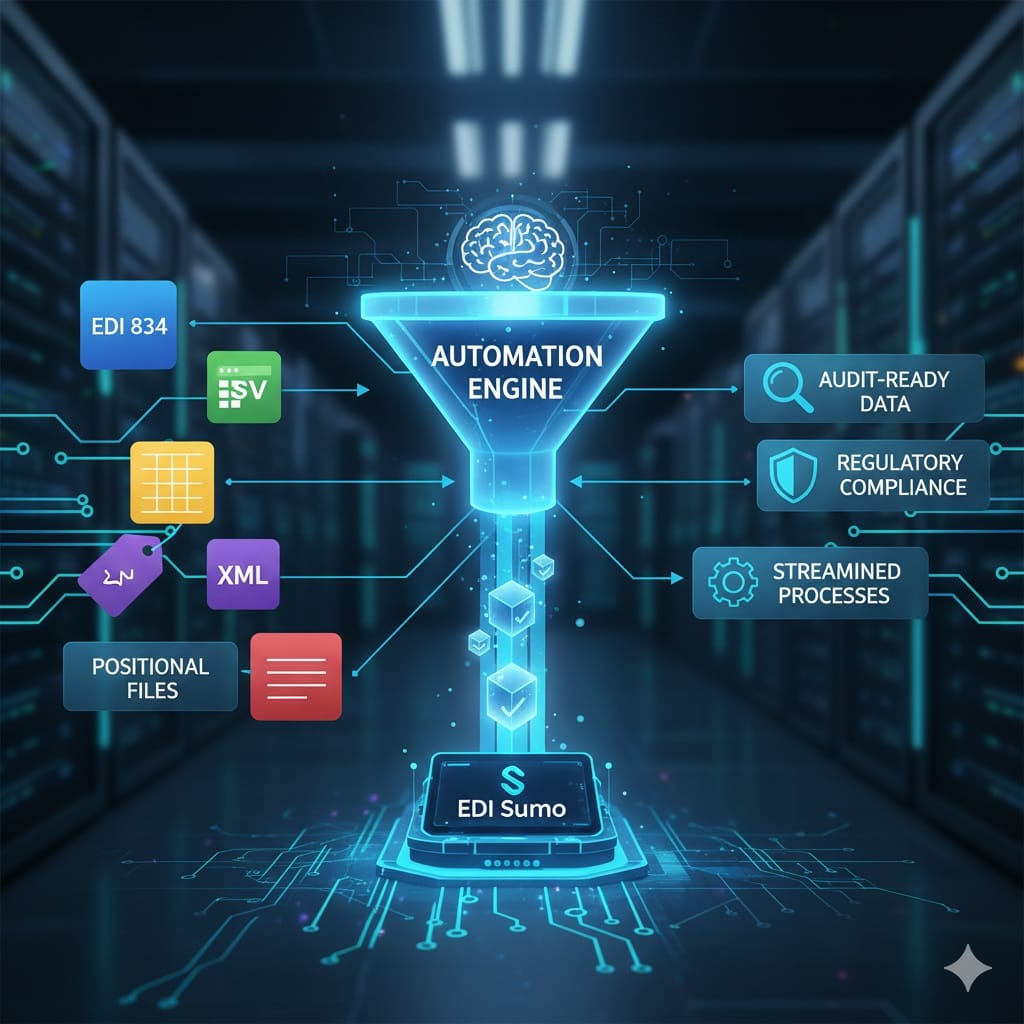
EDI Sumo is designed around that operational reality — improving visibility, validation, and compliance across complex enrollment and claims processes while maintaining the performance healthcare payers depend on.
The Bottom Line
Homomorphic encryption is an exciting development in privacy-preserving analytics. It may eventually play a meaningful role in cross-payer research, distributed analytics, or highly sensitive multi-organization data collaboration. But today, it is not ready for the scale, speed, and integration demands of typical healthcare claims operations.
If your priority is reducing breach exposure, improving compliance posture, and accelerating claims workflows, you will achieve more impact by strengthening monitoring, validation, and access governance than by experimenting with computationally intensive encryption frameworks.
Innovation matters. But so does practicality.
For healthcare payers managing high-volume 837 transactions, the smartest path forward is balancing security with operational performance — not sacrificing one for the promise of the other.
If you want to explore practical approaches to secure, compliant EDI handling and real-time claims visibility, you can learn more at edisumo.com or schedule a conversation to discuss your environment.





.png)

.png)


.png)

