

HL7 vs. X12: What Payers Actually Use for Enrollment, Eligibility, Claims, and Payments

.png)

When you work on the payer side of healthcare—handling vision, dental, or medical insurance—your business depends on standardized digital information for core processes like enrollment (834), eligibility (270/271), claims (837), and payments (835).
Among the most frequent questions we hear at EDI Sumo is: which data standard do payers rely on for these transactions, HL7 or X12? The answer is clear. U.S. payers overwhelmingly use the X12 standard for all administrative and financial healthcare transactions. HL7 plays an important role in clinical data exchange, but it is not the standard for enrollments, eligibility, claims, or payment operations processed by health plans and insurers.
You may interact with HL7 data if you also support provider systems like hospitals or clinics—typically for patient clinical messaging—but in your core payer operations, X12 governs every critical transaction. This distinction is important for making automation, integration, or compliance decisions that affect the efficiency and accuracy of your organization’s processes.
EDI Standards: X12 and HL7 Defined
If you are making decisions about how to handle payer data or vetting EDI software, you need crisp definitions:
- X12 (ASC X12N): A U.S. national standard required by HIPAA for the electronic exchange of healthcare administrative information. This includes eligibility (270/271), enrollments (834), claims (837), remittance advice (835), claim status (277), and others. X12 is the only format mandated for most payer transactions.
- HL7 (Health Level Seven): A standard aimed at clinical data exchange. HL7 is most common in electronic health records (EHR) and hospital information systems—handling messages about patient lab results, orders, and admissions. It is not required (nor typically used) for payer admin processes.
Main Use Cases for Payers: X12 Transactions You Work With Every Day
Your healthcare operation processes a steady flow of these EDI X12 transaction sets:
- 834: Enrollment and benefit maintenance (from employers, brokers, exchanges)
- 270/271: Eligibility requests and responses
- 837: Claims submissions (professional, institutional, or dental)
- 835: Electronic remittance advice and payment explanations
- 277: Claim status updates and feedback to providers
- 999 and 997: Functional and implementation acknowledgments for file acceptance
- 990s: Batch responses, typically in claim file workflows
Each of these transaction types moves critical data between payers, employers, providers, clearinghouses, and government exchanges. HIPAA regulation requires X12 for these file types, and all major payers (Aetna, Cigna, UnitedHealthcare, Elevance, Blue Cross Blue Shield, and others) rely on this framework. At EDI Sumo, we design around these workflows with multi-format support, so whether you receive pure EDI or a mix of Excel, CSV, or XML, you can normalize and process your files efficiently.
What About HL7? Why Payers Rarely Use It for These Processes
HL7 aims to facilitate the exchange of clinical (not administrative) data between providers—think messages about patient admissions (ADTs), observations, orders, and results. Versions like HL7 v2.x dominate in-hospital messaging, while the newer FHIR standard enables API-driven patient record access for apps and EHR integrations.
But here is the key for payers: HL7 is not used for enrollment, eligibility, claims submission, or payment data flows.These remain the territory of X12 due to regulatory mandates and the need for clear, structured data on insurance policies, procedures, and payments.
- Payer-facing files are not HL7, even if your provider clients or integration projects reference HL7 for clinical info.
- HL7’s primary adoption is in hospitals, labs, and provider-side software.
- While HL7-FHIR to X12 "crosswalks" exist in tech pilots, operational payer workflows are still powered by X12.
Step-by-Step: How Modern Payers Standardize Administrative Data
At EDI Sumo, we help payers tame the complexity of handling multiple file formats and compliance validation. Here’s a practical framework:
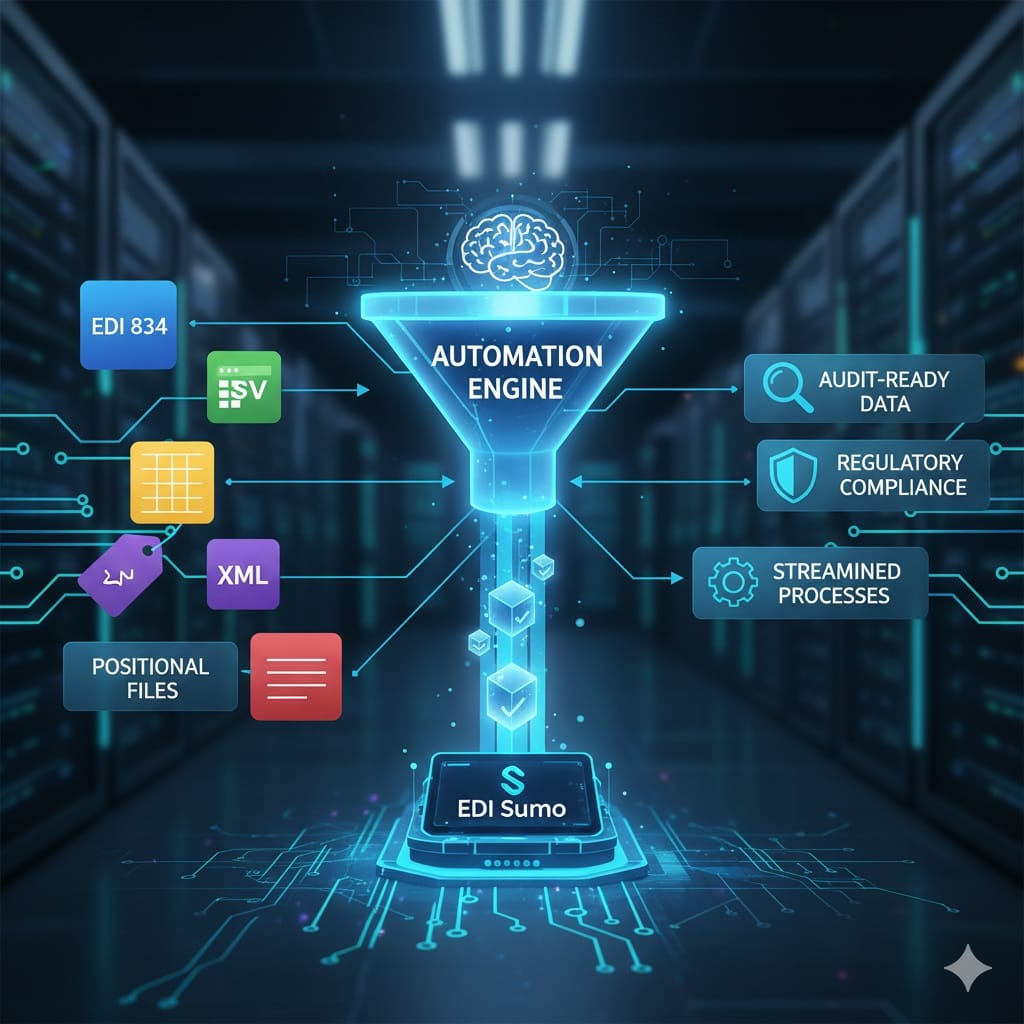
- Normalize Inputs: Use parsing tools to accept EDI 834, CSV, Excel, positional, and XML files. Convert every format to a unified internal view.
- Apply Real-Time Validation: Run compliance checks at the WEDI SNIP Levels 1-7 on incoming claim and eligibility files. Flag errors and discrepancies instantly instead of post-processing.
- Empower Stakeholders: With dashboards and real-time reporting, give enrollment and claims directors visibility and actionable insights, not static file logs.
- Integrate with Core Platforms: Seamlessly connect standardized data to Guidewire, IBM Sterling B2Bi, or your core admin system. Bridge legacy and modern solutions as you grow. For more on overcoming EDI integration challenges, see our post solving the next layer of healthcare integration.
- Enable Auditable Workflows: Maintain a real-time audit trail for every transaction type (including 277 claim status, 990s, and functional acks) to satisfy both compliance and business needs.
Comparing X12 and HL7: The Essentials for Healthcare Payers
- Purpose: X12 focuses on financial and insurance business logic, enforcing structured fields for policy, procedure, patient, and payment details. HL7 is built for exchanging clinical events, such as laboratory results and physician orders.
- Format: X12 uses specified flat files (often with segment delimiters). HL7 v2.x is pipe-delimited, used mostly in clinical messages, and FHIR leverages APIs and web data formats.
- Mandates: HIPAA requires X12 for payers, so you will use it for claims, eligibility, enrollment, and payment. HL7 is optional and only relevant if you process or store direct clinical data.
- Industry Adoption: Every major payer, national and regional, uses X12. HL7 is the standard for clinical integration between EHRs, labs, and hospital systems.
To explore how these differences impact your EDI strategy, our blog on EDI health insurance basics provides more background on these transaction sets and their role in payer systems.
Expert Guidance: What EDI Sumo Recommends for Payers
At EDI Sumo, we recommend starting with a strategic review of how you receive and process administrative data:
- Confirm every system that sends or receives EDI files supports X12 standards for the core transactions (834, 837, 835, 270/271, 277, 990/999). If you encounter HL7, it’s probably in provider messaging, not in payer operations.
- Automate multi-format intake, so your teams can accept files in CSV, XML, positional, or traditional EDI, then rapidly convert and validate. This is essential for reducing help desk tickets and IT bottlenecks. EDI Sumo's solutions are built for this hybrid world.
- Leverage audit trails and customizable dashboards that make all enrollment, claims, and eligibility data transparent for business and compliance stakeholders. For customer service improvements and efficiency, see our guide to upgrading healthcare EDI monitoring.
- Choose integration partners and tools that respect both historical and emerging standards. While some hybrid projects now map FHIR/HL7 to X12 for data synchronization, true payer transactions remain in X12 for the foreseeable future.
- Work with partners who prioritize HIPAA, security, and real-time validation. At EDI Sumo, we provide real-time error alerts, audit tracking, SFTP and API options, and seamless integration to leading claims and enrollment systems.
Real-World Example: How Standardizing X12 Drives Efficiency
We see the greatest gains when payers consolidate their varied data sources into a unified process. For example, EDI Sumo worked with a payer who handled 834 enrollments from brokers, large employers, and public exchanges in a mix of EDI, CSV, and XML. Before automation, each format meant manual uploads and frequent errors. Using EDI Sumo’s multi-format normalization, they reduced manual review times and improved eligibility lookup speed for their customer support. This cut operational delays and improved compliance metrics across the organization.
Best Practices for Enrollment, Eligibility, Claims, and Payment EDI
- Always validate incoming and outgoing files using the latest SNIP compliance checks. Even a minor error in an 834 or 837 can lead to large downstream issues.
- Empower business users with access to non-technical dashboards. Relying only on IT for every enrollment or payment inquiry adds unnecessary delays. EDI Sumo supports role-based access to data across the business.
- Automate discrepancy notifications and error handling wherever possible. Our platform can alert teams to missing dependents, mismatched data, or eligibility gaps as soon as files are received.
- Integrate EDI tools and systems directly—avoid too many file handoffs between systems to reduce data loss or corruption.
- Regularly audit all transactions types and maintain detailed histories for compliance, business analysis, and rapid response in case of inquiries.
FAQ: HL7 vs X12 for Healthcare Payers
Which transactions require X12 for payers?
For United States payers, all enrollment (834), eligibility (270/271), claims (837), payments (835), claim status (277), and related acknowledgment transactions (999/997, 990) must use X12 formats to comply with HIPAA. These transactions form the backbone of payer administrative work.
Can HL7 be used for claims, enrollment, or eligibility in insurance?
No. While HL7 is prevalent in clinical messaging, it is not used in payer workflows for claims, eligibility checks, enrollment, or payment. X12 is the required and widely adopted standard for these operational needs.
Is it possible to directly connect HL7 clinical systems to payer EDI platforms?
Some modern integration engines and pilot projects map HL7 FHIR resources into X12 fields for hybrid solutions. But if you are a health plan, the operational side remains X12-driven, and any HL7 conversion happens via middleware.
How does EDI Sumo help payers with X12 processing?
EDI Sumo automates intake and validation of X12 files (and non-EDI files), delivers real-time monitoring, alerts, and dashboards, and unifies the data for easier integration with internal platforms. Our solution reduces IT workload and provides transparency for all business users.
What’s the main risk if you don’t standardize and automate your X12 process?
Risks include increased manual error, compliance failures, SLA delays, higher support ticket volumes, and greater cost. Automating with a solution like EDI Sumo’s drastically cuts these risks by introducing workflow transparency and automated validation.
What if your organization receives files in non-X12 formats like CSV, Excel, or XML?
With the right tools, such as those offered by EDI Sumo, you can standardize and process any format, not just EDI, ensuring all enrollment and claims data are clean, uniform, and easily auditable.





.png)

.png)


.png)

