

Guidewire, IBM Sterling, and Your Data Lake: Making Them Play Nice in Real Time

.png)
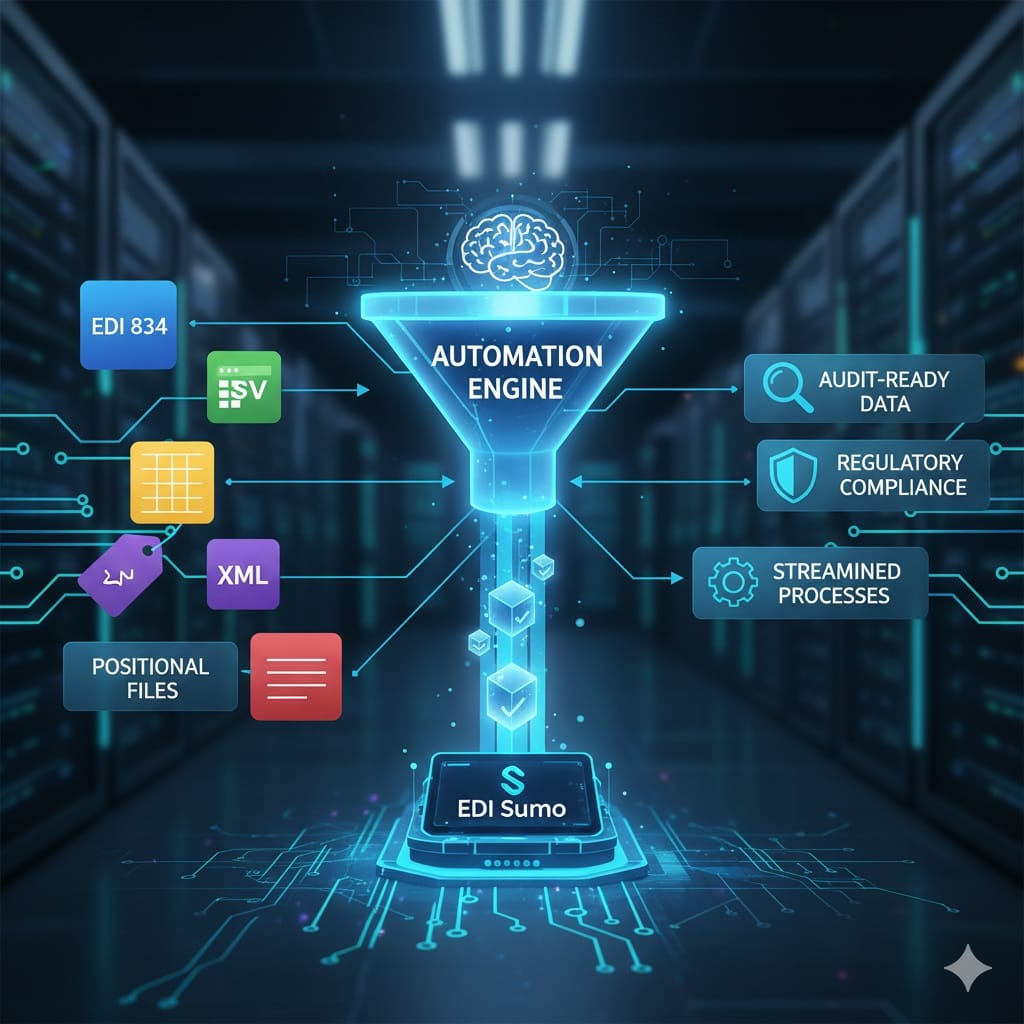
When Guidewire, IBM Sterling, and a cloud-based data lake operate in silos, healthcare payers face delays, downstream data errors, and compliance exposure that compound with every transaction. Real-time integration — with validation at the edge, transformation in Sterling, clean loading into Guidewire, and continuous streaming to the data lake — eliminates that lag. EDI Sumo provides the monitoring layer that keeps the entire flow visible, auditable, and resilient.
- Batch-based data movement causes claims processing delays, outdated customer service records, lagging compliance reporting, and errors that surface too late to prevent rework.
- Guidewire should be your system of record — not your transformation engine. Validation and staging must happen upstream before data reaches ClaimsCenter, PolicyCenter, or BillingCenter.
- IBM Sterling functions as the B2B translation and control layer — normalizing EDI, XML, CSV, and other formats before they touch Guidewire.
- Your data lake should receive continuous streaming updates, not nightly dumps, to support live compliance reporting, analytics, and audit trails.
- Schema drift, poor environment isolation, and missing real-time monitoring are the three most common failure points in payer integration stacks.
Healthcare payers rely on clean, accurate data flowing from enrollment through claims and into customer service. When Guidewire, IBM Sterling, and your data lake operate in silos, friction builds quickly. Delays, downstream data issues, and compliance risks are not technical inconveniences — they are operational liabilities that affect claims speed, provider relationships, and regulatory standing.
Why Is Real-Time Integration Non-Negotiable for Health Insurance Payers?
Health insurance operations generate enormous transaction volume every day — claims submissions, eligibility updates, policy changes, provider files. Each event impacts multiple downstream systems. When data moves in overnight batches, the consequences compound.
| Area | Batch Data Movement | Real-Time Integration |
|---|---|---|
| Claims processing | Delayed — waiting for next batch cycle | Immediate — errors caught at intake |
| Customer service records | Outdated — yesterday's snapshot | Current — live eligibility and claim status |
| Compliance reporting | Lags — reflects prior batch state | Live — reflects current transactions |
| Error detection | Discovered during adjudication | Caught at validation gateway |
| Audit traceability | Reconstructed from logs | Continuous — every event recorded |
Real-time data exchange eliminates that lag. Teams see the current state of eligibility and claim status instantly. Errors are caught at intake, not during adjudication. Reporting reflects reality — not yesterday's snapshot.
What Role Should Each Platform Play in a Payer Integration Stack?
A clean integration model assigns each platform a distinct responsibility. Mixing these responsibilities is where most payer environments introduce unnecessary complexity and fragility.
ClaimsCenter, PolicyCenter, and BillingCenter manage payer operations. Guidewire should remain your system of record — not your transformation engine. Data must arrive clean and pre-validated.
The intake and translation engine between external partners and internal systems. Translates EDI, XML, CSV, and other formats. Applies validation and business rules. Flags errors before they reach downstream systems.
Stores historical and streaming data for analytics, reporting, and compliance. Should receive continuous updates — not nightly dumps — so compliance teams, analysts, and executives work from live information.
What Does a Clean Real-Time Data Flow Look Like in Practice?
-
1Validate at the edge.
When data arrives — EDI 834 enrollments, eligibility files, claims transactions — it hits a validation gateway first. File structure is checked against schema, required fields are validated, and formatting errors are flagged immediately. Invalid data never reaches core systems.
-
2Translate and enrich in Sterling.
If partner formats differ from your internal structure, IBM Sterling handles transformation — converting file types, applying business logic, standardizing layouts, and enriching missing data where appropriate. This eliminates manual correction and ensures consistency before ingestion.
-
3Load clean data into Guidewire.
Once validated and translated, data flows into Guidewire with proper mapping to ClaimsCenter, PolicyCenter, or BillingCenter. The result: reduced manual entry, fewer reconciliation issues, lower support burden, and improved data confidence across the operation.
-
4Stream events to the data lake.
Every update — claims status changes, eligibility modifications, billing events — streams into your data lake in near real time. This enables up-to-date dashboards, instant compliance reporting, full audit traceability, and faster root-cause analysis. No waiting for batch jobs. No blind spots.
What Best Practices Prevent the Most Common Payer Integration Failures?
- Explicit schema management. Maintain clear documentation of partner schemas, internal data models, mapping logic, and version history. When schemas change, update Sterling transformations and data lake ingestion rules immediately. Schema drift is one of the most common silent failure points in payer integrations.
- Strict security and environment isolation. HIPAA compliance requires role-based permissions, attribute-level security, and segregated production and test data. No mixing of sensitive data across environments. Every integration flow must be auditable.
- Multi-format standardization. Partners send EDI, XML, flat files, spreadsheets, and APIs — that is the reality. Your transformation layer must normalize all formats into a single internal standard before passing data downstream. Testing new formats thoroughly before production prevents expensive remediation later.
- Real-time monitoring and alerting. Central dashboards and automated alerts reduce firefighting. Failed transactions surface immediately. Missing files trigger alerts. SLA breaches are visible in real time. With proper monitoring, teams respond proactively — not after customers escalate issues.
- Controlled rollout over sweeping transformation. Start with one high-volume or error-prone process — EDI 834 enrollments, claims intake, or eligibility transactions. Map the full lifecycle from intake to reporting. Test thoroughly in non-production environments. Then expand methodically. Confidence builds through controlled execution.
Frequently Asked Questions: Guidewire, IBM Sterling & Data Lake Integration
Why shouldn't Guidewire be used as a transformation engine?
What is schema drift and why is it dangerous in payer integrations?
What is the difference between streaming data to a data lake versus nightly batch loads?
How does EDI Sumo fit into a Guidewire and IBM Sterling environment?
How should payers approach HIPAA compliance in a multi-platform integration environment?
Related Resources & Hub Pages
- From Spreadsheets to Dashboards: Upgrading Healthcare EDI Monitoring for Real-Time Insights
- SNIP Edits and Custom Business Rules: How to Build a Clean-Claims Validation Strategy
- EDI 834 Multi-Format Enrollment Normalization: How Payers Handle CSV, XML, and Positional Files
- Simplifying Multi-Format Enrollment Data Integration for Health Insurance Payers
- Top Pain Points in Healthcare Data Integration and How to Solve Them
- EDI Sumo Integrations
- EDI Sumo Claims Management Solutions
Who Is Watching Your Entire EDI Flow in Real Time?
Guidewire processes. Sterling translates. Your data lake stores. EDI Sumo monitors the whole thing — providing proactive alerting, layered validation, and role-based dashboards so claims, enrollment, compliance, and IT teams all see the same clear picture of what is moving and what is not.
Request a DemoReach us at info@edisumo.com or call 877-551-9050





.png)

.png)


.png)

