

From 5010 to 008060: What Health Plans Should Check Across 834, 837, and 835 Files

.png)

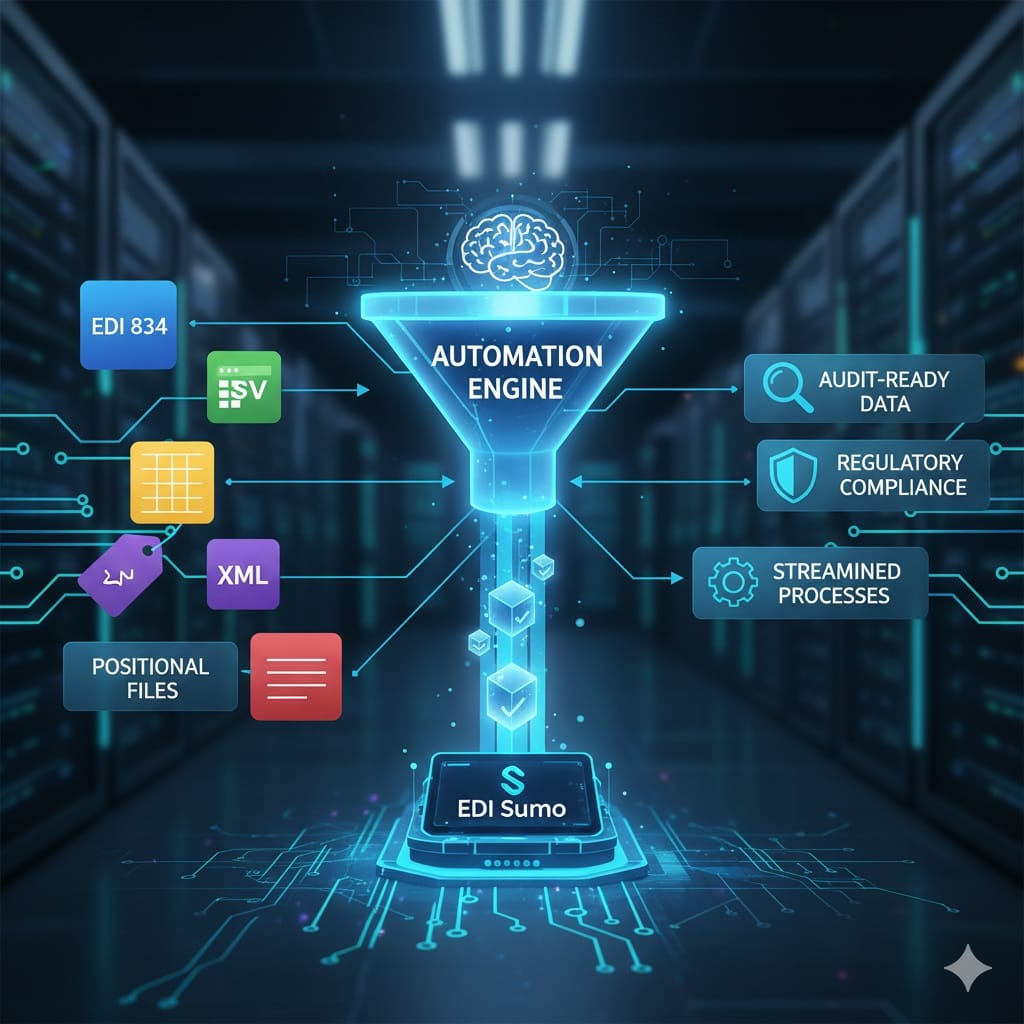
Health plans preparing for the transition from HIPAA 5010 to X12 008060 standards must go beyond basic file checks. To reduce denials, revenue leakage, and administrative burden, it is essential to implement detailed cross-file validation between 834 enrollment, 837 claim, and 835 payment transactions. Leading organizations apply rules that tie member eligibility, benefit structure, claims data, and payment outcomes into a unified process. Platforms like EDI Sumo make this possible, letting you automate reconciliation and normalization for any format—X12, CSV, XML, or positional files—and highlight gaps before they become operational or compliance risks.
Progressing beyond 5010 is about more than a version upgrade. The real opportunity is in aligning the 834, 837, and 835 as a data lifecycle—making sure enrollment, claims, and payment information is consistently accurate and visible across your health plan’s systems and teams.
- Map out your 834 enrollment, 837 claim, and 835 payment data as a single stream, not isolated transactions.
- Set up automated, cross-file checks (ID, coverage dates, product, COB alignment) to eliminate costly breaks, reduce denial rates, and improve provider relations.
- Leverage EDI platforms like EDI Sumo to standardize formats, surface reconciliation exceptions, and enable cross-team visibility without taxing IT.
- Validate file versions, guides, and internal business rules early to streamline the eventual 008060 transition.
As health plan data standards evolve—most recently from HIPAA 5010 to X12 008060—the operational success of payers will depend on their ability to see and manage the full lifecycle of member, claim, and payment data. This article covers the essential steps and best practices to check, automate, and connect 834, 837, and 835 EDI files for cleaner operations, lower error rates, and faster resolutions.
You will find specific, actionable advice from industry resources and practitioner experiences, along with a checklist you can apply immediately, and an explanation of how EDI Sumo helps health plans modernize data flow without the pain of total system overhauls.
Definitions: Understanding the EDI Transactions- 834 - Benefit Enrollment and Maintenance: The standard for transmitting member enrollment and eligibility details from groups, sponsors, or exchanges to health plans.
- 837 - Healthcare Claim: The file sent by providers to payers to request payment for services delivered, containing details about patient, date of service, procedures, and charges.
- 835 - Claim Payment/Advice (ERA): The remittance advice file that conveys adjudication, payment, adjustment, and denial details back to providers, mapped line-by-line against each claim.
Each of these files serves a specific role, but operational risks and opportunities arise where their data intersects.
Step-by-Step: Building Reliable Cross-File Checks 1. Clarify Your Version LandscapeDocument your current implementations: which X12 versions are in use for each major trading partner (for instance, 5010 for 834/837/835, soon 008060 for some partners), source file types (including CSV or XML), and related payer-specific guides. This inventory forms the foundation for all downstream validation. For guidance, read more about inventorying EDI maps before a major upgrade.
2. Cross-File Checks Starting with 834 EnrollmentEnrollment data sets the stage for every future touch. Health plans should:
- Synchronize member IDs across all three files, validating that every 837 and 835 entry matches a known, active 834 record for each date of service.
- Check effective dates and termination dates to reject, pend, or flag claims that fall outside allowed coverage windows.
- Ensure benefit or product in the 834 matches the procedure codes and claim details in the 837, using tables for code-to-product mapping.
- Validate dependent relationships so every patient in 837 can be matched to a subscriber and dependent on the 834 for the date of service.
- Automate eligibility checks, confirming the 837’s member, group, and coverage is active for all claim dates based on the latest 834 transaction.
- Cross-validate provider NPIs/taxonomy codes, ensuring they are current and contractually appropriate for each claim (with both the 837 and 835 referencing the same provider details).
- Check diagnosis and procedure codes for each claim, validating against the member’s actual product benefit configuration as well as latest code sets.
- Balance claimed charges and adjustments: every amount in the 837 must flow to an expected adjudication outcome in the 835, with reconciled totals and clearly linked member IDs.
- Ensure every payment, adjustment, and denial reported in the 835 can be reassociated to a specific 837 claim and the underlying 834 eligibility details using claim, control, and trace numbers.
- Analyze denial patterns in the 835 (using standard reason codes) and tie them back to upstream enrollment or claim issues, so systemic errors are addressed at the source.
- Cross-check allowed and paid amounts with provider contracts and member benefits as configured in the 834 to flag reimbursement exceptions and plan mismatches.
- Centralized monitoring with dashboards and real-time alerts means business teams always know when a file is missing, in error, or deviating from normal patterns—solutions like EDI Sumo provide this visibility as standard.
- Strong acknowledgment/error handling: Track all TA1/999 application acknowledgments and feed application errors (824, 277) into daily reconciliation routines.
- Data quality ownership outside IT: Give enrollment, claims, and finance teams readable, actionable cross-file views, freeing IT to focus on platform reliability and security. EDI Sumo’s customer service features put these views directly in end users’ hands.
- Automate recurring checks: Set up nightly or real-time jobs to reconcile newly arrived files, flag mismatches, and ensure teams resolve exceptions proactively.
- Continuous improvement: Regularly review exception reports and denial causes to tighten business rule definitions, improving future auto-adjudication and payment cycles.
EDI Sumo is designed specifically to help health plans standardize and automate the most challenging aspects of EDI management. Core capabilities include:
- Multi-format data ingestion (EDI, CSV, XML, positional, API)—no manual pre-processing needed
- Eligibility automation, real-time tracking, and custom validation on inbound 834 files with instant discrepancy alerts
- Claims management with real-time 837 file monitoring, WEDI/SNIP Level 1–7 support, error detection, and instant notifications
- Role-based access dashboards for claims, eligibility, and payments, exposing human-readable transaction details to business teams
- Direct integrations with major payer and clearinghouse platforms as well as on-premise install options for secure, compliant deployment
- Configurable audit trails and detailed reporting throughout the enrollment-claim-payment lifecycle
- Proven, HIPAA-compliant security with end-to-end encryption and strong authentication controls
This unified approach empowers payer IT, operations, and customer service teams with clearer, faster answers—reducing escalations and eliminating the bottleneck of raw file review or manual error checks. To learn more about how these capabilities work in real payer organizations, visit claims management with EDI Sumo or see how EDI Sumo’s eligibility processing capabilities keep data current and accurate across formats and partners.
Checklist: Steps for Immediate Improvement Within First 2 Weeks- Catalogue all inbound and outbound 834, 837, 835 feeds along with their current file formats and versions
- Document payer and trading partner-specific companion guides and business rules for every major transaction path
- Identify steps in enrollment or claims manually handled by staff or prone to recurring errors
- Implement member ID and coverage date checks, gating 837 claim acceptance by 834 eligibility success
- Schedule nightly reconciliation that matches 835 payments to 837 claims and flags mismatches for manual review
- Start basic denial monitoring, alerting when CARC/RARC codes point back to likely 834 or 837 issues
- Roll out role-based dashboards that make 834, 837, and 835 activity visible outside IT
- Automate posting/secondary billing logic using live 835 data
- Introduce advanced validation—including product-specific code sets—to reduce unnecessary denials or pendings
How do 834, 837, and 835 files fit together in a health plan’s workflow?
The 834 establishes member eligibility for coverage. Providers bill claims via the 837 using those eligibility records. Once adjudicated, the 835 reports payment, adjustment, and reasons for any denials back to providers. Cross-file validation means each transaction is checked in context of the others—not as isolated events.
Do we need to overhaul everything to prepare for X12 008060?
No. Start by improving data quality and automation around current 5010 transactions. Most core business checks—ID alignment, date coverage, COB, and reconciliation—remain valid in newer standards. Tools like EDI Sumo shield you from upstream changes and let you abstract away format differences as standards evolve.
Should IT or business teams own exception management?
Many organizations get best results by having IT manage security and infrastructure, while business teams (enrollment, claims, finance, customer service) own the actual rule logic, dashboards, and exception queue. EDI Sumo’s platform is designed to enable this division of responsibility cleanly.
How can we make EDI files more accessible to non-technical teams?
Solutions like EDI Sumo include visual dashboards and human-readable summaries of raw EDI files so support teams can see the status, errors, and history of member, claim, and payment activity without decoding text segments. This makes training and daily operations easier across departments.
As 5010 is gradually replaced or supplemented by new versions like X12 008060, the best results for health plans come not just from compliance, but from operational excellence—making data accurate, accessible, and actionable for every team. That transformation is within reach.
To understand how your organization can build unified visibility and automate reconciliation across 834, 837, and 835 transactions, consider reaching out to EDI Sumo’s experts. Schedule a demo or contact us at 877-551-9050 or info@edisumo.com to see how your data can work harder for you.





.png)

.png)


.png)

